
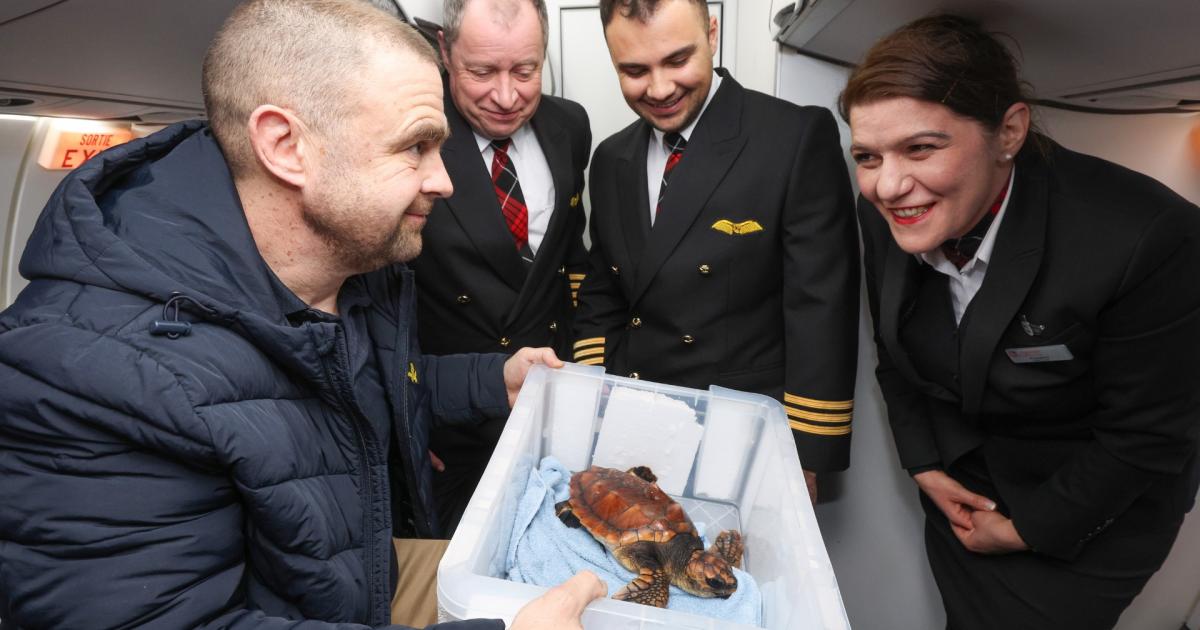
Crush, a young loggerhead sea turtle, was found stranded on a beach in Jersey after being swept through the Atlantic during the storm.
The young turtle was transported on a Loganair flight from Jersey to Southampton today, (Tuesday, February 10) so the animal could continue its treatment at Weymouth Sealife centre in Dorset.
Marine experts said the turtle had suffered from cold stunning, a condition caused by exposure to cold water, which left it barely able to move.
Kico Iraola, displays curator at the Dorset Sea Life Centre, said turtles that wash up in UK waters often arrive in a critical condition.
“When they arrive, they are very, very cold, like in a hibernation state,” he said.
“They’ve been drifting through the Atlantic Ocean for who knows how long, some weeks, maybe months.”
Crush was taken to New Era Veterinary Hospital in Jersey, where she spent around three weeks receiving life-saving treatment after being found dehydrated and weak.
Peter Hawroth, a vet at the practice, said the turtle was slowly stabilised before being cleared to travel.
Crush arriving in Southampton to be passed over to Kico Iraola at Weymouth Sealife (Image: Stuart Martin (Loganair))
Speaking to the Daily Echo about the flight, which left Jersey at 7.05am, Peter said: “We started very early at about 5.30am, and she’s been very good, active all the way.
“She didn’t seem to notice the plane and was just desperate to get out of the box and get to swimming.”
While at the small animal practice in Jersey, Crush was treated for cold stunning by being warmed up one degree at a time.
She also received a week’s course of antibiotics and eye treatments.
Peter said: “Our treatments have finished and she needs to get to a better place, which is the sea life centre.”
After landing in Southampton, Crush was transferred into the care of Kico, who said he would drive her to Weymouth Sea Life Centre.
The turtle was secured in a dry box fitted with a heat lamp to keep her temperature regulated during the journey.
Kico said although it is not possible to know for certain where Crush originated, DNA testing will be carried out to determine which population she is from.
He said they know she is not from the Mediterranean and believe she is likely from Florida.
Once at the centre, rehabilitation will continue, with Crush kept in shallow water while she is fed and rehydrated until she becomes strong enough to be released.
Kico added: “We want to make sure she is big and strong and wait till the warmer months – probably June and release her back into the ocean.”
Once she reaches full strength, Crush will be taken to a centre in Gran Canaria and released onto a beach.
“Turtles will use their instincts to go into the water and go back to the beach where they were born to lay eggs,” Kico added.