
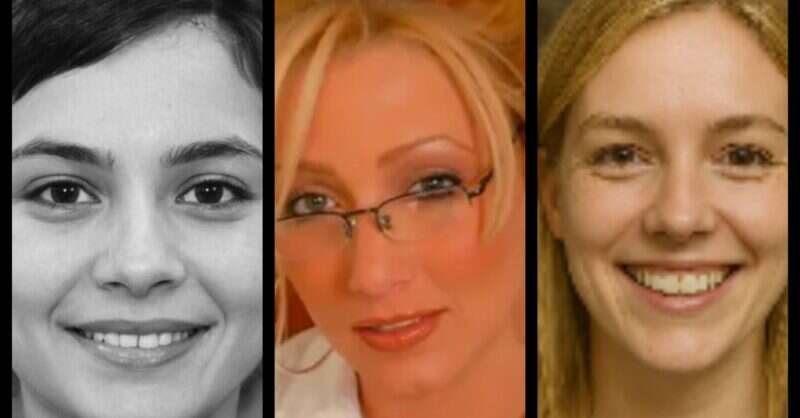

Faces of fakery (left to right): perfume writer Esme Gelder (AI generated byline pic and written work), sex expert (uses photo of porn actress with another name), travel expert Jessie Chambers (AI generated pic and articles).
New research from Press Gazette has uncovered a fresh tranche of likely fake and AI-generated experts making their way into UK publications.
Press Gazette looked at 50 pieces each from five UK newsbrands which quoted “experts”. The titles were selected because they have all come up in previous Press Gazette research as having published fake and likely AI-generated content shared by PRs.
Out of a sample of 250 expert-quoting articles published in The Sun, Daily Express, Mirror, Daily Mail and Daily Star in 2025 and late 2024, 27 experts do not exist, are impossible to track down/verify online or were not named in the first place.
Many more stories (not included in the 27) quoted sources where the expertise was merely questionable, such as a widely-quoted gut health expert dispensing health advice with no apparent medical qualifications, quoted in press releases promoting an e-commerce website, an e-commerce expert from a carpet company offering pest control advice and personal finance advice dispensed by the CEO of a coupons hosting website.
The research exposed a prolific travel writer whose ‘employer’ has admitted she does not exist and makes use of AI, and a ‘sex expert’ who has taken the face of a porn star.
One Daily Mirror article quoting an unnamed “pilot” talking about the best time to book a flight came up as entirely AI-generated in a check using text-checking service Pangram. The article was sent to the Mirror by a PR company promoting the website Travel Bargains.
Nearly all the highlighted expert-based articles originated from PRs seeking brand mentions and valuable SEO links to commercial companies.
[See full spreadsheet detailing the 27 articles highlighted in Press Gazette research]
The Sun has deleted five articles flagged to it by Press Gazette in the latest research (out of eight questionable flagged articles).
The research also uncovered nine dubious expert articles published in the Mirror, seven published in the Daily Mail, one in the Daily Star and two in the Express.
Mirror, Express and Star publisher Reach has said it is proactively tackling the issue of fake experts, including creating a directory of trusted PR companies (full comment below).
The new research includes fake experts from popular UK construction work portals MyJobQuote and PriceYourJob, which have deluged British publications with fake AI-generated copy on topics such as home improvement and cleaning over the past four years and were previously exposed by Press Gazette.
The portrait of a prolific travel writer is AI-generated (according to image and video AI detection platform Identifai), and her blog posts on Global Work and Travel are also mainly AI-generated (according to Pangram).
Global Work and Travel admitted to Press Gazette that Chambers was not real.
A spokesperson said: “Jessie Chambers is an editorial byline and representative voice used across our owned content and media commentary. It reflects the collective expertise, operational insight, and real-world travel experience of our internal teams, rather than a single standalone contributor.
“Commentary attributed to Jessie Chambers is drawn from approved internal perspectives within our business and is used to provide a consistent, attributable point of reference for our travel insights and industry commentary.
“As a tech-forward organisation, we make use of modern content tools to support drafting and formatting. All quoted opinions, advice, and factual information are grounded in human experience and reviewed internally prior to publication or distribution.
“To avoid any potential confusion, we’ve also updated the author bio on our site to more clearly reflect the collaborative editorial nature of this content.”
Expert uses picture of adult film actress by another name
A sex and relationships expert for extra-marital dating website Ilicit Encounters has appeared in dozens of stories on Daily Mirror, New York Post, Vice, The Scottish Sun, Wales Online and the Daily Mail, among others.
A photo of her that appeared in The Scottish Sun is also used by porn actresses including Tiffany Leigh and Samantha Summers.
A call to Illicit Encounters revealed there is apparently a member of staff who works in PR behind the expert comment, but their credentials as a sex and relationships expert are unclear.
A widely quoted gut expert offers medical advice in publications such as the Daily Record, Wales Online and Daily Express.
Their gut health tips include such articles as: “Gut health expert says you should never drink a certain popular drink at breakfast” and “Gut health expert explains what your poo says about you and when to see GP”.
The expert appears to be a businessman, who owns an online shop, rather than a medical professional.
On Linkedin their expertise is listed as change management and healthcare management.
Press Gazette contacted them to ask for evidence of qualifications, but received no reply.
Author Esme Gelder has widely-published portfolio of AI-generated articles
The latest search also turned up Esme Gelder, a perfume expert quoted in a Sun story that was deleted by the publication after being flagged by Press Gazette.
Gelder’s own work appears on lifestyle websites such as The Tease, Starts at 60 and Girls Living Well. The sites are packed with advertising and affiliate links to products that give publishers a share of sales.
Using Pangram, Press Gazette tested Gelder-bylined articles on each of the sites and found them all to be fully AI-generated. According to Identifai, her byline image was also likely AI generated.
NeoMam Studios, which campaigns against deceptive practices in PR, assisted Press Gazette on this research using data tools to track down expert-led stories at British newspapers, looking for stories containing words such as “expert warns” and “expert recommends”. It focused on the 50 most recently published stories fitting this search criteria for each title and collated these with data from brand websites and Linkedin profiles.
NeoMam managing director Alex Cassidy said: “A large part of the recent discourse has rightly focused on how bad actors abusing new technology have become one of the biggest risks to journalism.
“But this study reveals something more uncomfortable: that an inherent failure of trust persists alongside the acceleration of artificial intelligence.
“Unfortunately, the UK press remains too easily exploitable. When journalists are forced to source comment under unrealistic deadlines, they are actively disincentivised from checking whether a quoted expert is real. And in that vacuum the fastest PR wins, not necessarily the most credible.
“This environment allows fake, embellished, or unverifiable experts to feature in national coverage without ever having to validate their identity. The fundamental processes on both the press and PR sides need to change, so that expertise is treated as something to be proven not just stated.”
Reach has introduced stricter policies to counter fake experts
The Sun and Daily Mail declined to comment.
Reach chief content officer David Higgerson said: “We continue to proactively go through archive material looking for instances of where fake experts may have been used. We’re encouraged to see that the stricter policies we’ve introduced have made a positive impact and therefore many of the examples we’re seeing now pre-date those being brought in.
“As the industry is seeing, this is becoming an increasingly complex issue. For example, we have recently seen previously trusted and well-established PR agencies sharing fake quotes. To help tackle this we have created our own directory of trusted PR agencies and won’t hesitate to remove agencies and PRs as well as add them. We are also considering more severe steps for agencies who haven’t shown us they are taking enough steps on their side – including wholesale blocking of emails from those domains.
“Of course, all of this is on top of supporting our journalists with more tools and guidance to catch out bad actors. We will keep adapting our approach as the situation evolves and appreciate that this is a cross-industry issue that we can all support each other on.”
Email pged@pressgazette.co.uk to point out mistakes, provide story tips or send in a letter for publication on our “Letters Page” blog