
The TWZ Newsletter
Weekly insights and analysis on the latest developments in military technology, strategy, and foreign policy.
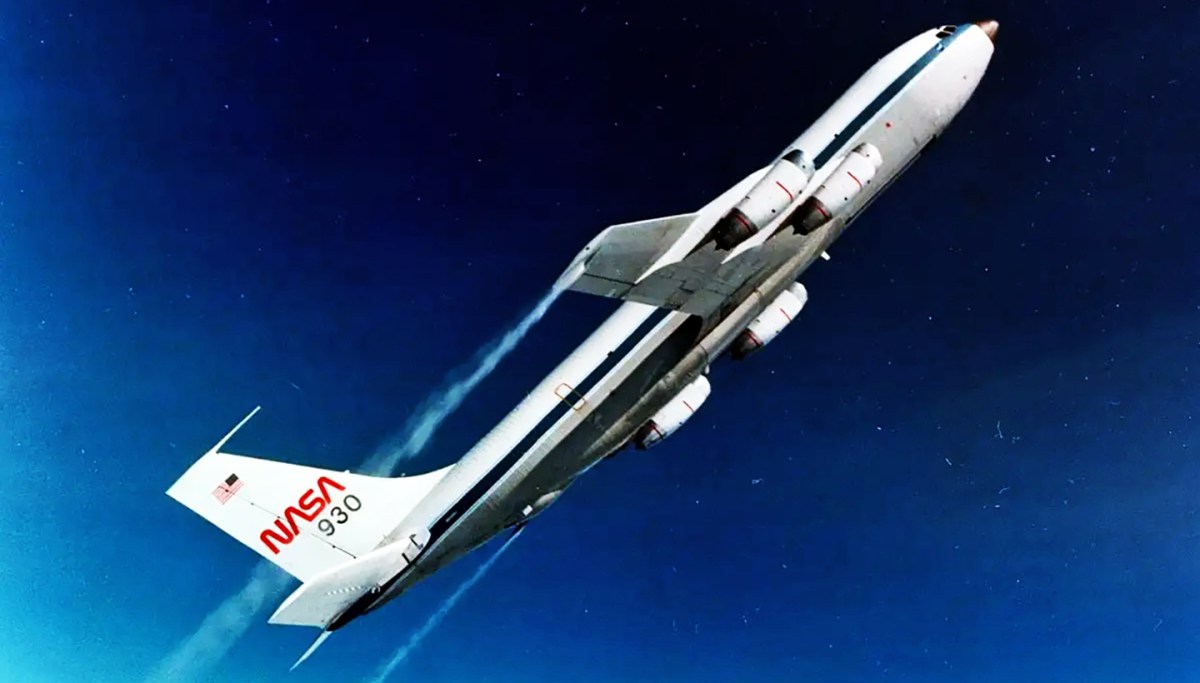
For NASA astronauts, experiencing zero-gravity conditions prior to mission launch is a necessary, if absurdly fun and enviable, part of training and familiarization. The ability to provide a microgravity environment here on Earth is also important for a number of scientific research reasons, and especially for spaceflight applications. For the better part of a century, access into this environment has been provided by specialized fixed-wing aircraft that fly parabolic arcs – collectively, and evocatively, dubbed “The Vomit Comet” for the physical side effect of weightlessness they tend to induce. While a single private company has handled these zero-G flights for NASA for years, a new contract solicitation shows the agency is once again inviting competitors to bid for the work, with the possibility of providing new solutions for a decades-old requirement.
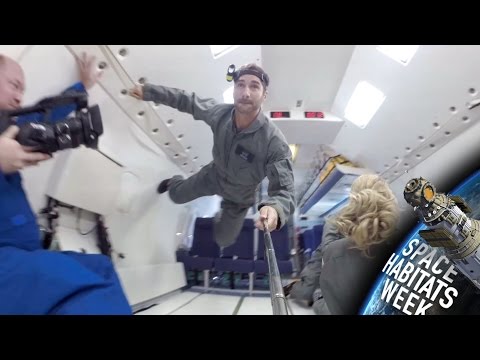
What It Feels Like to Fly in NASA’s Crazy Zero-Gravity Plane
The solicitation, posted by NASA’s Armstrong Flight Research Center in support of the Flight Opportunities Program, seeks information from industry on a variety of capabilities to deliver reduced-gravity and microgravity environments, specifically for testing new technologies and conducting research. The document emphasizes that the method of achieving the effect of weightlessness can look different than it has in the past.
“Respondents are encouraged to submit capabilities statements with innovative approaches to delivering Parabolic Flight Services,” the solicitation states. “This may include the use of aircraft platforms not traditionally used for parabolic flight services (e.g., business jets, experimental aircraft, supersonics, autonomous systems). NASA is interested in flexible, scalable, and novel operational concepts with the potential to help NASA expand access to reduced-gravity environments and accelerate space technology readiness.”
Starting in the late 2000s, NASA has used the same commercial provider for both human zero-gravity familiarization training and technological experiments. That’s the Florida-based Zero-G corporation, which offers parabolic flights on a retrofitted Boeing 727-200 dubbed ‘G-Force One.’ On the standard 90-minute flight the company offers, the aircraft will hit an altitude of 24,000 feet before beginning a steep climb at a 45-degree angle into a parabola that peaks around 32,000 feet. During the maneuver, passengers pull 1.8 Gs, according to the company; near the crest of the arc, the low-gravity phase begins, creating roughly half a minute of weightlessness.
G-Force One completes 15 parabola maneuvers in a single flight.
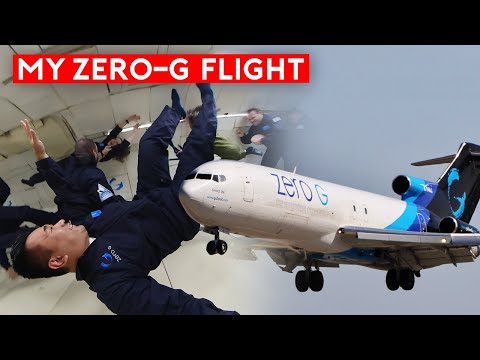
Total Weightless! What Happened on my Zero Gravity Flight?
While Zero-G offers separate rates for research flights, individuals ages eight and up can have the full experience for $8,900 per person, or $295,000 for the full 28-seat plane, plus a dedicated photographer. This option also allows for television and movie filming opportunities; Zero-G has a staff production director to support film production.
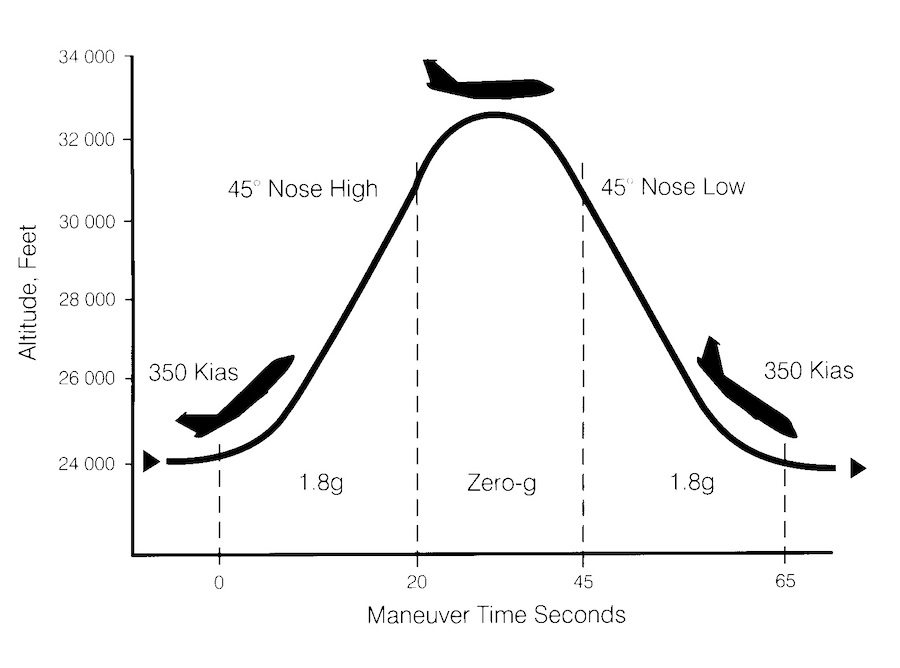 A general graphic showing the parabolic profile flown for zero-G. (UCSD.edu)
NASA granted Zero-G a five-year Indefinite Delivery, Indefinite-Quantity contract worth $7.5 million in 2021, marking a continuing partnership between the two entities.
“From 2008 to 2015, NASA and Zero-G had a previous contract under which the company flew microgravity missions in Texas,” Space.com noted at the time. “Though, unlike this new contract, those flights were conducted under ‘public use’ government regulations rather than under FAA regulations.”
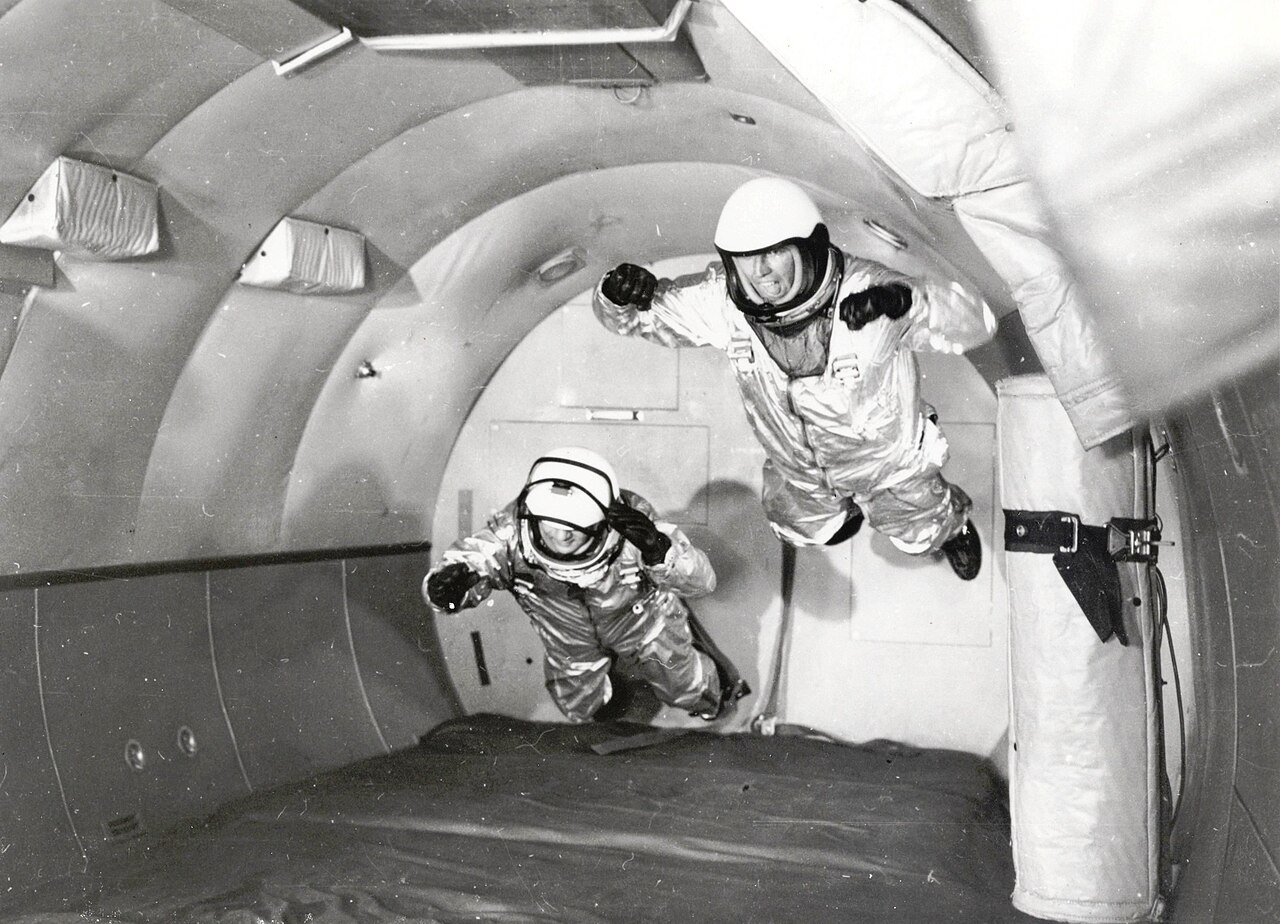 Astronauts in simulated weightless flight in C-131 aircraft flying “zero-g” trajectory at Wright Air Development Center. Weightless flights were a new form of training for the Mercury astronauts and parabolic flights that briefly go beyond the Earth’s tug of gravity continue to be used for spaceflight training purposes. These flights are nicknamed the “vomit comet” because of the nausea that is often induced. (NASA)
Zero-G says it remains the only FAA-approved provider of parabolic flights in the United States.
Vomit Comet history began with a Convair C-131 Samaritan, a militarized version of a twin-engine passenger aircraft originally used by the Air Force for VIP transport and medical evacuation (MEDEVAC) missions. The service began using the planes to simulate zero gravity in 1957, and NASA took over the work in 1973.
ZERO “G”
Eventually, a Boeing KC-135 Stratotanker, a type that first went into USAF service in 1957 and variants of which are still used for aerial refueling today, became the new Vomit Comet. One of the KC-135As that served in this role reportedly executed more than 58,000 parabolas and played a key role in filming for the blockbuster “Apollo 13.”
“Then-lead test director John Yaniec said KC-135A was still going strong when it was retired in 2004, but its unique role made it ‘increasingly difficult and expensive to maintain,’” Space.com reported in 2017.
Zero G in Airplane
A C-9B (DC-9) that NASA acquired subsequently took over the role for about a decade before it too was put out to pasture. Vomit Comet duties were then fully turned over to the private sector.
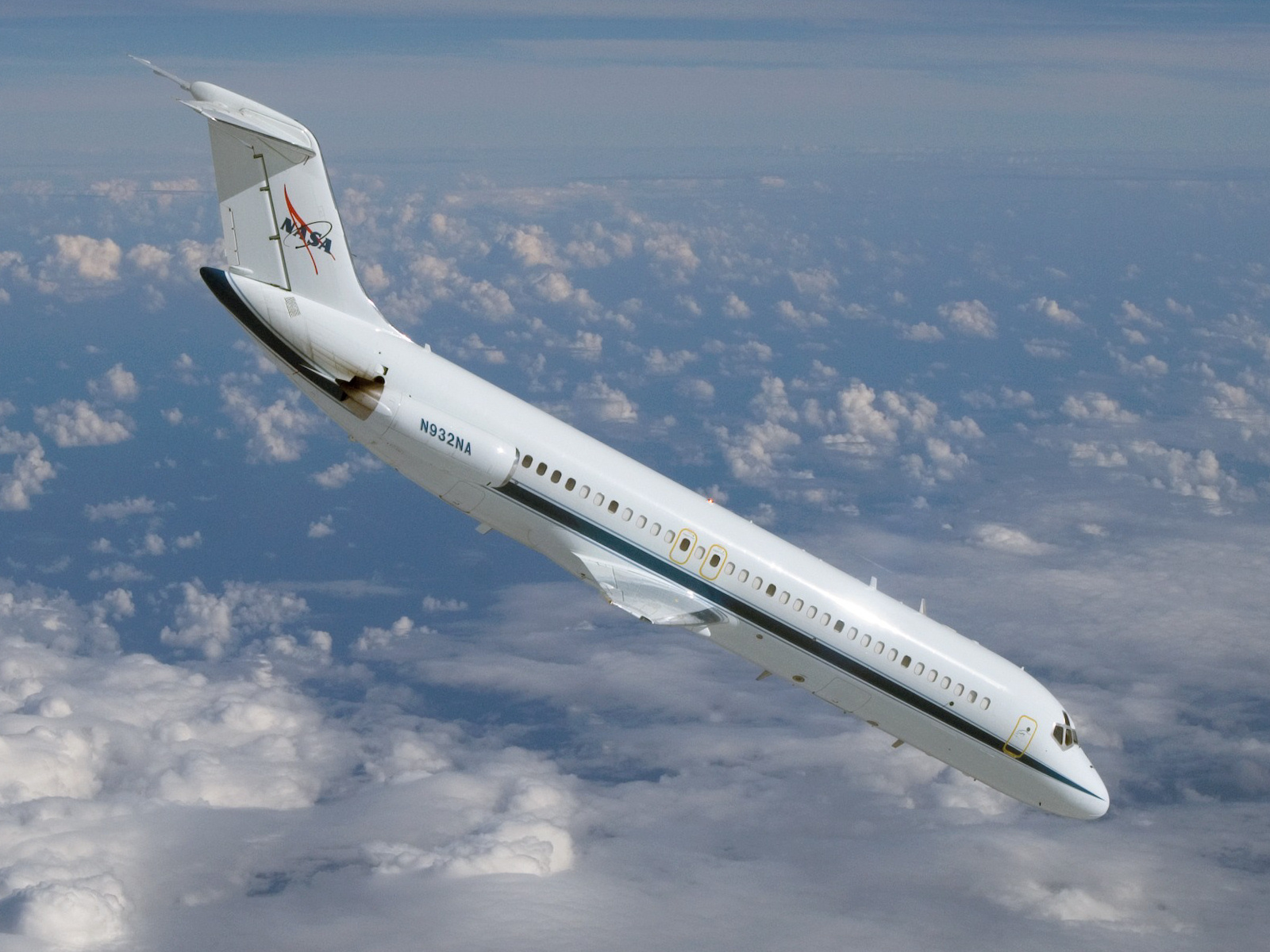 A NASA DC-9 reduced-gravity aircraft is featured in this image during a parabolic flight photographed from a T-38 aircraft. The aircraft, based at Ellington Field near Johnson Space Center, flies a series of parabola patterns over the Gulf of Mexico to afford opportunities for astronauts and investigators to experience brief periods of weightlessness. (NASA)
While Zero-G had flown more than 2,300 research parabola flights for NASA as of 2025 – and offered a taste of the final frontier to ground-based Space Force Guardians, among others – the benefits of expanding the pool of providers are self-evident. Zero-G temporarily shuttered operations in 2020 during the worst of the COVID-19 pandemic and, in 2022, had to take G-Force One out of service for a period due to unspecified equipment issues. (Air Force Academy cadets who were expecting to experience weightlessness at the conclusion of a summer program went SCUBA diving instead). With commercial 727s increasingly rare, it’s likely that maintaining G-Force One and sourcing replacement parts is becoming more costly and difficult.
It’s not certain, though, what competitors exist for Zero-G’s offering. While the solicitation mentions autonomous systems as one possibility for research flights, it also notes that “NASA expects some (if not most) payloads to have a human-tended requirement.”
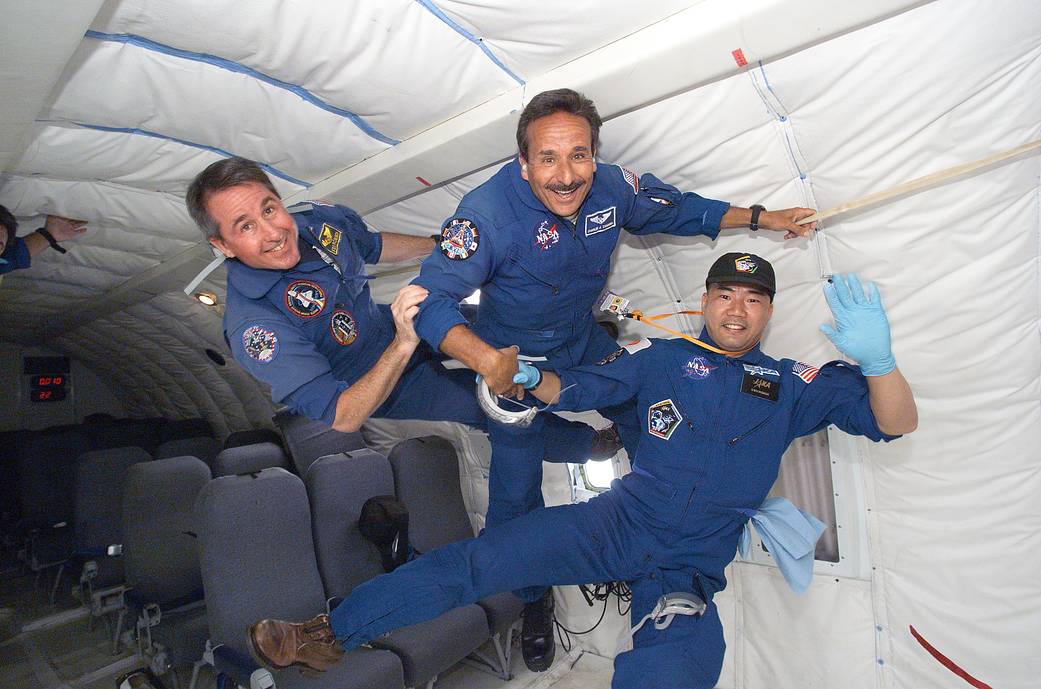 A trio of astronauts from the Return to Flight crew train for their flight by floating in NASA’s famed KC-135 aircraft. From left, mission specialists Stephen K. Robinson, Charles J. Camarda, and Soichi Noguchi of the Japan Aerospace Exploration Agency (JAXA), experience brief weightlessness. (NASA)
Eligible contractors must be capable of providing two or more parabolic maneuver types per flight to simulate a range of gravity conditions, including microgravity, and Lunar and Martian gravity, among others. Their platforms need to be capable of sustaining each gravity level for at least 10 seconds, though 30 seconds or better is preferred.
“In some cases, the objective may be to maximize the duration of low gravity exposure with less emphasis on accuracy and stability. This would be most likely with a non-critical payload where the objective is to give the flight participant a microgravity experience,” the solicitation notes. “In other cases, the accuracy and stability of the gravity level may be critical and duration less important.”
While Zero-G appears to have cornered the U.S. parabolic flight market for now, Europe has several different options. The French Space Agency’s Novespace research subsidiary operates parabolic flights using the Airbus A310 for researchers and private enthusiasts. In the United Kingdom, the startup Blue Abyss offers zero-G flights with a modified Boeing 757.
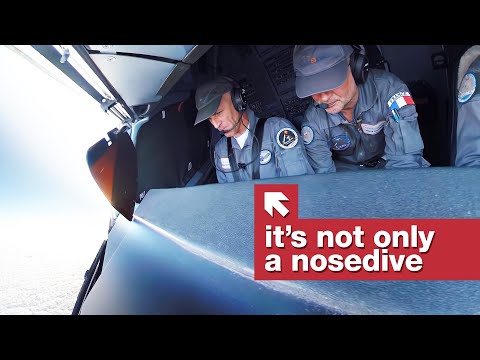
This is how zero-g flights actually work
Blue Abyss now appears to be positioning itself as a competitor in the space. Last year, it broke ground on an ambitious space training facility in Brook Park, Ohio, partnering with NASA on a project it says will ultimately offer parabolic flight capabilities.
Using disparate performing aircraft and even unmanned systems for tailored low-gravity missions could open new frontiers in providing these environments here on Earth. For instance, higher-performing aircraft could potentially offer longer sustained zero-G intervals, while unmanned systems could take this even further, especially for non-human payloads. Different platforms offering different services could also allow for cheaper and faster access to low-gravity within Earth’s atmosphere.
Case in point, drone-based microgravity experiments are also underway in Europe. In 2023, the British company Gravitilab used a specially adapted quadcopter to simulate weightlessness conditions for its payload in a 2,000-foot drop.
The achievement will “open the world of microgravity research to a new market,” the company announced at the time.
NASA’s market research solicitation will remain open until March 2.
Contact the editor: Tyler@twz.com