
 Getty Images/Ringer illustration
 By Brian PhillipsFeb. 11, 1:04 pm UTC • 10 min
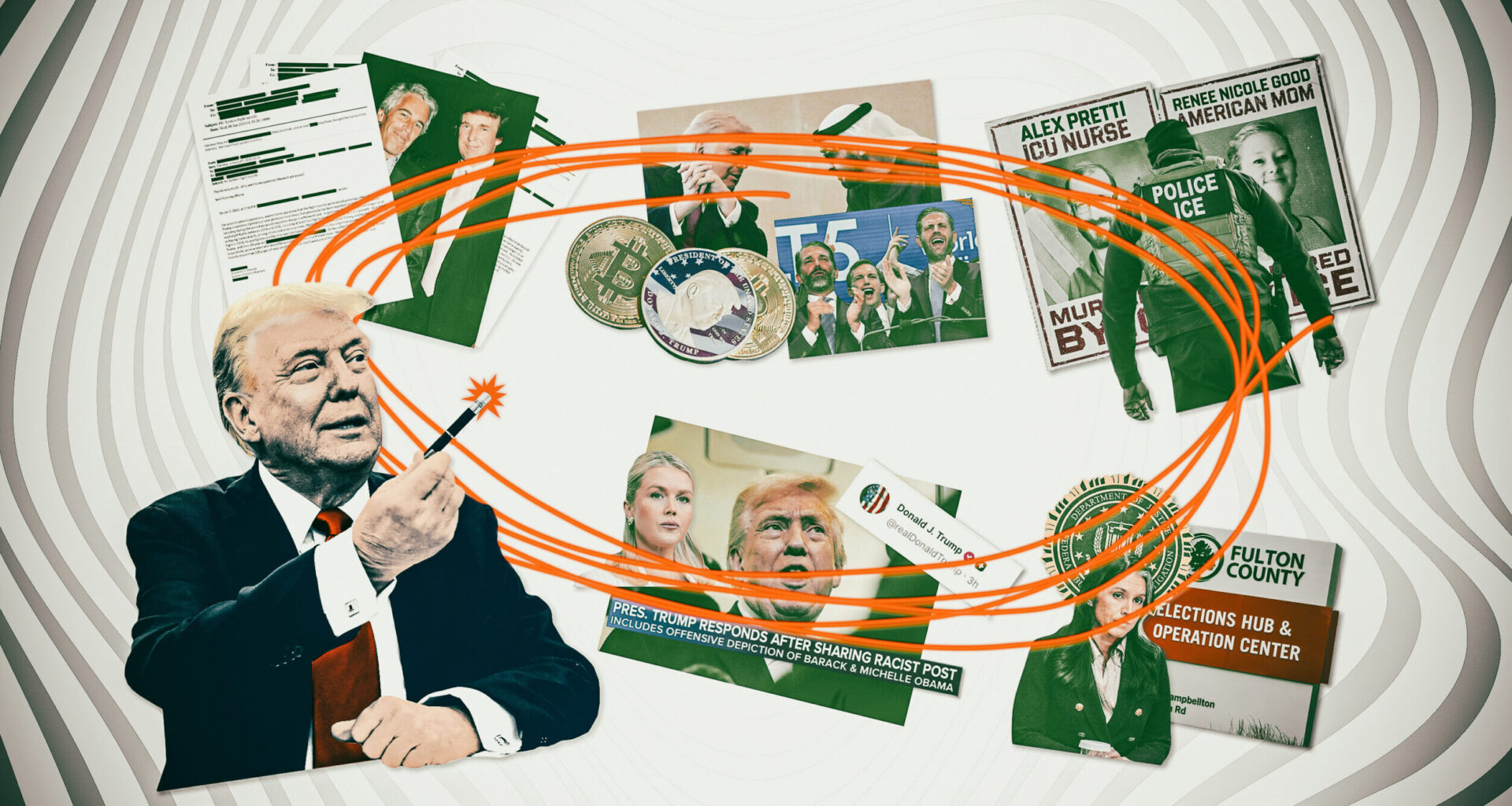
I have this idea that I’ve taken to calling Evil Laser Pointer Theory. It’s called Evil Laser Pointer Theory because it involves evil laser pointers. Mostly it’s a way to explain the Trump administration’s approach to scandal, or, if you want to be grandiose about it, to explain the flow of information in our current political reality. It’s not an original idea at all, but the events of the past couple of weeks have provided a near-perfect illustration of how it works in practice. I also think I’m the first person to translate it into laser pointer form, which—let’s be honest—is not nothing.
You’re familiar with laser pointers, right? The little handheld devices that zap a brightly colored dot onto whatever you aim—or, in laser pointer parlance, “point”—them at? Lecturers use them to direct attention to key points on a blackboard. They’re like lightsabers for TED Talks. Also—and this is relevant to Evil Laser Pointer Theory—they’re beloved by cats. Cats love to chase the little dots. They can never catch the dots, of course, but if you shine a laser pointer at a wall or make the dot go wriggling across the floor, a cat will be like, SKAAA FWPPP WHAT IS THAT BUG GOTTA GET IT, and they’ll drop whatever important cat business they were conducting and fling themselves after it.
I started thinking about this because I was wondering why scandals never seem to stick to the Trump administration. Even if you like the Trump administration—though fewer and fewer of you do—you have to admit the president has done a lot of stuff that would have ended the political career of anyone else who tried it. Actually, it’s not just that the scandals don’t stick; it’s that they have this weird way of sort of fizzling out of the discourse after initially drawing frenzied attention.
A vibe is a dangerous thing to build an argument around, but you’ve surely noticed this yourself. A furor will spin up around some particular aspect of Trump’s floridly corrupt existence—say, his long-running ties to Jeffrey Epstein. Then some seemingly major development will occur in the story: The Justice Department releases 3.5 million new pages from the Epstein files. And far from exonerating him, the new development makes him look terrible. The files are full of disturbing material, like photographs of a woman with quotes from Lolita written on her body; Trump’s name is all over the documents, appearing more than 4,000 times; Epstein survivors say the release is still incomplete, and meanwhile the convicted child sex trafficker and Epstein associate Ghislaine Maxwell is promising to clear Trump’s name in return for transparently unethical clemency. But rather than damaging the president, the story just kind of … floats there. People don’t exactly ignore it, but it doesn’t quite saturate the culture, either. Nor does it influence the machinery of government. It gets passively absorbed into the toxic atmosphere of the age, and nothing changes.
The laser pointer zaps another target: that racist Obama video, for instance. You probably heard about this, too. Just before midnight on Thursday, in the midst of one of the president’s regular late-night posting sprees, Trump’s Truth Social account shared a really ugly video portraying Barack and Michelle Obama as apes. This depiction, of course, belongs to an old and hate-drenched genre of racist imagery portraying Black people as subhuman primates. Trump has a long history of promoting white supremacist tropes but the clip, which superimposed the Obamas’ heads on gorilla-like bodies that danced along to “The Lion Sleeps Tonight,” was startling even by his standards.
Everyone in the country, as usual, was either angry about this (normal, correct) or lost in a performative nihilism so bottomless it makes me question the existence of the human soul (special shout-out to the crypto community; more on them in a second). The president of the NAACP called the video “utterly despicable.” South Carolina Senator Tim Scott, one of the most powerful Black Republicans in Washington, posted on X that the clip was “the most racist thing I’ve seen out of this White House.” The Trump-aligned Black Conservative Federation issued a statement condemning the depiction of the Obamas as “unacceptable, offensive, and indefensible.”
On the performative nihilism side, reactions to the clip, whose 62-second running time was mostly devoted to pushing the lie that Joe Biden’s victory in the 2020 presidential election stemmed from voter fraud, veered between pseudo-indignation and outright glee. Trump-loving crypto enthusiasts—is there any other kind?—almost instantly launched a memecoin called $APEBAMA. X posts touting the currency, which I am not going to link to for sanitary reasons, were littered with new, excruciating AI-generated images depicting the Obamas as monkeys. Within 12 hours, $4 million worth of the coin was traded. The White House press secretary, Karoline Leavitt, fiercely defended the clip, ordering reporters to “stop the fake outrage.” On Friday morning, however, the White House deleted the video, claiming that a staff member with access to Trump’s Truth Social account had shared it “erroneously.” When asked by reporters if he condemned the clip, Trump replied, “Of course I do.” Then he refused to apologize.
The initial discourse around the video—the flurry of statements and counterstatements, the incoherent response from Trump and his underlings the sense of a short-term content circus lurching into motion around a moral horror—was deeply familiar from past Trump administration news cycles. What was also familiar was that strange phenomenon: the way the story inexplicably faded into nothing after about 18 furious hours. In the past, a scandal like this might have dominated the national conversation for days. In our age of polycrisis, however, it seems impossible for any narrative to stay in focus for more than a single arc of Posting Through It. The weekend hit, the Super Bowl arrived, and President Passionate Music Lover was posting more bigoted content about Bad Bunny, and then he was ranting about China posing an existential threat to ice hockey for some reason? The brightly colored dots went fwip, fwip across the floor. And suddenly Thursday felt like 15 years ago.
It’s been like this for weeks. Well, no, it’s been like this for years, but the phenomenon has been especially strong over the past couple of weeks. Do you remember the last two-plus weeks? I do, dimly, in the dreamlike and indistinct way I recall the distant past. Here is a very, very partial list of some of the brain-breaking events that occurred during that centuries-long span:
National outrage over federal immigration agent brutality, focused on the killings of Renee Good and Alex Pretti shows no sign of abating; Trump is forced to promise a “softer touch” as 700 agents are withdrawn from Minnesota.The Wall Street Journal reveals that an investment firm controlled by a senior member of the United Arab Emirates royal family paid $500 million for a stake in the Trump family crypto company months before the UAE was granted access to tightly controlled American AI chips. It’s one of the most flagrant signs so far of rampant corruption in the White House.The government releases a massive new cache from the Epstein files, including dozens of nude photos of young women that were apparently included by accident. The new pages paint the clearest picture yet of a sexually predatory boys’ club operating at the highest levels of society and including some of the biggest names in tech, politics, business, and academia.Tulsi Gabbard, Trump’s director of national intelligence, attends a mysterious FBI raid on a Georgia election office. Georgia is the center of Trump’s relentless bullshitting about fraud in the 2020 election, so it’s possible that the search was being conducted to help drum up “evidence” for his claims (which have already been seismically debunked). It later emerges that Gabbard set up an unusual call between the agents searching the election office and Trump himself. Not suspicious at all!Trump, whose approval rating is massively underwater, goes on a right-wing podcast and calls for Republicans to nationalize elections. This would place voting under the authority of the federal government, which, if you haven’t noticed, is under the authority of Trump himself.An employee at the National Security Agency accuses Gabbard of withholding classified information from the intelligence community for political reasons, a massive violation of intelligence norms. Allegedly, the NSA recorded two foreign intelligence operatives discussing “a person close to Donald Trump.” According to the whistleblower, Gabbard squashed the report of the call and took the intelligence directly to Trump’s chief of staff. We don’t know what was discussed on the call, but you don’t have to read too deeply between the lines here to land on “Yikes!” But Republicans on the House and Senate intelligence committees rejected the whistleblower’s claims.
Be honest—how much of this did you follow? How much of it would you say you retained? Unless you’re a hopeless doomscroller (normal, correct), my guess is that you have a pretty clear sense of the assault being waged by federal immigration agents on American cities, a vaguer sense of what’s in the Epstein files and an extremely vague sense that Trump may be laying the groundwork to take over American elections. I’d bet you didn’t hear at all about the $500 million UAE payment or Gabbard’s alleged tampering with U.S. intelligence, even though they’ve been two of the biggest stories in D.C. over the past two weeks.
And this is where Evil Laser Pointer Theory comes in. Because we’re chasing too many dots. The controversies distract from the other controversies; everything happens too fast and too haphazardly to stay in focus. The life cycle of the last outrageous thing ends when the next outrageous thing happens, and guess what, it already did. It used to be possible for the national discourse to keep one story front and center for months at a time—Watergate, Iran-Contra, noted Epstein associate Bill Clinton’s affair with an intern—but not anymore. Tech, right-wing populism, and the collapse of institutional media have combined to create an environment in which it’s easier for the White House to manage 10 scandals than it is for it to manage one. Neuroscience suggests that the human brain can hold four things in its short-term memory, and Trump can easily drop 30 posts between the start of prime time and midnight. The chaos machine turns us all into cats; the more lasers we have to chase, the less we’re able to focus on any one of them.
This is not, again, a new observation. Steve Bannon described the MAGA media strategy as “flood the zone with shit” as far back as 2018. Still, the dynamic has been absolutely lurid in 2026. Just when public fury over ICE seems to be reaching critical mass, a massive new Epstein cache drops. Just when the Epstein story seems like it might be building, a flagrantly racist video appears on Trump’s personal Truth Social account. (“We’re moving on,” Leavitt said Tuesday when asked about the Epstein files, and boy, are they ever.) Each time, we go scrabbling across the floor, because what else are we supposed to do? And each time, we come away with nothing.
In the not very distant past, a president who said his own political party should “take over” elections would have been understood to be threatening the constitutional order. A cache of documents suggesting the existence of a sex trafficking cabal at the top of American society, or a whistleblower report asserting that the director of national intelligence was conspiring with the White House to hide wrongdoing by a member of the president’s inner circle, or evidence strongly suggesting the president was being paid hundreds of millions of dollars to give foreign governments access to American technological secrets would have crowded out every other story for months. Now? There are too many of them. They’re just the background noise to your Tuesday.
Whether the administration is orchestrating all this on purpose is almost beside the point. The system works the way it works, and we have ended up with a system in which the Trump administration can benefit even from its own most ham-fisted fuckups. Every fuckup is another dot to chase! Look at the spasm of contradictory responses to the racist Truth Social video: That seems more likely to be the result of an incompetent communications team with an erratic boss than a brilliant media-manipulation strategy, but either way, it has the same effect. It blurs the story. It makes the truth seem harder to reach. It eases you into the sort of uncertainty that becomes apathy if it’s allowed to persist.
How did we land in this spot It’s a story about economics and technology as much as politics or culture. As the news industry has declined, more and more of its functions have been off-loaded onto social media, which is disorganized by nature, driven by novelty, and optimized for momentary dopamine hits: Look at this new thing to be mad about They’re also increasingly off-loaded onto podcasts, which can be fun and informative, but—and I say this as a podcast enjoyer and sometimes podcast maker—the format of “two to four people sitting around a table having a spontaneous conversation” is never going to yield the most sustained attention or the most thorough analysis of any issue. At the same time, the class of billionaires that has latched on to the Republican Party as a vehicle to fulfill its policy aims has been busily co-opting what remains of the legacy media. The moment calls for Brightly Colored Dot News Hour with Walter Cronkite. Instead, we’ve got Laser Pointer Fridays with Tony Dokoupil.
It’s ironic, or maybe just tragic, that Jeff Bezos decided to gut The Washington Post just as the Trump administration was having its most chaos-riddled month in recent memory. What can counteract the Evil Laser Pointer approach to information, after all, is an intelligent, deliberate ordering of the news, one that can place multiple stories in a logical hierarchy, track them over time without losing focus, and make the cacophony of events intelligible to the audience. America needs newspapers; the clearest sign that this is true is that the people in charge want us to have anything but.

Brian Phillips
Brian Phillips is the New York Times bestselling author of ‘Impossible Owls’ and the host of the podcasts ‘Truthless’ and ‘22 Goals.’ A former staff writer for Grantland and senior writer for MTV News, he has written for The New Yorker and The New York Times Magazine, among others.