
Astronomers have made a historic discovery by directly detecting cosmic rays deep inside a dense, starless molecular cloud. This breakthrough provides an invaluable look at the invisible particles that shape star and planet formation. Led by researchers from the Technion-Israel Institute of Technology, the study focused on Barnard 68, a cold, gas-filled cloud 400 light-years away from Earth.
Unlike other stellar nurseries, Barnard 68 is starless and isolated, which made it the perfect candidate to measure the effects of cosmic rays without interference. By capturing the faint infrared glow generated by these particles, scientists were able to document their influence inside this otherwise quiet region of space.
Cosmic Rays: The Hidden Drivers of Star Formation
Cosmic rays are like invisible messengers racing through space at nearly the speed of light. These high-energy particles, which include protons and atomic nuclei, have long been suspected of playing a role in shaping the chemical and physical conditions inside molecular clouds. But for years, measuring their effects in star-forming regions has been tricky.
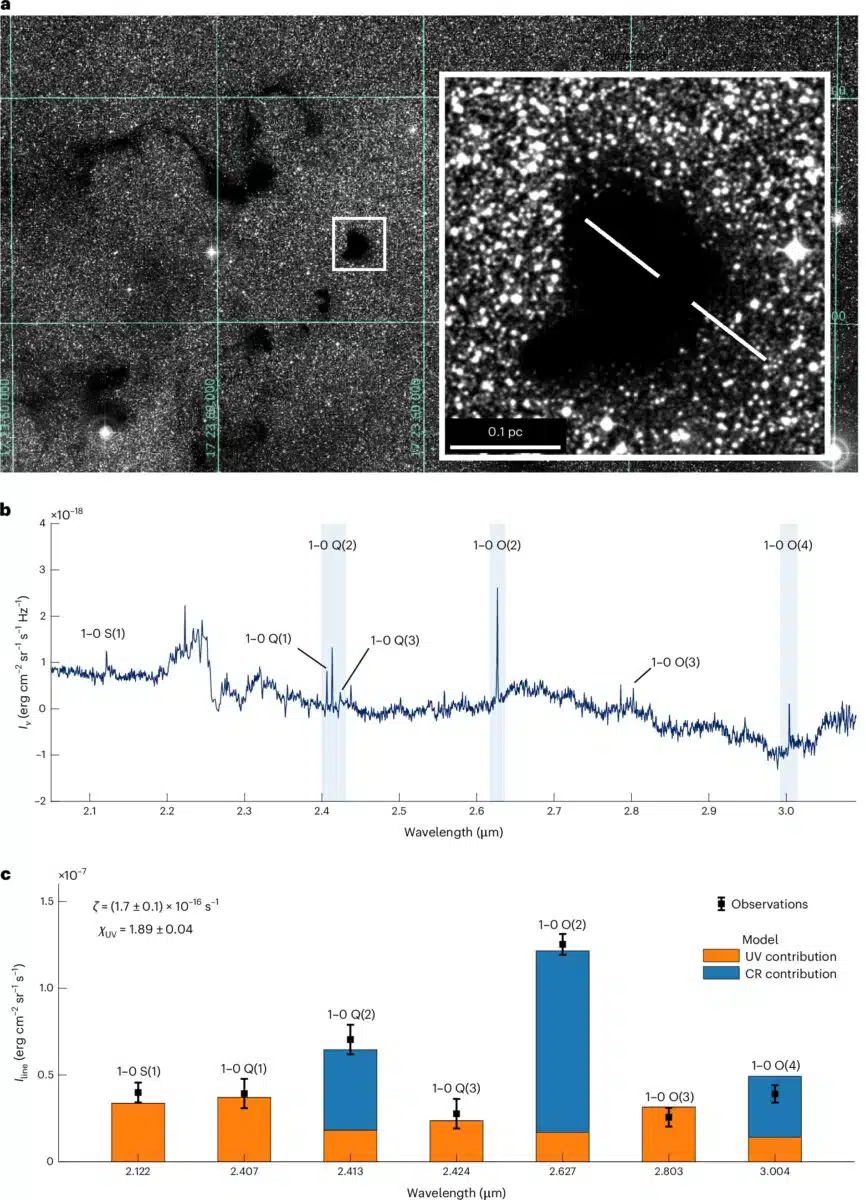 The image shows Barnard 68 data, with spectra and model comparisons highlighting UV and cosmic ray contributions. Credit: Nature Astronomy
In Barnard 68, scientists finally managed to capture a direct signal of cosmic rays’ impact on the hydrogen gas that fills the cloud. According to Dr. Shmuel Bialy, one of the lead researchers, these particles collide with hydrogen molecules, knocking electrons loose and causing them to vibrate. This vibration leads to the emission of faint infrared radiation, a unique “fingerprint” of cosmic-ray activity.
“This infrared radiation serves as a unique fingerprint of the interaction between cosmic rays and hydrogen in the nebula,” he explained.
Barnard 68: A Quiet, Ideal Testing Ground
Barnard 68 was chosen for this study not just because of its proximity but because of its unique characteristics. It’s a cold, dense cloud of gas and dust with no stars, making it unusually quiet and isolated. It’s situated in front of distant stars, blocking their light and allowing scientists to isolate the specific radiation emitted by cosmic-ray interactions.
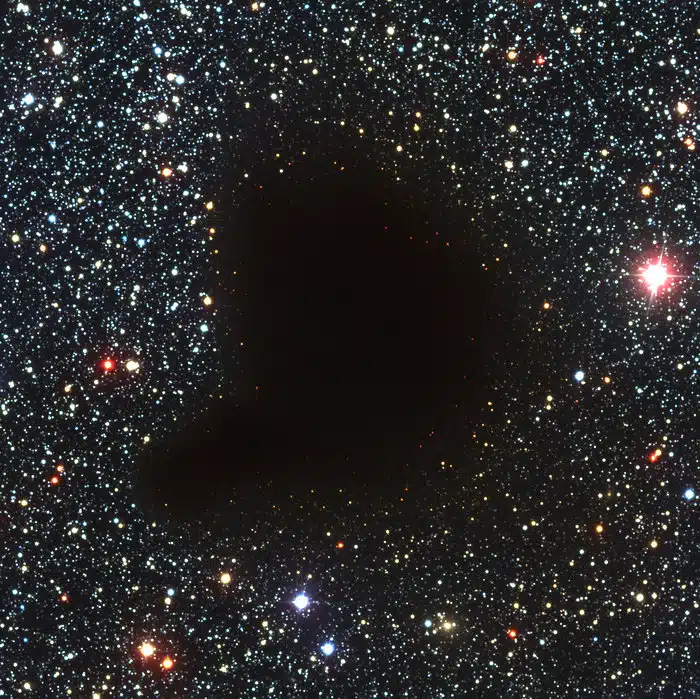 This photo shows a unique sky field in the Milky Way, centered on the dark globule Barnard 68 (B68). Credit: ESO
What makes this so important is that the faint infrared glow detected by the James Webb Space Telescope couldn’t be attributed to more common energy sources like nearby stars’ ultraviolet light. As stated by Amit Chemke, a master’s student involved in the study, the cosmic-ray signature matched perfectly with the predictions of their theoretical models, confirming that cosmic rays were indeed the source of the signal.
“The signals detected by the space telescope matched perfectly with the predictions of the theoretical model we developed,”Chemke said.
Is This the Key to Star Formation?
The discovery, published in Nature Astronomy, goes beyond simply measuring cosmic rays; these particles play a key role in ionizing gas molecules, a crucial step that triggers the collapse of gas clouds, which is a precursor to star formation.
“Previously, researchers had to take a roundabout approach by observing rare molecules such as protonated molecular hydrogen or molecular ions and then attempting to calculate the ionization rate from their concentrations,” noted Dr. Brandt Gaches, leader of the Emmy Noether Group dedicated to the Next Generation of Cosmic Ray.
Moreover, this discovery links cosmic rays to the creation of molecules like water, ammonia, and methanol, which are essential for planet formation. In other words, these high-energy particles aren’t just shaping stars, they’re also helping set the stage for planets that might one day host life.
Scientists plan to use this method to study other star-forming clouds across the Milky Way. However, as Dr. Bialy pointed out, future studies will face challenges in more crowded regions, where the influence of nearby stars and other sources of energy could complicate the analysis. Still, this study opens up an exciting new avenue for stellar research.