
They say that Germany used to be the ‘train’ of EU integration, France the ‘engine’ and Britain the ‘brake’.
But ahead of this week’s EU leaders retreat in a Flemish castle, it is Italy and Germany which have teamed up in a push for more “competitiveness”.
With the British brake gone, what is slowing us down?
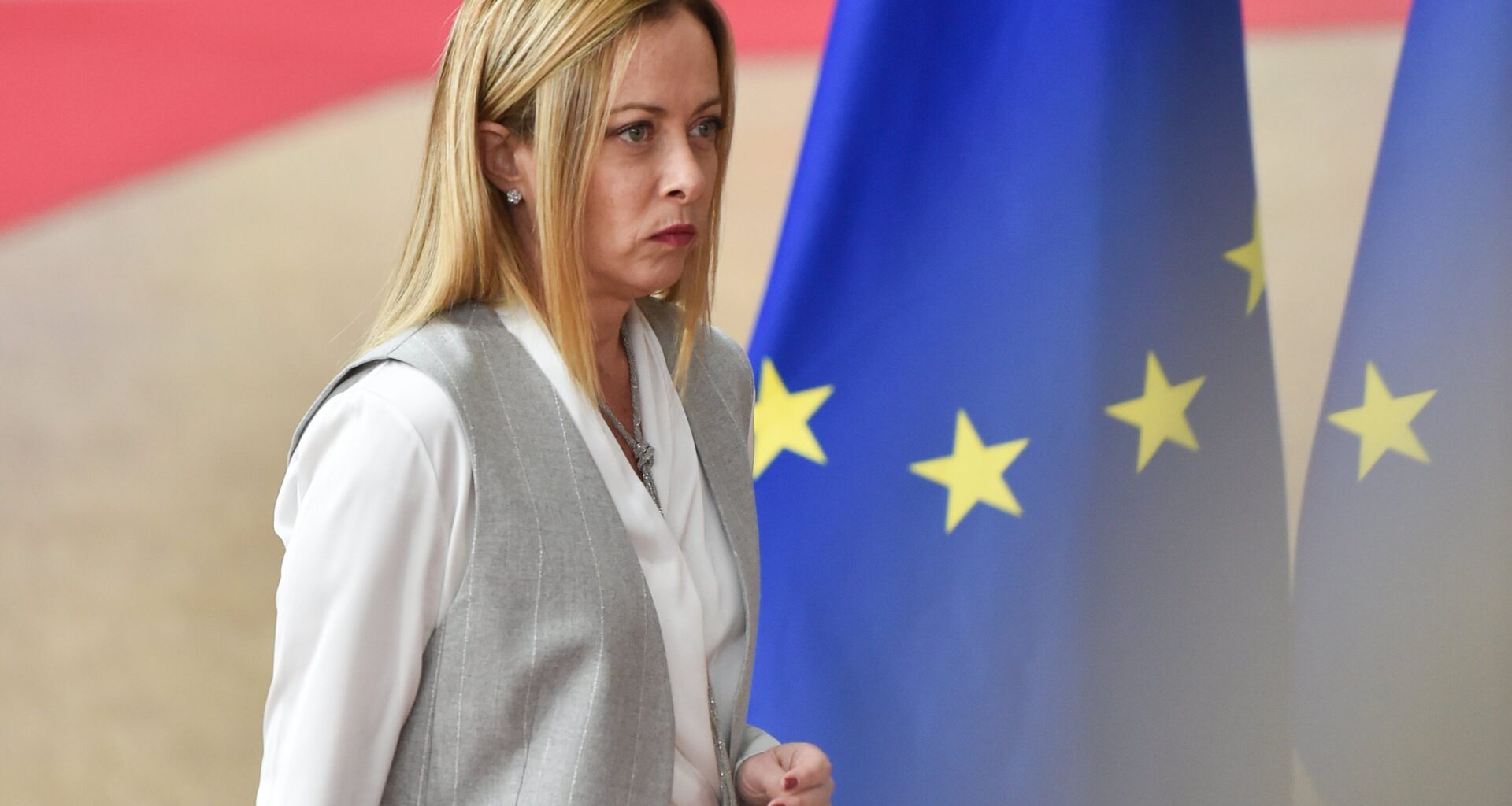
German chancellor Friedrich Merz and Italian prime minister Georgia Meloni’s joint letter to fellow leaders states that their countries are the “two main industrial European nations” — which will no doubt raise eyebrows in Paris but is likely to set the tone for the retreat.
We have agreed the obviously beneficial trade deals with Mercosur and India.
Single market for services
However, it is the single market for services which is still the ‘Euromillions’-sized prize Europe has yet to win. Boosting the services sector would far outweigh all the upsides of trade deals and counter any possible negatives of Donald Trump’s tariffs.
Based in Ireland, why can’t I get a mortgage from a German bank, or access the French version of Netflix, or insure my home with a Swedish insurer.
Why can’t European SMEs provide professional services easily across Europe, or send employees around Europe to work on projects or hire people and have their professional qualifications recognised quickly?
Merz and Meloni have some good ideas and some not so good, but as everyone agrees Europe must become “more competitive”, the term is so banal as to be useless.
The real question is who will implement the necessary painful national reforms first. That takes real leadership. Merz and Meloni seem to think, like some of their rightwing allies in the European Parliament, that simply deregulating at the EU level will solve the problem of low economic growth.
There are far wider and deeper competitiveness issues in Europe than just EU regulation.
Importantly, Merz and Meloni correctly highlight International Monetary Fund (IMF) statistics showing that economic barriers add up to the equivalent of an internal tariff of 44 percent on goods and a whopping 110 percent internal tariff on services.
We are, in effect, sanctioning our own economies.
However, while they try to blame the EU Commission and EU legislators for the barriers they fail to mention that the same IMF report states that the “particular problem is the substantial domestic barriers to entry in services in several countries”.
Italy has, for example, one of the most highly-protected service sectors in Europe. It leads in rejecting professional qualifications from other parts of the EU according to the EU Regulated Professions Database.
In a recent Commission economic report Italy was found to have “one of the most restrictive retail regulatory frameworks in the EU”, that “competition in Italy is hindered by obstacles to the opening up of markets and restrictions in the service sector” and that “entry barriers remain particularly high for regulated professions”, highlighting accountants, architects, civil engineers and real estate agents.
German ‘fortress’?
Germany is also a fortress of services, largely closed off to its neighbours. As the Financial Times noted recently, in over 30 years of the single market, only one French baker has ever had their professional certificate recognised in Germany.
German guilds of skilled crafts have delivered high quality services since the Middle Ages and dozens of professions require a specialised certificate to open a business, which keeps standards high but also forms a huge barrier to intra-EU competition.
If you are a qualified carpenter, plasterer, electrician, hairdresser or optician, and can speak German, why can you not move to Germany and easily start to work?
In addition, Germany is fond of ‘gold-plating’ EU laws by adding their own domestic legislation on top. Of course, if people complain about red tape, it is Brussels which gets the blame.
In Europe, goods do mostly move freely, as do people, but services are still largely stuck behind a web of national bureaucracy while EU bureaucracy is often the scapegoat.
In the latest commission single market strategy, the priorities are tackling diverging services regulations at national level, boosting recognition of professional qualifications and removing burdens on companies who wish to send employees across borders.
Let us see which countries support these priorities with real reforms.
People following EU politics for as long as I have will remember the heated debates about the so-called “Polish plumber” many feared was coming to take our jobs when the services directive was first proposed over 20 years ago.
This fear contributed to the defeat of the French referendum on the European Constitution in 2005 and only a watered-down version was agreed in 2006.
As it turned out, France and many other European countries have badly needed extra workers since that time and the Polish economy has boomed in the same period, so fears of cheap labour from the East have proven unfounded.
The 2004 enlargement has been, despite challenges, a great success for Europe as a whole.
Today, despite being widely lauded when launched in 2024, only 15 percent of the Draghi Report has been implemented according to the European Policy Innovation Council.
Of course, while chancellor Merz and prime minister Meloni enjoy walking the castle grounds with fellow EU leaders this week, they can point the finger at many others foot-dragging on the needed reforms.
Just recently in Ireland, for example, the funds industry has argued against a single supervisor in asset management, an essential part of any capital markets union. Similar interest groups can be found blocking progress in telecoms, energy, research and other services sectors.
Each country has its domestic interest groups and difficulties. What we do not need is more of the classic ‘Blame Brussels culture’. National capitals are just as much part of the EU as the institutions in Brussels. We all have work to do. In end, there must be a ‘grand bargain’ in economic reforms which moves us forward.
The commission has put a range of proposals on the table, and parliament will be constructive but often it is national capitals which are most often the brake.
Making the leap to a real single market in services would reduce prices for Europeans, create millions of new jobs and be our best defence against Trump and his populist allies in Europe.
Now that would really be winning the ‘Euromillions’ prize.