
Drawing is much more to an artist than just another medium. For a painter particularly, it’s the way they evolve ideas and find out who they are as an artist before brush even hits canvas. From Michelangelo to Picasso, we’ve come to think of drawing as the quickest way to access an artist’s thought processes. Yet even by the standards of these great masters, Lucian Freud was almost pathologically preoccupied with the act of drawing. That’s the principal revelation of the National Portrait Gallery’s new exhibition, the largest British survey to date of Freud’s works on paper. From wax crayon sketches done at the age of six to highly personal late drawings, it provides a fascinating and essential trawl through little-regarded aspects of one of Britain’s most treasured artists.
Freud’s early paintings are so preoccupied with sinuously suggestive lines and densely inscribed textures they often feel like drawings with paint added as an afterthought. Self-Portrait with Hyacinth in a Pot (1947), in which the 25-year-old peers back at us with an expression of self-regarding hyper-sensitivity against a yellow pastel background, all huge eyes and flaring nostrils, is precisely that. While Freud was only 11 when his family fled Berlin for Britain in 1933, the steely focus on material details – the tight waves of his hair, the flowers’ curving petals – feels very Germanic, while edging into then fashionable Surrealism. In the quirky Quince on a Blue Table (1943), a zebra’s head cranes into the canvas over a starkly painted still life.
This show offers glimpses of a young experimental Freud that will be a revelation to most viewers: cack-handed sketches done on a Welsh cottage holiday with the poet Stephen Spender, aged 18, bring a hint of toilet wall graffiti; sleekly accomplished book illustrations could pass for frames from some modish graphic novel produced last week.
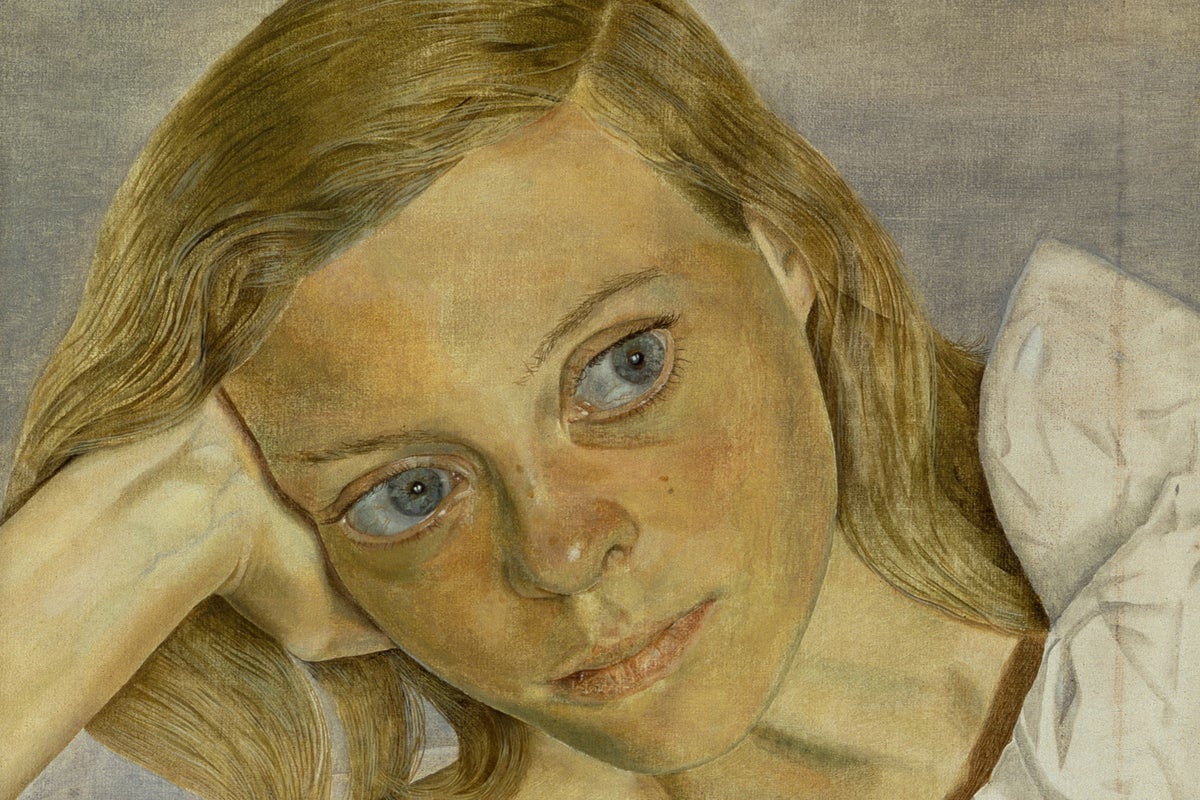
Even well-known early paintings such as Girl with Roses (1947), showing his first wife Kitty Garman, retain a starkly outlined graphic quality, not least in the enormous, eerily staring eyes; hardly flattering, but at least you can’t accuse him of wishy-washy prettiness.
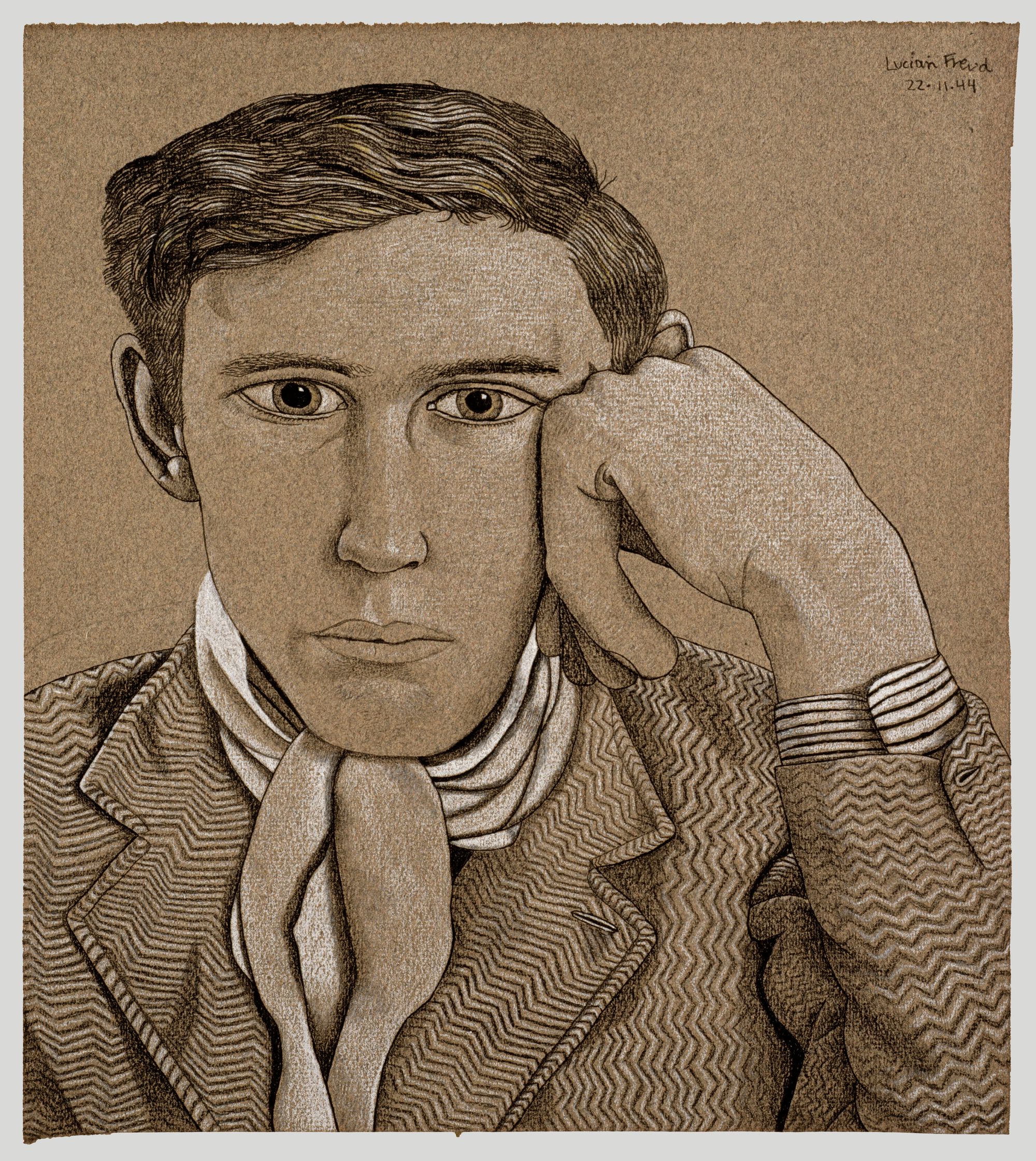
Drawings of Freud’s male friends have a similarly seductive, stylised quality, including Portrait of a Young Man (1942), which is being used as one of the show’s key promotional images. Far more powerful, however, is Christian Berard (1948), in which the French designer appears almost miraculously real and present. Yet the sense of disarming spontaneity is undercut in typical Freud fashion by the minutely detailed rendering of the beard and tufty textures of his dressing gown. Freud’s great friend Francis Bacon, meanwhile, is captured, tellingly with his trousers unfastened, in just a few impulsive lines.
Moving into the more familiar territory of Freud’s mature work, many of the “drawings” are in fact etchings, prints created by cutting into copper plates. While Freud drew directly into the plates in the presence of the sitter, these works have the carefully crafted quality of objects intended for public exhibition. They include some of his best-known works, including portraits of the shaven-headed performance artist Leigh Bowery and the majestically corpulent benefits officer Sue Tilley, shown alongside the related paintings.
open image in gallery
‘Portrait of a Young Man’ (1942), Lucian Freud, Black crayon and chalk on paper (The Lucian Freud Archive. All Rights Reserved 2025 / Bridgeman Images, Lent by a private collection)
Much more revealing are rapidly executed preparatory drawings for paintings and etchings. These have the intimate, unguarded quality of images intended only for the artist’s own eyes. Most moving are sketches in pencil and charcoal of the one subject Freud painted more frequently than himself: his mother. In an image such as the impulsively scrawled The Painter’s Mother (1984), with the folds of the elderly woman’s jowls and carelessly swept-back hair framing her still beady eyes, we feel we’re present in the moment with Freud as he tries to seize an instant from eternity while there’s still time.
Many of the etchings are, of course, phenomenal works in their own right. In Bella (1983), the plate is so densely scraped and gouged that his fashion designer daughter’s features look like they’re forged from burnished iron. More personal, however, is a large sketch executed in brush-cleaning fluid, in which three attempts to capture Bella’s likeness merge messily together, giving a rare sense of looking into aspects of the painting process Freud didn’t intend us to see.
This exhibition is full of great things, whether etchings, paintings or drawings, but it’s in the latter that we’re pulled deepest into the world of a man who gave the impression of living his life in the full glare of public attention, while remaining at his core absolutely private.
‘Lucian Freud: Drawing into Painting’ is at the National Portrait Gallery from 12 February until 4 May