
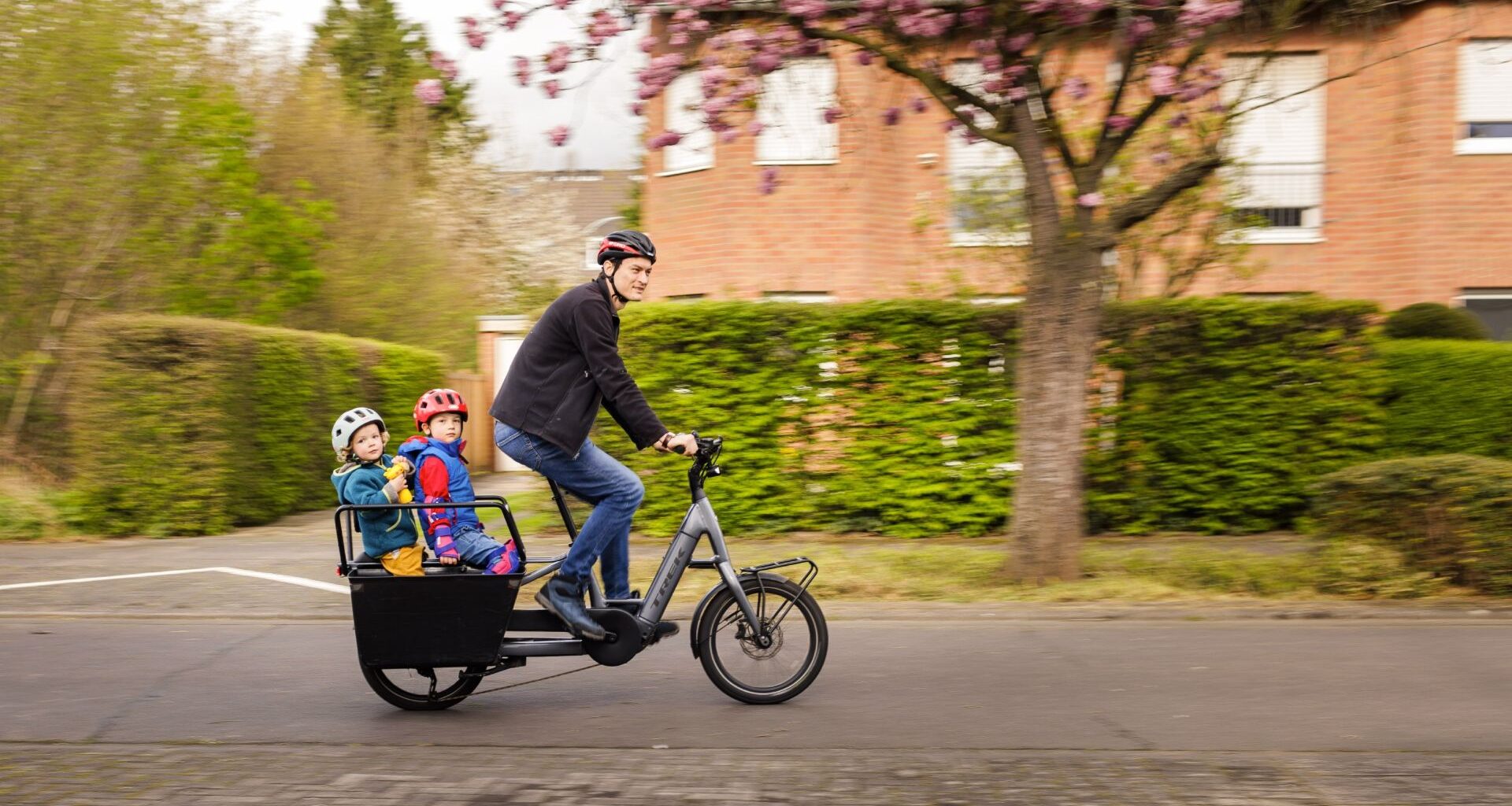
Like a lot of people, I use an e-bike to take my kids to school. We don’t use it every single day, but having the option to not fight against backed-up commuter traffic or struggle to locate a parking spot next to a bustling school drop-off zone is fantastic. It means quicker, more efficient trips, and since our kids are excited about riding, it makes getting out of the house smoother, with less consternation than when we depart by car.
Where I live in Seattle, Washington, we have to contend with weather (variable), hills (many, steep) and distracted drivers (concerning, dangerous). Despite these things, we still enjoy using our e-bike, and have simply found ways to adjust our approach to mitigate the impacts of these challenges. For example, we bundle up in the cold, sometimes go the long way to avoid large hills, and choose alternative routes to avoid higher-speed roads.
What we don’t have to contend with, at the moment at least, is bad policy decisions that influence how we choose to move around. This is not the case on the other side of the country in the state of New Jersey, where a new law was just adopted that creates significant new barriers to those interested in riding e-bikes.
You may like
Bad Bike Policy
(Image credit: Getty Images)
As one of the final acts of his gubernatorial term, outgoing New Jersey Governor Phil Murphy signed into law several stringent new requirements for e-bike riders in the state. Bill S4834/A6235, signed on January 19, 2026, stipulates that, “No person shall operate a low-speed electric bicycle or motorised bicycle unless the person shall be in possession of a valid driver’s license….or a motorised bicycle license.” In addition, the law requires that bikes operating on roads or public land be registered with the state and that no one under the age of 15 be permitted to ride an e-bike in the state going forward.
As a result of this law, e-bike riders in New Jersey will be expected to carry a license, registration and proof of insurance while riding, and those under 15 are not allowed to use e-bikes at all. These requirements mirror the legal conditions for operating a full-sized motor vehicle in the state and represent the most significant e-bike restrictions anywhere in the U.S., by a significant margin
This is all, quite frankly, absurd.
It makes perfect sense for someone operating a 4,000+ lb motor vehicle that is capable of travelling 80 miles per hour to pass a test and carry proof of insurance, since statistically, motor vehicles are one of the most deadly things on the planet. In the U.S., guns and cars are responsible for similar numbers of annual deaths.
The same thing, however, cannot be said of bicycles, even electric ones.
Low speed e-bikes, i.e. Class I and II e-bikes, which have speeds capped at 20 mph (32 kph) are not a threat to anyone, and treating them as such creates unnecessary additional barriers to their use. The benefits of e-bikes have been well studied at this point, and in addition to reducing traffic and pollution in measurable ways, e-bikes have been shown to meaningfully empower those who don’t have access to motor vehicles.
There are deeper issues at hand, also. Since this legislation was rolled out so hastily, several questions about the implementation remain unanswered. At the moment, there is no such thing as an e-bike license, nor is there a method to register an e-bike with the state.
You may like
Further, questions remain about how this law will be enforced and if it is possible to do so equitably. Could, for example, this law be used as an excuse to target or harass certain people? Will riders be randomly stopped and checked for compliance? And what of out-of-state residents visiting New Jersey? Will they need to meet these same requirements? These are the questions that should have been discussed and solved while the laws were in the legislature, not left open-ended after the fact.
By enacting these measures, the cost and difficulty of procuring and using an e-bike in the state have gone up significantly, creating additional barriers to their use. Critics of the new law are concerned about its potential complications, including for those people with medical conditions that prevent them from obtaining a driver’s license but who can safely ride e-bikes.
Conclusion
(Image credit: Getty Images)
It’s hard to understand how things could have gotten to this point. Reports indicate that the process to write and vote on these bills was extremely rushed and the outgoing administration decided to push it through despite public testimony that was nearly universal in its opposition to the measures.
I don’t have an issue with the age restriction on e-bikes. This aspect of the law seems reasonable, but why include the rest? And it’s clear that e-motorcycles, which go much faster than low-speed e-bikes, are a real problem that should have more legal guardrails in place. Why didn’t New Jersey consider these types of vehicles as part of this legislative push?
While the intent may have been to make New Jersey a safer place, the outcome is, sadly, a poorly-written policy that makes getting around even more complex for residents. Hopefully, this law gets challenged, or at least amended, before it can cause too much harm.
When news of this new law popped up on my radar, it seemed like a joke. Sadly, it’s real, and I am concerned by both how it transpired and how it will be enacted in practice.
Like most people who ride bikes, I also walk and drive. Sometimes I take public transit. We all benefit from having a variety of options to best suit the situation at hand. If every single person commuting to work drove a car, alone, the resulting traffic volume would be so massive that it would require everyone to spend several hours of their lives trapped in an endless snarl of fume-drenched car-induced stupor each and every day. More bikes, pedestrians, and public transit = less traffic.
By creating additional barriers to e-bike use, New Jersey has set in motion a chain of events that no one, it seems, asked for.