
When news of a bird flu outbreak was first announced in October last year, there was shock and worry among poultry owners and farmers.
More than three months on and with “flockdown” restrictions still in place, Katriona Shovlin, who runs Hen Weekend in Upchurch, has spoken to KentOnline about the impact it has had on her mental health and day-to-day life…
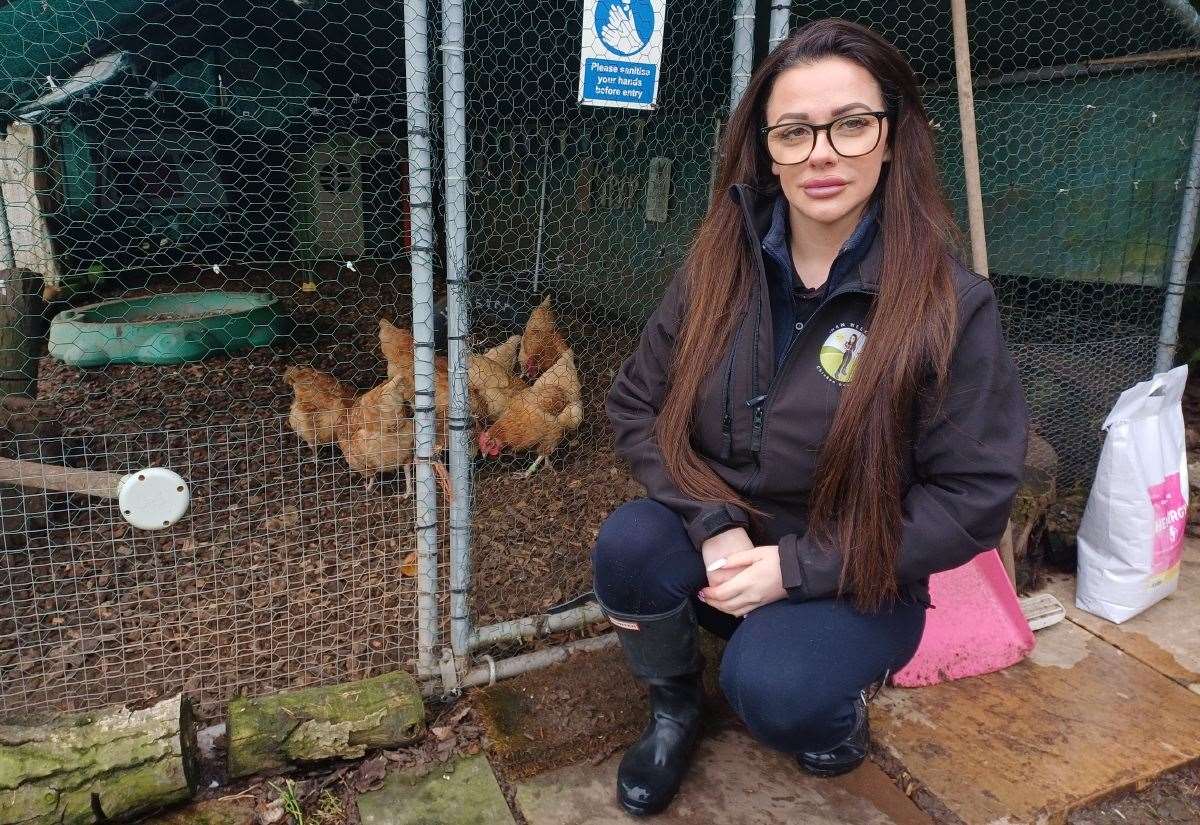
 Katriona Shovlin, also known as Kat, runs Hen Weekend in Upchurch. Picture: Cara Simmonds
Kat, who describes herself as a “full-time hen-trepreneur”, set up her business more than two years ago.
The mum-of-one noticed a gap in the market for temporary accommodation for chickens when she was looking for somewhere to board her own birds.
Animals at her “all-inclusive hotel” receive food, bedding and an afternoon treat of corn.
She even appeared on hit BBC series Dragon Den last January, where she pitched her quirky idea.
Before the arrival of avian influenza, there were automatic sliding doors from the hen houses into the chicken run so the birds could come and go as they pleased. They were even serenaded with classical music at all times.
Bird flu restrictions have been in place since the first outbreak in late October. Picture: Cara Simmonds
However, that all changed on October 28 when official word came from the Department for Environment, Food and Rural Affairs (Defra) that a case of bird flu had been confirmed nearby.
Overnight, it meant she was unable to move the hens or give them back to their owners without a special licence.
It also meant she could not take on any new animals, which was her main source of income.
“Some days have been really heavy and dark,” she explained. “I can’t really describe it. It’s just been hard and sad.
“It’s the social aspect of things – not seeing my customers. Talking to people over the internet is not the same.
You have to wash your wellies in a Defra-approved disinfectant. Picture: Cara SimmondsThe 33-year-old says it has now become part of her daily routine. Picture: Cara Simmonds
“In the poultry world, we call this flockdown instead of lockdown. It is literally like Covid-19 all over again.
“All the other owners are feeling the same way, we’ve got like our own little community. This is our life.”
In what has now become part of her day-to-day routine, Kat has to dip her wellies into bowls filled with a bird flu disinfectant, approved by Defra, before and after she sees her hens.
It ensures nothing can be transferred that is picked up from the ground.
She also has plastic tarpaulins secured in place and fruit netting surrounding the chicken run.
The current zones within Sittingbourne and the surrounding areas as of February 2026
Not only does it make it weatherproof, but more importantly, it keeps wild birds from flying in and helping themselves to water and food, which would potentially pass on the virus.
There are signs to wash your hands scattered around the site – a constant reminder that bird flu has not gone away.
Kat has nine hens of her own and eight that have been housed in the hotel since last January.
They began their stay at Hen Weekend as their owner had fallen ill but, due to the restrictions, the months have now turned into a year.
On social media, Kat has kept her clients up-to-date with what has been happening and also revealed how it has been “such an uphill struggle”.
The hens would normally be allowed in a wider pen to roam, but instead have to be kept in the chicken run. Picture: Cara Simmonds
Not only is it affecting her financially, but her mental health is suffering.
“Hen Weekend isn’t just a business, it’s my passion, my purpose, and what keeps me going every single day,” she wrote on her Facebook page.
“Having that suddenly taken away has been incredibly hard.”
Kat told KentOnline she was worried about losing customers.
“But mostly I don’t want people forgetting about this sort of service,” she added. “What I’m most scared of is people experiencing this lockdown as a bad thing and giving up their hens.
One of the lodgings at the hen hotel, left empty due to the outbreak. Picture: Cara Simmonds
“They are amazing pets to keep – don’t let this put you off, because I know how special they are.
“I want more and more people to get them, not give them up.”
The virus was first detected at the end of October at the Happy Pants Ranch in Newington.
A further two cases were confirmed at large commercial poultry flocks in nearby farms.
Happy Pants boss, Amey James, spoke of her devastation after more than 60 birds were culled at the animal sanctuary.
It has also impacted Kat’s mental health, as she is experiencing her own “flockdown”. Picture: Cara Simmonds
As a result, a 3km monitoring control zone has been put in place around each of the affected areas, along with a larger 10km surveillance zone.
While the disease primarily affects birds, some strains can spread to humans through close contact with infected animals or contaminated environments.
People could get a range of symptoms, from mild flu-like illness to severe respiratory disease.
Kat says the restrictions could be in place indefinitely, however, those impacted shouldn’t be scared.
She explained: “As long as people are registering their birds and letting Defra come and do their inspections, it should be okay.
It is not yet known when the restrictions will lift. Picture: Cara Simmonds
“They’re not the chicken police. They just want to come and see that your birds are safe and that is all.
“There is an awful lot of confusion as to whether bird flu is still here – it very much is.”
The 33-year-old added: “I think about the future every single day, probably more than I did before.
“It’s really hard, but I’m hoping that we can recover from this. There is a lack of specialist poultry care at the moment.
“I’m hopeful and sure we’ll come back bigger than ever.”