
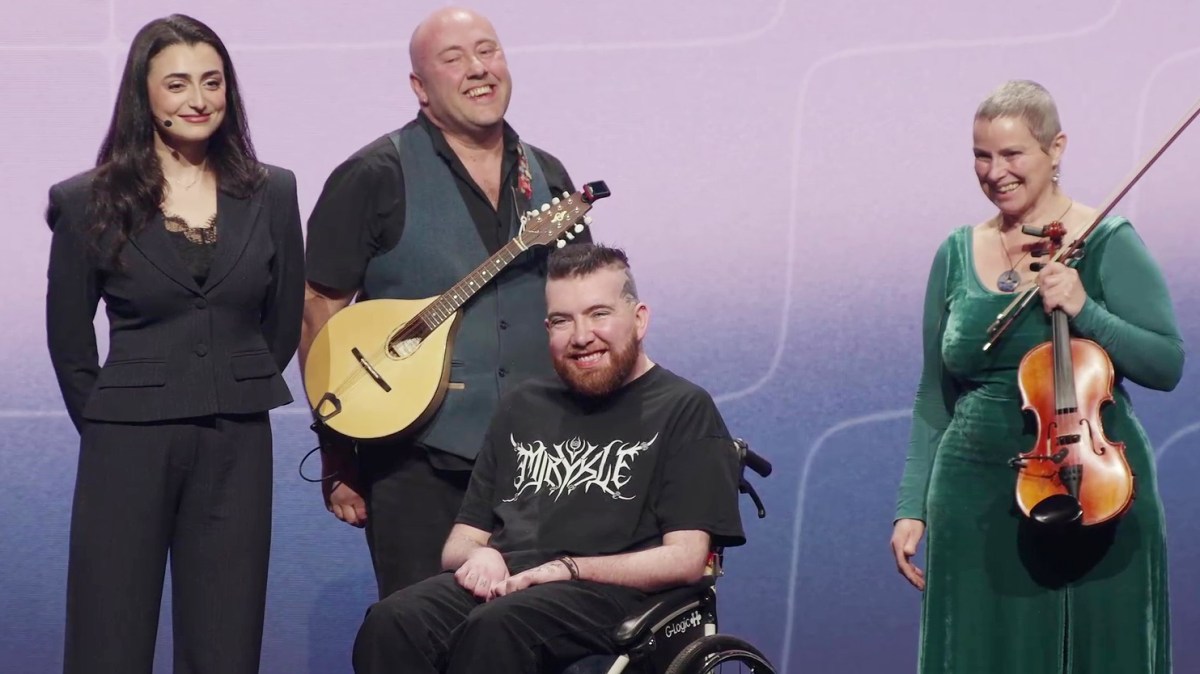
A talented folk musician was left devastated and was forced to quit his band after motor neurone disease took away his voice. Yet on Wednesday afternoon, he “sang” once again, with the help of vocals cloned using AI from practice sessions in his kitchen.
When Patrick Darling sat down in the kitchen with his acoustic guitar to sing one of his songs, before the disease took hold, he thought perhaps he would watch it back to adjust his style, or maybe show it to bandmates and friends for feedback.
His singing was casual, imperfect and husky in places. It was not a performance or a studio-level recording. But that quiet moment in a kitchen has given Darling back his voice — and his music.
Darling, a musician in a ceilidh band, was diagnosed with motor neurone disease in 2023, at just 29 years old.
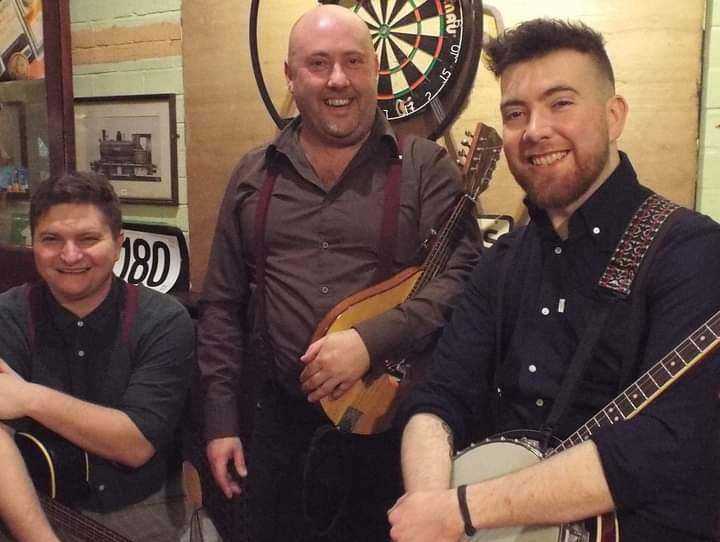
Darling with bandmates before his MND diagnosis
Over the course of months, Darling became weaker, eventually having to be carried on stage and struggling to breathe while he sang.
The emotional performance this week was his first since July 2024 with his folk group, the Ceili House Band, for a debut of his new song, Ghost of a Man I Never Met, written and recorded after his diagnosis.
Darling, who lives in Bristol, had been singing, composing and playing music since 14. Losing his voice had a “profound and devastating” effect on him.
“Being predominantly self-taught, I learnt to play bass guitar, acoustic guitar, electric guitar, piano, melodica, mandolin and tenor banjo,” Darling said. “Singing has always been my biggest love and I’ve spent most of my musical life performing live in various bands. Sadly, due to my motor neurone disease, I have completely lost the ability to sing and play my instruments.
“Losing my ability to sing had a deeply profound and devastating effect on me. But the ElevenLabs singing voice that we’ve created is wonderful and definitely sounds like me!
“The technology created by ElevenLabs changes lives. It provides hope, support and meaning to people in ways that you can’t fully appreciate unless you’ve lived it yourself. All I can say is thank you.”
With the UK-based firm’s software, which is free for those with an MND diagnosis, he was able to recreate his voice.
• AI voice company ElevenLabs valued at $11bn after latest fundraise
The process is fundamentally different from singing in a conventional sense, but remains intensely creative. Darling types using his assistive technology what he wants his singing voice to do, describing the effect in words rather than singing in the traditional way. The descriptions — “more vibrato now”, for example — will be translated by the software into his voice.
Moreover, he can create and compose with far greater ease and agency than before while using his own voice.
His bandmates, who performed with him on Wednesday, were overwhelmed by the prospect of singing with him again.
Speaking ahead of their performance at the ElevenLabs forum in London on Wednesday, Nick Cocking, a mandolin player, said hearing the recording of Darling’s new voice was emotional.
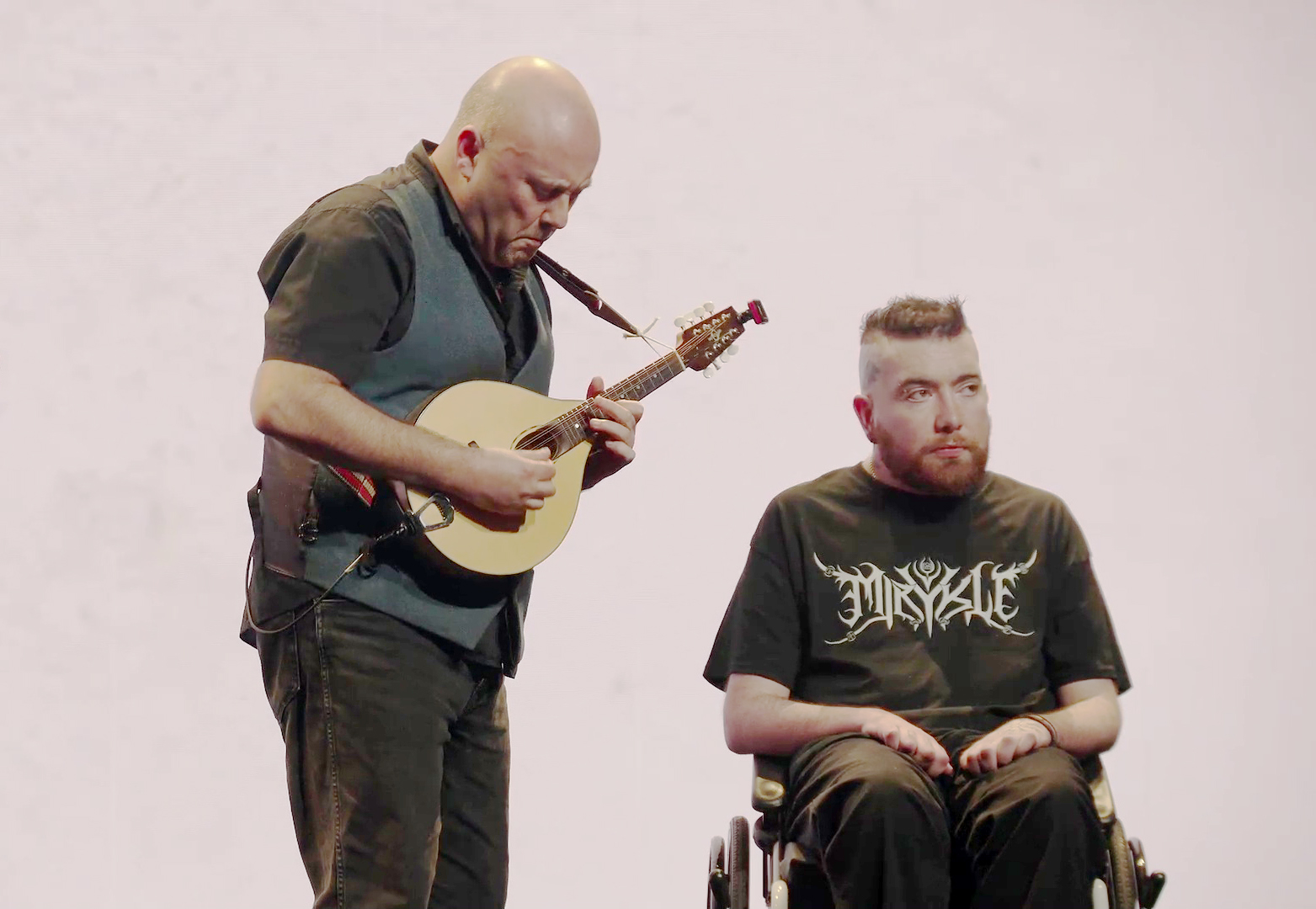
On stage in London with Nick Cocking
“It took me about 20 listens to get past the first three words, because it was just overwhelming. It was just amazing. It felt like Paddy had been sat in his bedroom playing the guitar and put a voice track on it and sent me the track for me to put a mandolin part on,” Cocking said.
• Stroke patients get their voice back through robotic necklace
Hari Ma, the band’s fiddle player, said the song gave her mixed feelings and resurfaced her anger at what had happened to her friend. “It brings up the frustration of not having been able to communicate with him because I’m used to communicating with him on a really deep level … It’s really a mixed bag, but a lot of anger and frustration at how difficult things are for him,” Ma said.
“But also really freaking proud of him because, he’s such a hero. He’s such a wilful guy, when he puts his mind to things and he’s just always kept going with the music and he’s never given up. What he’s created is absolutely amazing.”
Richard Cave, Darling’s speech and language therapist, said: “He’s the first person to try this out, living with a condition. And he basically helped me and helped ElevenLabs to just work it out and to make sure that it works.
“He [sent] some old recordings of him playing the acoustic guitar, I think it was in his kitchen. He was just practising, beautiful songs.”
The imperfection — slightly missed notes or emotion that you would get in a live performance — is what Cave thinks makes the voice so special.
• MND sufferer records voice bank so she can swear at her husband
“The interesting thing was the original recordings were not meant for anything, they were just meant for his practice,” Cave said. “Some of the notes he didn’t hit, it was a bit croaky. The interesting thing was the voice that came out, the synthetic voice, didn’t hit all the notes either, and it was a bit raspy at times … both Patrick and I loved it, because it was him. Perfection is not what we want here. We want authenticity.”
MND is a fatal condition with no cure and affects about 5,000 adults in the UK at any one time.
Darling’s family were in the audience on Wednesday afternoon, to hear him sing for the first time since he retired from music.
Looking ahead to the performance, Cocking had said: “The best thing is that we’re going to be playing with him when he’s singing, but he’s not suffering at the same time as he’s singing. That was horrible. Really horrible. He can relax and he’s done all the work and he can share his creativity without it causing him pain.”