
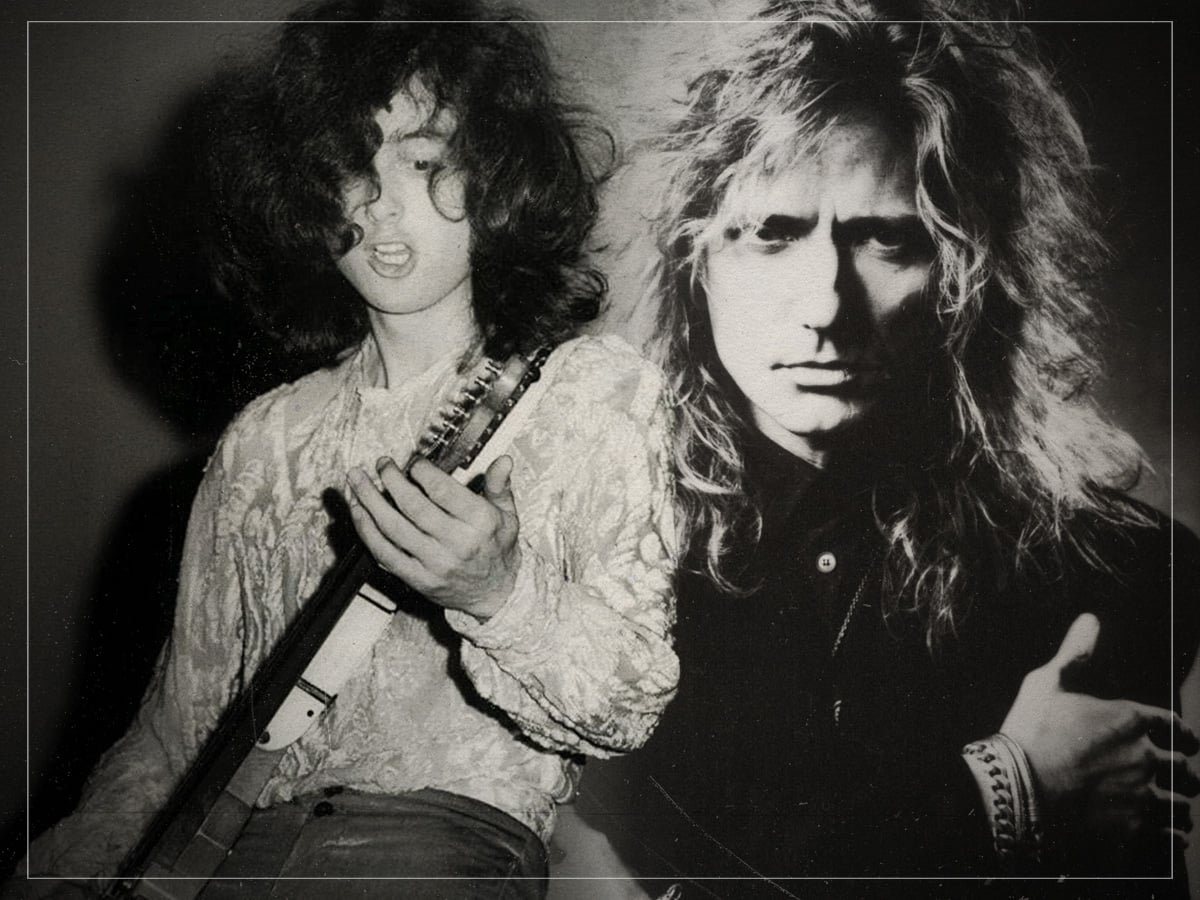
(Credits: Far Out / Jimmy Page / David Coverdale)
Fri 13 February 2026 0:00, UK
A decade into Led Zeppelin’s existence, they could still make a rational argument for being the biggest rock ‘n’ roll band on earth, but the days of appearing cutting edge or ‘dangerous’ were long gone, as the louder voices in the emerging punk scene had reframed them as unhip dad rock, or yesterday’s news.
Jimmy Page, who was only in his mid-30s at the time, was a good sport during that sea change, and he learned to take a lot of the blowback with a grain of salt.
“[The punks] took potshots at us and all the existing bands,” he recalled to the LA Times in 1993, “but I remember going to see The Damned, who I really enjoyed, and someone in the group took me aside and said, ‘Don’t take any notice about all this knocking…because I always play ‘Stairway [to Heaven]’ when I go home.”
If he still felt like he was on the right musical path in the ‘70s, though, that no longer held true after the death of John Bonham and the demise of Led Zeppelin in the ’80s.
“I think everyone goes through a period where you have a fear of losing that spark,” Page admitted, “And I went through some of that. I was fully aware the work that I did during the ‘80s certainly wasn’t of the quality of Zeppelin, but that wasn’t necessarily my own fault. The other components weren’t there. I didn’t feel I had the right pieces.”
The guitarist had released a pair of marginally successful albums in the mid-‘80s with a supergroup called The Firm, with ex-Bad Company singer Paul Rodgers on vocals, but he now seemed happy enough throwing that band under the bus. Both Page and Rodgers were still mourning their old bands at the time, perhaps, and the chemistry had never quite realigned.
If there was a lesson to be learned, it was to avoid hitching your wagons to a newly single frontman trying to rediscover himself, especially if he reminds you of your ‘ex’, but somehow that memo didn’t stick in Page’s mind, because by 1993, he was out promoting a new collaboration with David Coverdale of Whitesnake.
 (Credits: Far Out / Album Sleeve)
“Working with David was a totally different thing,” he insisted, “It was suddenly right back to that original spark of creativity and idea flowing. I feel I have my heart in it again”.
Page might have been kidding himself a bit, as before forming the short-lived Coverdale-Page partnership in 1991, he’d been trying for several years to get Led Zeppelin back together for a new project, but Robert Plant couldn’t be budged on the idea.
This left him to “wade through scores of cassettes” of demos he’d been working on, desperate for a singer worthy of bringing them to life. Finally, his manager suggested Coverdale, the former leather-clad, Plant-esque, hair metal frontman who was going through an identity crisis during the flannel takeover of rock in the ‘90s.
“I had never gone into music for the image thing at all,” Coverdale claimed, “and I really couldn’t do it anymore”, and so, Coverdale-Page was born, much to Plant’s annoyance. “I found it difficult to understand [Page’s] choice of bedfellow,” the spurned ex-partner later said, “I just could not get it”.
For his part, Coverdale made it clear that the project was never intended to be ‘Led Snake’ or anything so sacrilegious as that, and in the end, the one album the duo released in 1993 proved to be a big commercial success, hitting the top five in both the UK and US. If it had truly reignited Jimmy Page’s “spark”, though, he had a weird way of thanking Coverdale for it, for just a year later, he reunited with Plant for an MTV Unplugged concert taping, and that brief fling with a younger muse was instantly over.
The Far Out Led Zeppelin Newsletter
All the latest stories about Led Zeppelin from the independent voice of culture.
Straight to your inbox.