
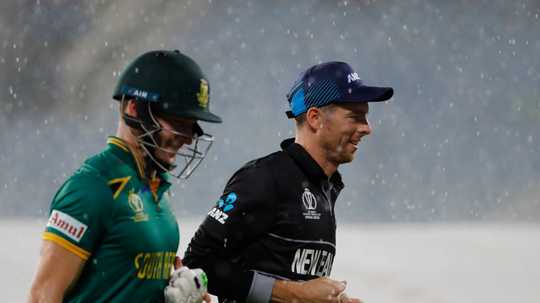
India versus Pakistan. The Ashes. Springboks versus All Blacks.
South Africa versus New Zealand in cricket World Cups isn’t in that league of colossal contests, but the fixture comes with a compelling narrative freighted with drama and consequence.
South Africa have won seven of their 13 completed men’s World Cup meetings against the Kiwis in both formats, including all four in the T20 version. But New Zealand have won both ODI knockout games – the quarterfinal in Mirpur in 2011 and the semifinal at Eden Park four years later.
The former was the most infamous of all of South Africa’s chokes. Chasing only 222 to win, they lost their last seven wickets for 51 runs and were bowled out for 172. The tipping point came when Kyle Mills ran onto the field in a substitute’s bib, ostensibly to bring water to his teammates. It seemed his real mission was to rile up the South Africans at the crease, and he succeeded to the extent that the umpires had to intervene to stop Faf du Plessis from using his bat on Mills for an unintended purpose.
In 2015, Johannesburg-born Grant Elliott put Dale Steyn on his backside with a mighty drive down the ground for six to win the match with a ball to spare. The subplot was that CSA’s suits, in their craven indifference to how cricket actually works, demanded the inclusion of an additional black or brown player in the XI. Out went Kyle Abbott, South Africa’s most successful fast bowler in that tournament. In came Vernon Philander, who was not entirely over a hamstring injury. Both players were victims of the administrators’ folly. The thoughtless decision undermined trust in them – by public and players alike – for years to come.
The countries’ women’s teams have met five times in ODI World Cups but never in a knockout game. New Zealand lead that race 3-2. They’re also ahead 4-2 in the T20I stakes, and won the 2024 final against South Africa in Dubai.
That, too, was sensational. But, happily, only for standard cricketing reasons. The South Africans, who had also reached the 2022 final at Newlands, where they were beaten by Australia, were favoured to win. Only for New Zealand to successfully defend a modest 158 and triumph by 32 runs.
All told on the South Africa-New Zealand World Cup scorecard, the Kiwis are 13-11 ahead going into Saturday’s men’s T20 World Cup clash between the teams in Ahmedabad. It isn’t the most meaningful game. South Africa have beaten Canada and Afghanistan. New Zealand have won against the Afghans and the United Arab Emirates. Saturday’s match pits the most successful of group D’s teams against each other, but both will know they are on course for places in the Super Eight.
At his press conference on Friday, Matt Henry wasn’t at liberty to say the match was pretty much a dead rubber: “It’s always exciting to play South Africa, and nothing changes in a World Cup. They’re always going to be strong in all areas. It’s a challenge we look forward to.”
What’s not to like, Henry said: “We’ve always got on really well with South African sides. With franchise cricket now, you get to know a lot of the players around the world. I think it’s brought the game close together. It’s exciting to see guys you haven’t seen for a while and catch up. But we know that when we play the game, it’s fierce competition.”
Aiden Markram concurred, and, on Valentine’s Day eve, no less, did his bit to stoke the bromance: “[New Zealand’s] approach to cricket is similar to South Africa’s in the sense of never quite being frontrunners but always trying to get in there and be with the big and successful teams.
“They’re a great bunch of guys who are good at their skills, good at what they do, competitive as well, similar to South Africans. Because of that, there’s quite a bit of respect between the teams.”
Four Kiwis were among the 45 foreign players in the latest edition of the SA20, and this year’s IPL will feature 17 South Africans and a dozen New Zealanders among its overseas contingent of 85. You might say the foreign fraternisation built into the modern franchise system has dulled some of the competitiveness of the international game. You might also say international cricket has become a more mature place now that players who are on opposing sides share dressingrooms in far-flung T20 tournaments.
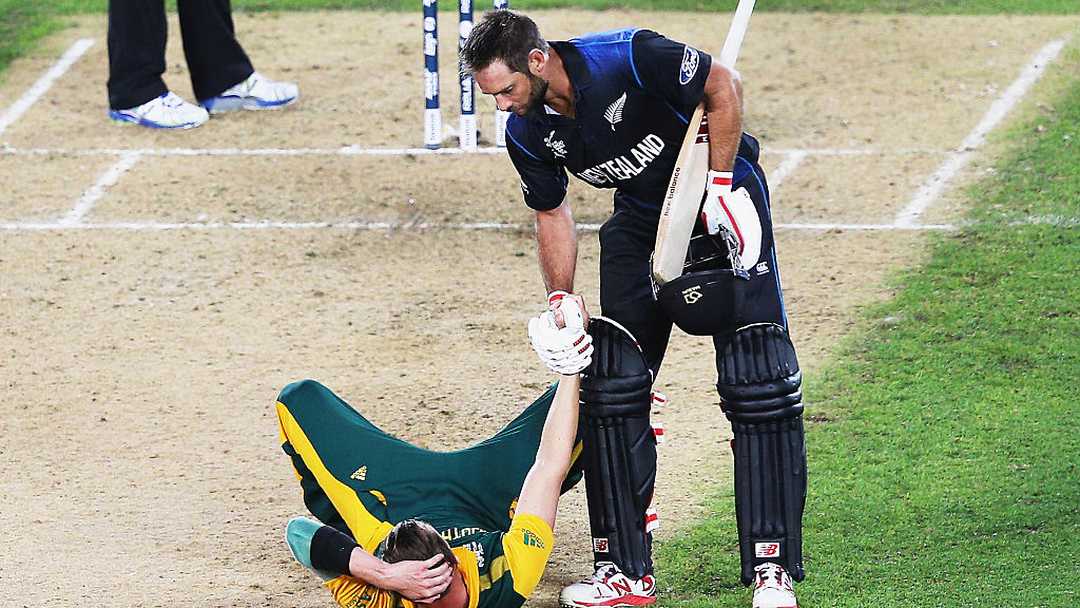
An iconic moment in the SA-NZ rivalry circa 2015 ©Getty
“Sharing change rooms in franchise cricket, you end up becoming mates with some of the guys,” Markram said, and acknowledged the international game “potentially not having that same presence and edge that it used to have back in the day”.
Talk of dressing rooms brings us to Rob Walter, whose resignation as South Africa’s white-ball head coach was announced in April last year. He is now in the same position with New Zealand. That must be a significant advantage?
“I wouldn’t say [he’s revealing South Africa’s] secrets,” Henry said. “There’s plenty of data out there and we’ve played a lot with these guys as well.”
Walter concurred: “We sit in a meeting and they’ll tell me stuff I already knew and I’ll tell them stuff they already knew. So I don’t think it gives us any edge.
“The boys are going to be out in the middle. They’re going to be competing. They’re the ones who have to execute the skills and stuff that they already know about each other. The team that responds quickest and executes best on the day is probably going to win.”
Henry remained firmly on message: “It’s great to get clarity on plans, but it’s usually about adapting to the conditions and trying to be the most effective. Sometimes the conditions outweigh the plans, and it’s important to get that clarity. But it’s always great to talk to Rob. He’s got a wealth of experience; not just from South Africa but around the world as well.”
Did it feel strange for Walter that he had swapped one of Saturday’s teams for the other?
“It’s not odd at all,” Walter said. “I think often that’s overdone by everyone else. My job is to coach New Zealand. There are two environments I probably know the best from a cricketing point of view – South Africa and New Zealand. Now it’s about working with these guys and trying to get them to do well in this tournament.”
Walter was born and raised and cut his coaching teeth in South Africa. But he and his family have lived in New Zealand since 2016. He commuted to and from South Africa throughout his tenure in the top job with the Proteas, which ran from January 2023 to April 2025. That made him best placed to address the resemblances and contrasts between Saffers and Kiwis as players and people.
“No two cultures are the same, not even in your own country,” Walter said. “The similarities, I guess, are that they’re cricketers first and foremost.
“Cricketers are generally the same all over, but I think New Zealanders and South Africans are very similar in terms of who they are from a cricket point of view; how they play the game. And so it doesn’t feel hugely different to be in the two environments.
“They’re a good bunch of guys on both sides of the coin – hungry to do well, super competitive, and pretty humble characters. So, yeah, that’s the same.”
Besides the fact that their rugby teams have won, between them, seven of the 10 men’s World Cups yet played – the Boks lead that count 4-3 – South Africans and New Zealanders share a certain Southern Hemisphere outlook. They rub along easily in the cultural casualness they have in common. We say braai. They say barbecue. We both say, and drink, beer. And grow, make and wax lyrically about, and drink, wine.
But the Boks are better than the All Blacks, of course.