
 ESA / M. Pedoussaut
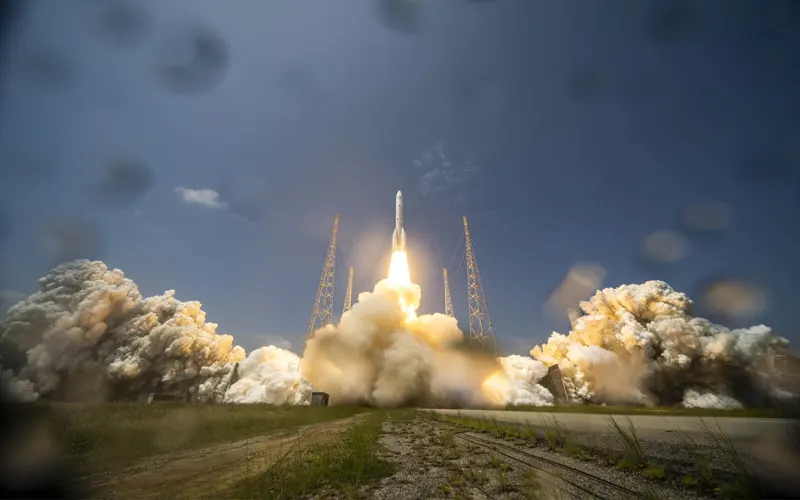
The first flight of Ariane 64, the more powerful four-booster variant of the Ariane 6 rocket, has been successfully launched from French Guiana. The rocket carried 32 satellites for the Amazon LEO constellation, formerly known as Project Kuiper.
Arianespace launched the first Ariane 6 rocket in its two-booster configuration (Ariane 62) in July 2024. Another four flights followed in 2025, all launched aboard Ariane 62 rockets. On 12 February, Arianespace launched the first four-booster variant of the rocket from the Guiana Space Centre. This version of the rocket is capable of delivering payloads of over 21 tonnes to low Earth orbit, more than twice as much as the rocket’s two-booster variant.
The flight, designated LE-01 (Leo Europe 01) by Amazon, was launched from the ELA-4 launch complex at 16:45 UTC. Following a pair of second-stage burns, satellite separation began one hour and 29 minutes into the flight and concluded 35 minutes later after 12 deployments, with the final satellite drifting away from its payload adaptor. A third and final burn 160 minutes after liftoff will place the upper stage into a destructive orbit, with the mission concluding when it burns up in Earth’s atmosphere.
LE-01 was the first of 18 missions Amazon has contracted Arianespace to conduct as it deploys its Amazon LEO constellation, positioned as a global broadband competitor to Starlink. Arianespace has indicated that it plans to launch up to 8 Ariane 6 flights in 2026, a significant portion of which will be dedicated to working through its backlog for Amazon. This will include the first flight of the upgraded Block II Ariane 64 variant, featuring the more powerful P160C boosters, which were officially certified for flight by the European Space Agency in December 2025.
Working through its backlog will be an important milestone for Arianespace as it grapples with a financial position that left it with €372 million in accumulated losses by the end of 2025. These losses prompted a capital restructuring under French commercial law in December, during which the company reduced its share capital to zero and cancelled all 37,206,901 existing shares. It then immediately carried out a €200,020,000 capital increase through the issuance of 10,001 new shares, fully subscribed by ArianeGroup, making Arianespace a wholly owned subsidiary.
While this recapitalisation provides short-term relief, Arianespace will need to notably accelerate its commercial activity to reverse a decline that saw revenues drop from €1.4 billion in 2015 to €152 million in 2024.
In addition to its own financial struggles, Arianespace will likely also be keen to quickly work through its backlog to ensure availability of Ariane 6 rockets for the deployment of Europe’s IRIS2 secure communications constellation, which is expected to begin toward the end of the decade.
Keep European Spaceflight Independent
Your donation will help European Spaceflight to continue digging into the stories others miss. Every euro keeps our reporting alive.