
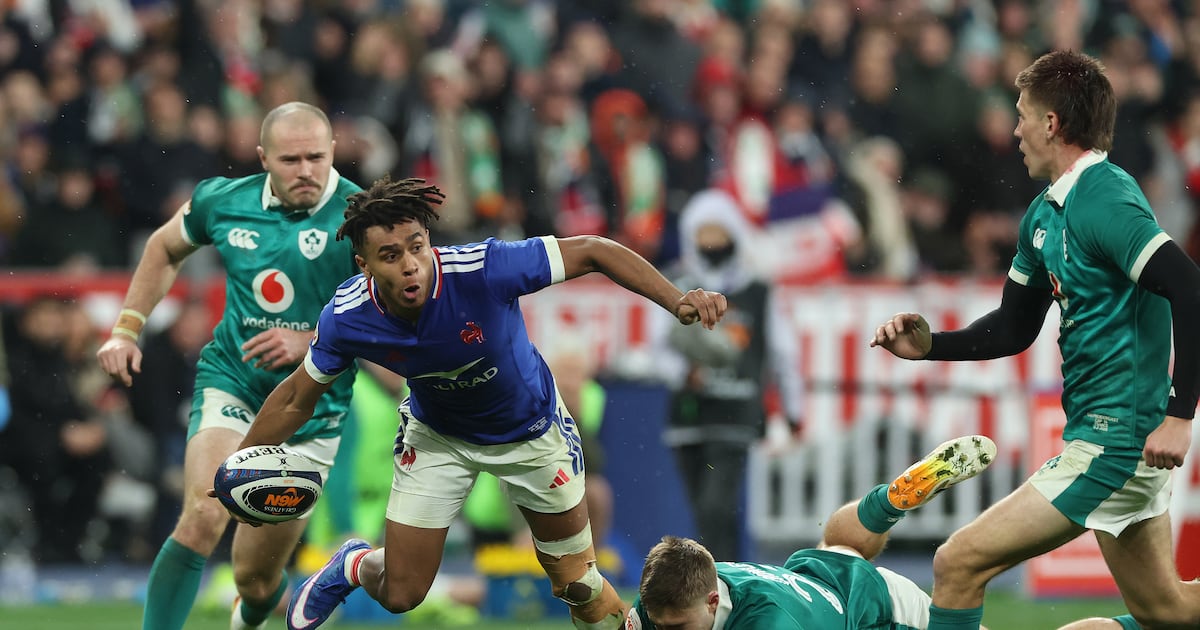
In rugby, there is a belief that defeat reveals more truths than victory. In the opening round of this year’s Six Nations, there were three very different revelations for the vanquished.
At Twickenham, the true depth of the decline of Welsh rugby was laid bare. England attacked with impunity because the Welsh were incapable of resistance. It was a melancholic feeling to watch the famous scarlet jersey being brought so low.
In Rome, another set of jerseys told their own sad tale. The horrendous lavender shirts that were forced on the Scottish players were an embarrassment.
 Do Ireland’s rugby pathways need a serious overhaul?
One of our game’s greatest traditions is the swapping of jerseys after a Test match. However, any Italian player who hesitated to swap their Italian shirt for something that more resembled a used artist’s smock than a sacred shirt that represents the Scottish nation could not be blamed.
It was no accident that the Scots played like the jersey they wore. They performed in a disjointed, distracted manner well below their capabilities, proving once again their defining quality of being consistently inconsistent.
On a sodden pitch, the Italians deserved their gutsy victory. In the last 10 months, Italy have put in two creditable performances across three Tests against the Springboks and defeated both Australia and Scotland.
Ireland, you have been warned.
After Ireland’s humbling defeat in Paris, the incessant whinging, moaning and complaining across the island speaks of a nation deluded about the reality of its rugby programme.
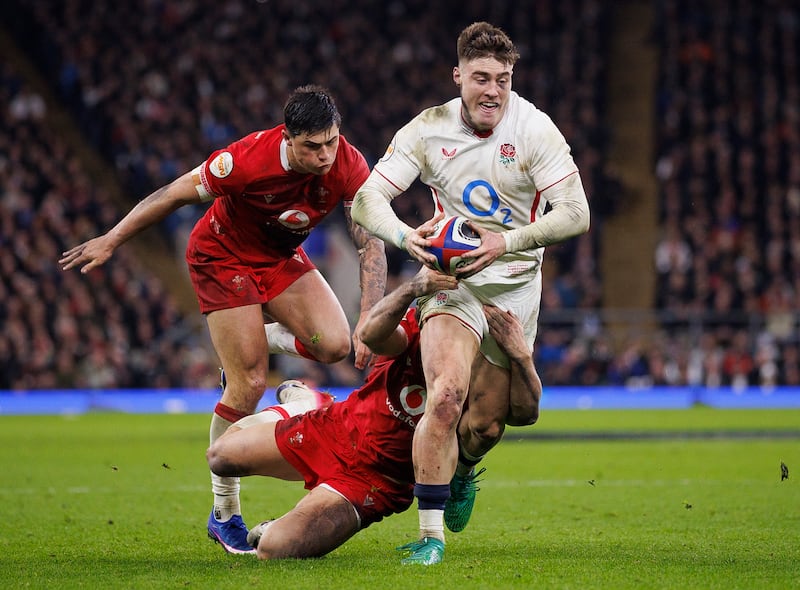 England cantered to victory against a Sorry Wales in their opening match of the Six Nations. Photograph: Bob Bradford/CameraSport via Getty Images
It is believed that the Scottish author Robert Louis Stevenson wrote: “Sooner or later we all sit down to the banquet of consequences.” Whether Stevenson was the source of those wise words is debated, but their truth has never been in doubt. Ireland are munching on the consequences of having a historically high number of players on last year’s Lions tour, a horrendous injury toll and an elite player pathway programme that has stalled.
Despite the absence of James Lowe, Hugo Keenan, Tadhg Furlong, Andrew Porter, Bundee Aki, Robbie Henshaw, Mack Hansen, Ryan Baird, Paddy McCarthy and Jack Boyle, it astounded me that so many in the Irish rugby community expected their team to go to Paris and return home with their honour intact.
The delusion was also evident when Ireland’s second-half tries were described as a comeback, rather than the French obviously taking their foot off the gas.
If Irish fans don’t believe their team can follow the path forged by the Wallabies and gurgle down the rugby drainpipe – at an almost unimaginable pace – they are once again kidding themselves.
Several sources who observe the workings of the Irish academy system have, for some time, been warning me of a decaying hubris within Irish academies. They describe a system that can still talk a good game, while the coaching of technical skills within the Irish elite player pathway is in rapid decline. The poor performances of the Irish Under-20s over the past two years give substance to these observations.
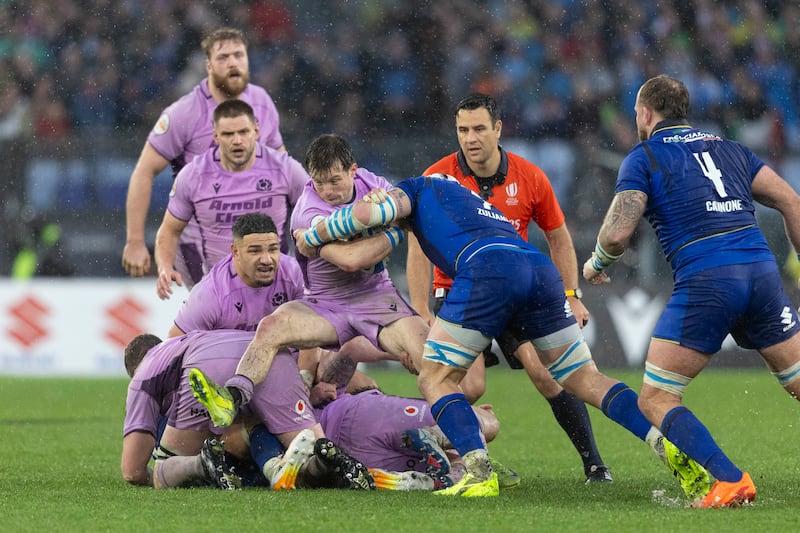 Look at the state of Scotland. Photograph: Ross MacDonald/SNS Group via Getty Images
There is strong evidence that the production line that has produced so many excellent players over the past two decades is no longer functioning as it should. A reorganisation and a return to technical excellence is required.
When the decline of the academies is combined with an ageing cohort of senior players inside Leinster and the national team, warning klaxons should be sounding that hard times are on the horizon.
With the enormity of Twickenham looming and the Italians no longer the easy pickings of the competition, the banquet of consequences for Irish looms large.
While the Aviva has been Ireland’s happy place, they will need all those in attendance to stop constantly getting up to buy pints during play, keep their entitled arses on the seats and help create an atmosphere that will empower their team to display the energy, positive body language and physicality that were non-existent in Paris.
More importantly, Ireland must urgently address the weaknesses in their backfield defensive structure that allowed the French kicking game to be so effective last week. With no sweeper behind the defensive line, the French chip-and-chase game delivered two tries, while the attacking kicks of Louis Bielle-Biarrey exploited the positional weakness of the Irish back three.
Against Scotland, the Italian winger Louis Lynagh – son of Wallaby great Michael – scored the match-defining try from an attacking short kick. Ireland can expect more of the same.
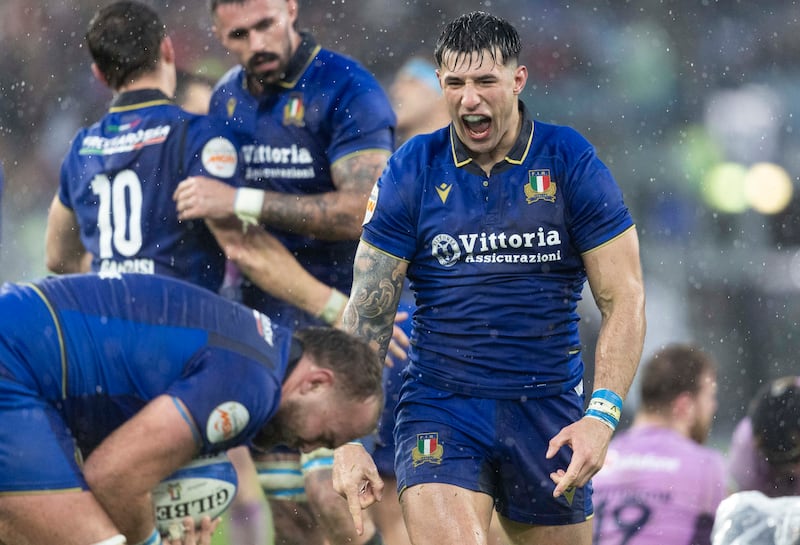 Ireland better show Italy the respect they have earned. Photograph: Ross MacDonald/SNS Group via Getty Images
The consistent improvement of the Azzurri over the past few seasons is no accident. Their head coach, Gonzalo Quesada, is building on the solid foundations created by Kieran Crowley. Under Quesada, the Italians are displaying old fashioned guts, spirit, commitment and a physicality that has not always been evident.
After years of low standards, the Italians are now capable of upsetting any of the other five teams. Ireland must give the Italians the respect they have earned.
When we consider Ireland’s heavy injury toll, the multiple changes Andy Farrell has made in his selection and the inevitable dislocation that player rotation brings, a stable Italian team has a chance.
Italy will walk on to the pitch full of confidence, energy and the freedom of a “nothing to lose, everything to gain” mindset.
Any belief that the Azzurri will simply roll over and give Ireland an easy win is another exercise in delusion. It won’t be glamorous and will be closer than many expect. It should be Ireland, but don’t bet your house on it.