
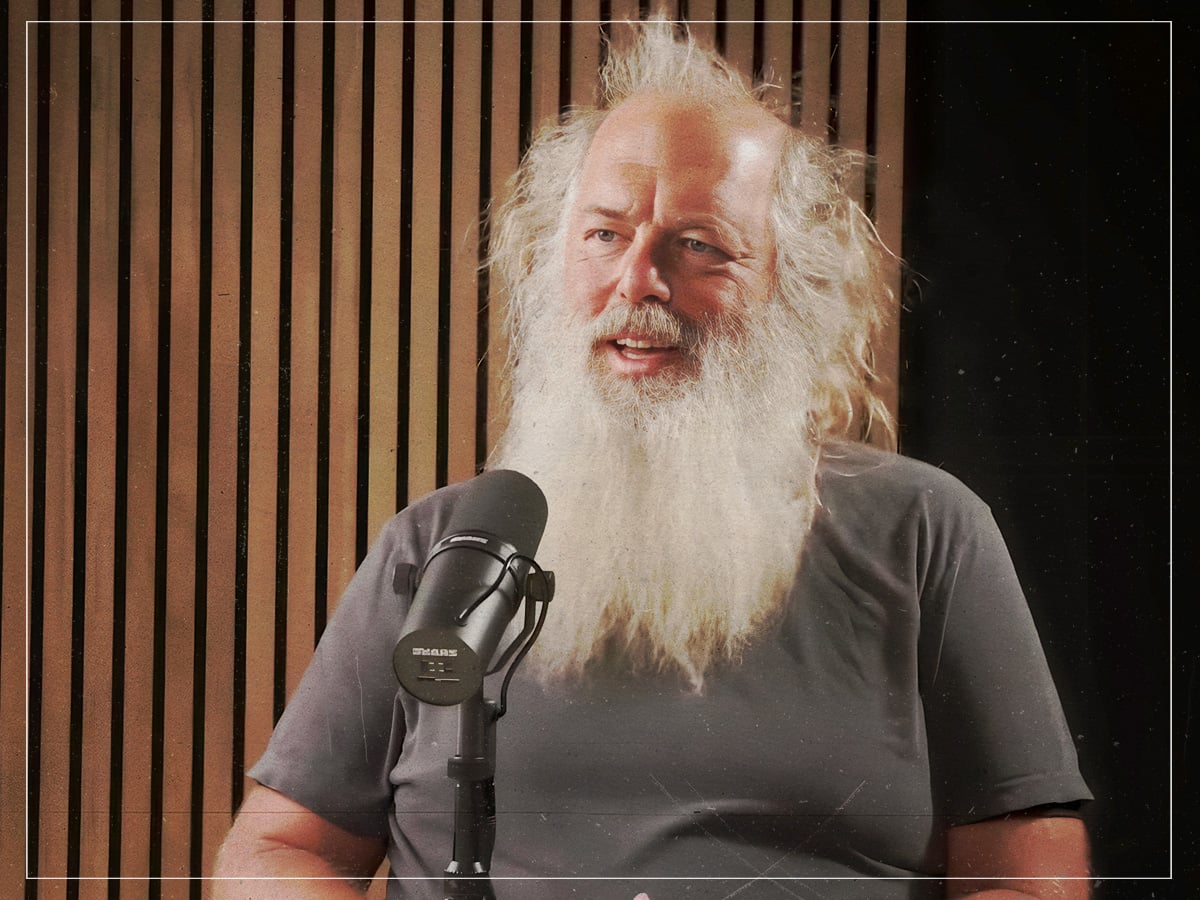
(Credits: Far Out / YouTube Still)
Fri 13 February 2026 14:21, UK
There is a hallowed position that, for a while, seemed to be a shadowy throne only occupied by the smartest individuals. But now, the role of producer is as coveted as being the star under the spotlight. An indulgence in laptop performance has meant that becoming a producer is as achievable, perhaps even slightly more so, than ever before. Rick Rubin, however, is cut from a different cloth.
Producers like George Martin, who chaired The Beatles’ productions, or Timbaland, one of hip-hop’s most potent deliverers of tunes, have innate musical talent. But, Rubin would lead up the efforts of Def Jam bereft of any such skill, happily admitting that while his taste was second-to-none, his ability to actually make music was limited to clapping his hands.
It meant that, sometimes, he would come up against a band who simply couldn’t get on board with his vision for working. Rubin, often barefooted and always opinionated, would sit back at the mixing desk, with engineers manning most of the key dials, and dictate based purely on vibes how a song should go or not go. It was, for some, a step too far. Especially for old hands.
In 2012, for the first time in nearly 35 years, Black Sabbath entered the studio once again with Ozzy Osbourne in tow, and Rick Rubin was in charge of ensuring that everything went off without a hitch. In his storied career, Rubin has worked with everyone from Jay-Z to Johnny Cash, but his experience didn’t prepare him for a job with the heavy metal icons.
As a producer, collaborating with artists who have reached the veteran stage of their career and achieved everything there is to achieve can be a difficult task. In the case of Black Sabbath, they have not only sold millions of records and headlined festivals worldwide, but they also pioneered the genre of heavy metal. Therefore, naturally, they were reluctant to take Rubin’s advice on board.
 Credits: Ross Halfin Photography
Although Rubin’s methods get results, as his CV shows, he does work in an unconventional manner, which has rubbed many artists up the wrong way. His most outspoken critic is Slipknot’s Corey Taylor, who worked with the producer on his band’s 2004 album Vol. 3: (The Subliminal Verses), later labelling Rubin “overrated” and “overpaid”.
While Black Sabbath’s Geezer Butler spoke more cordially about Rubin after he was at the helm for 13, there were elements to the producer’s approach that he didn’t find appropriate. Appearing on Sirius XM, the bassist stated: “Some of it I liked, some of it I didn’t like particularly. It was a weird experience, especially with being told to forget that you’re a heavy metal band.”
He continued: “That was the first thing [Rick] said to us. He played us our very first album, and he said, ‘Cast your mind back to then when there was no such thing as heavy metal or anything like that, and pretend it’s the follow-up album to that,’ which is a ridiculous thing to think.”
According to Butler, it wasn’t only him who had an issue with Rubin. He continued: “I think Ozzy one day went nuts ’cause he’d done, like, ten different vocals, and Rick kept saying, ‘Yeah, that’s great, but do another one.’ And Ozzy was, like, ‘If it’s great, why am I doing another one?’ He just lost it. And that’s the way it was.”
The bassist also claimed Tony Iommi responded angrily to Rubin and “wasn’t happy with some of the stuff he was trying to make him play”. Scathingly, Butler concluded by saying, “If you’ve got Rick Rubin involved, then it must be good, kind of thing.”
Although Butler didn’t enjoy the experience, pairing Black Sabbath with Rubin did have the desired effect from a commercial standpoint, as 13 topped the charts in both the United Kingdom and the United States. It also suggests the label put the band with the producer for this reason rather than a desire from Sabbath to head to Shangri-La.