
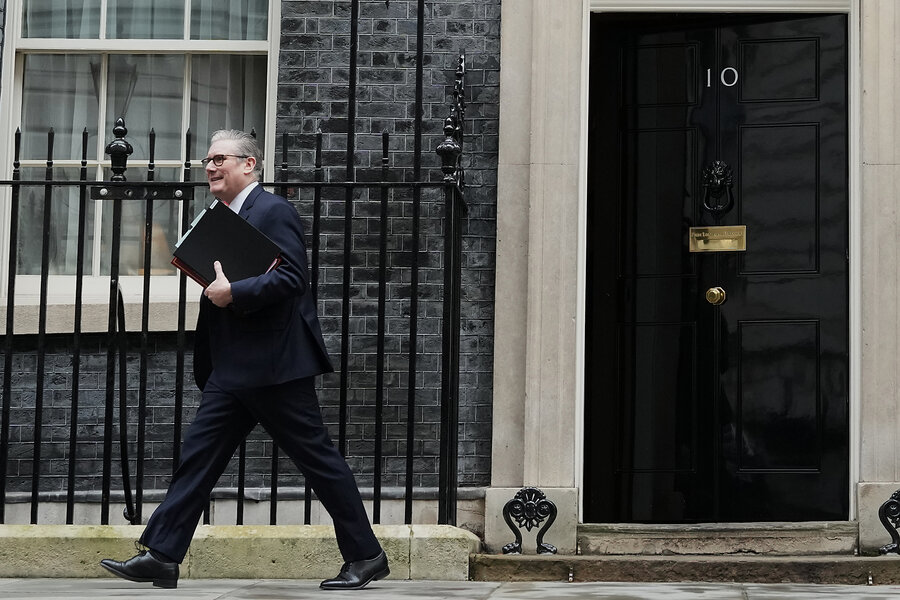
The shadow of Jeffrey Epstein looms large over British Prime Minister Keir Starmer.
Unlike President Donald Trump, Mr. Starmer never met the American financier and sex trafficker. Nor is he named in the Epstein files, the documents on Mr. Epstein’s crimes released by the U.S. Department of Justice.
Yet while Mr. Trump has faced only a muted public reaction to the files’ contents, in the U.K., Mr. Starmer’s political standing has been deeply shaken and his grip on power hangs by a thread. And he is just one of several British political figures under threat of being brought low – or perhaps brought lower – by the Epstein files’ revelations.
Why We Wrote This
Why has being named in the Epstein files had so little political effect upon American politicians and power brokers, particularly in the Trump administration, while in the United Kingdom, it’s been a government-shaking scandal? It may come down to public mood.
For many in the U.S., the difference between British and American responses to the scandal is striking. British experts say it is a result not so much of cultural factors as it is a byproduct of the the weaknesses and the strengths of Britain’s government – and it hints at how different societies have reacted to disappearing trust in democracy.

Peter Mandelson, Britain’s then-ambassador to the United States, talks with Mr. Starmer during a welcome reception at the ambassador’s residence in Washington, Feb. 26, 2025.
Unpopularity and incompetence
Two key British figures have so far emerged from the depths of the Epstein files: British politician Peter Mandelson, appointed the U.K.’s ambassador to Washington by Mr. Starmer in 2024, and Andrew Mountbatten-Windsor, previously known as Prince Andrew before his royal title was stripped. Both are deeply unpopular in Britain.
“You couldn’t go to a laboratory and invent someone more likely to antagonize a voter [than Mr. Mandelson],” says Martin Farr, a senior lecturer in contemporary British history at Newcastle University. The politician – who has already been forced to resign from major political positions twice due to other, unrelated scandals – has long positioned himself as the Labour Party’s shadowy behind-the-scenes strategist and master of the political “dark arts.” “He appears to embody so much of the distant, lanyard-wearing elitist classes,” says Dr. Farr.
Mr. Mountbatten-Windsor was first linked to Mr. Epstein in 2010, when Virginia Giuffre alleged that Mr. Epstein had flown her to the U.K. at age 17 to have sex with the then-prince. As more allegations have come to light – most recently that he shared confidential reports with Mr. Epstein while acting as an envoy for international trade – he has been stripped of his royal privileges, including the 30-room mansion where he lived close to Windsor Castle.
In a statement on Feb. 9, Buckingham Palace said that King Charles III was ready to “support” police in investigating the claims against Mr. Mountbatten-Windsor. It neatly summed up the prospects facing both Mr. Mandelson and the former royal. No one would be rushing to their defense.

Kirsty Wigglesworth/AP/File
Andrew Mountbatten-Windsor, formerly known as Prince Andrew, leaves an Easter service at St. George’s Chapel, Windsor Castle, England, April 20, 2025.
It is Mr. Mandelson who has made the current British government, which is also unpopular, vulnerable to the fallout of the Epstein files.
Mr. Starmer has faced blistering criticism for his decision to appoint Mr. Mandelson as the ambassador to the United States, even though Mr. Mandelson remained in touch with Mr. Epstein long after he had been jailed for sexually abusing a child in 2008. That choice alone – as well as more recent accusations that Mr. Mandelson passed sensitive government information on to Mr. Epstein – has been enough to prompt the resignation of several top insiders from Mr. Starmer’s office, including his chief of staff.
While his cabinet has rallied around him, others have called for his resignation. In front of a press conference in Glasgow, Scottish Labour leader Anas Sarwar urged Mr. Starmer to step down. “The people of this great country, Scotland, are crying out for competent government, for transparency, for honesty, and for delivery,” he said.
In a YouGov survey from Feb. 2, 60% respondents described Mr. Starmer as “incompetent,” while 46% said they viewed him “unfavorably.”
Mr. Starmer, however, isn’t alone in being disliked by the British public. Kemi Badenoch, leader of the opposing Conservative Party, is viewed unfavorably by 50% of the public, according to YouGov polling. Nigel Farage, the leader of the right-wing Reform UK, has more passionate supporters – but also more similarly passionate critics. Some 64% of the public see him unfavorably, YouGov says.
Frustration with politics has spiked in the U.K. in recent years, as trust in institutions has eroded. This has manifested not in the rise of any popular front or figure like Mr. Trump or his Make America Great Again movement, but rather, in widespread discontent. As a result, revelations like those in the Epstein files are not likely to be blunted by partisan loyalties or preconceived views as they may have been in the U.S.
“The public’s view on politics right now is: ‘We don’t particularly like any of you,’” says Tom Caygill, senior lecturer in politics at the U.K’s Nottingham Trent University. “For it to be polarized, there has to be a very concrete movement, a huge separation of people saying [to a certain party], ‘Yes, I absolutely back you to the hilt.’”

Police search one of Peter Mandelson’s homes as part of a probe into potential misconduct stemming from his ties to the late Jeffrey Epstein, in Wiltshire, England, Feb. 6, 2026,
First among equals
While Mr. Starmer’s tenure may be wobbling, the British political system has also shown itself to be more robust. The prime minister has come under intense pressure precisely because the British parliamentary system is designed to question him directly. Each week, the British leader appears in front of the U.K.’s lower house of Parliament to answer questions from opposition figures at the famously rowdy Prime Minister’s Questions.
“Americans don’t quite know the extent to which our head of government gets shouted at for half an hour a week. Our government is subject to scrutiny in a way that the [American] president never is,” says Dr. Farr.
It’s also far easier to depose a prime minister than it is a sitting president. While the U.S. Congress and president are elected separately and have separate mandates, the prime minister is in office only by virtue of being the leader of the largest party in Parliament, making them simply the “first among equals.” Elected parties can simply swap leaders – without the need to hold a general election.
If a prime minister’s judgement is seen as damaging to the party, then Parliament has even greater incentive to remove them. With an issue such as the Epstein files – and the government failures that allowed those close to Mr. Epstein to continue in positions of power without consequence – such damage is hard to escape.
“I think the British press and the British public have a particular perspective and view on consorting with pedophiles,” says Dr. Caygill. “I don’t think it matters who the individual was. I think they would be under the same level of pressure: just the general disgust.”