
Thousands of Americans in Georgia have been warned to stay inside as the local air quality has reached life-threatening levels Friday morning.
According to US Environmental Protection Agency, pollutants within a 40-mile radius of Albany, Georgia reached ‘very unhealthy’ levels, the EPA’s second-highest alert status.
Live data captured sharply elevated levels of PM2.5, microscopic particles composed of toxic compounds or heavy metals that are small enough to damage the lungs, exacerbate respiratory issues such as asthma, and even contribute to premature death.
Air quality-tracking website IQAir received reports from Albany of the Air Quality Index (AQI) reaching 239, which would rival some of the worst breathing conditions for any major city in the world, surpassed only by Cairo, Egypt.
Air quality levels are measured on a scale from 0 to 500: good (0–50) carries little risk, moderate (51–100) may affect sensitive individuals, unhealthy for sensitive groups (101–150) poses increased risk and unhealthy (151–200) impacts everyone, limiting outdoor activity.
At levels at or above 200, the air around Albany registered as so polluted that health officials have warned prolonged exposure could also contribute to cancer, stroke, and heart attacks. Residents are advised to avoid outdoor exercise and use a face covering when going outside.
The skyrocketing PM2.5 levels have been linked to recent wildfire smoke, which exacerbates a condition called stagnant air, where little to no wind and high atmospheric pressure trap pollution near ground level.
The National Weather Service has issued a major fire danger warning throughout most of North and Central Georgia, with winds currently moving south into the area around Albany.
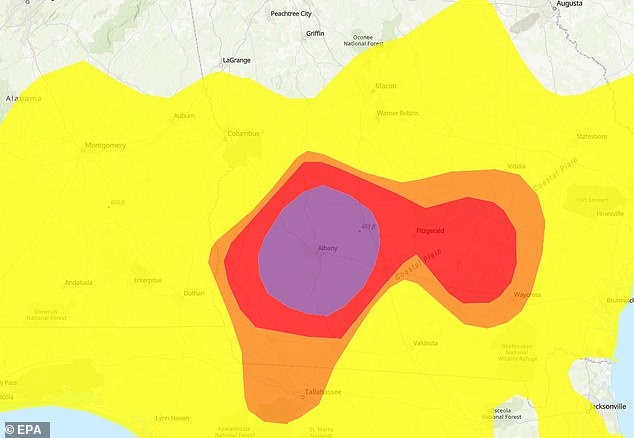
Air quality readings in Southern Georgia have reached ‘very unhealthy’ levels Friday (Pictured in purple), triggering warnings to stay indoors
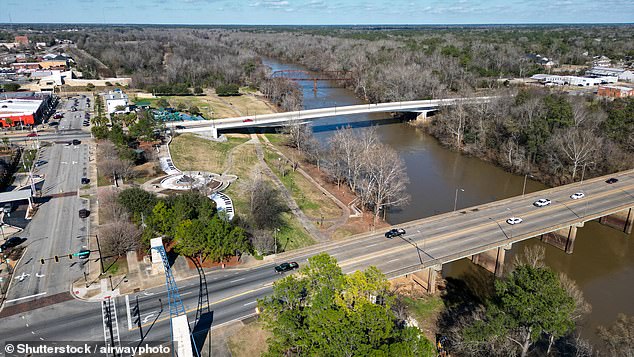
Albany, Georgia (Pictured) has a population of approximately 66,000 people. The air quality alert stretches over a 40-mile radius from the city
An even larger swath of Southern Georgia was reported by the EPA as falling into the ‘unhealthy’ category Friday morning, stretching roughly 150 miles across the state, from the state’s border with Alabama to Georgia’s Coastal Plain.
IQAir has reported multiple crop fires north of the zone hovering over Georgia, specifically in Adrian, Archery, and Millen, with winds pointed south towards the areas with AQI scores exceeding 150 Friday morning.
To understand the impact of stagnant air on nearby wildfire smoke, it is helpful to look at atmospheric pressure. Pressure is measured in millibars, with normal sea-level pressure being 1,013 millibars.
Anything between 1,015 and 1,020 millibars is considered a high-pressure system, with strong pressure exceeding 1,030 millibars, especially in the winter.
Albany’s air pressure was recorded surpassing 1,022 millibars when the worst AQI scores were seen, causing sinking air from above to warm and compress as it descends.
Stagnant air means the air around you is barely moving, like it’s stuck under a lid, so pollution, fire smoke, car fumes, and other particles can’t blow away or mix higher up in the atmosphere, causing them to build up near the ground where we breathe.
Albany sits at the center of the hazardous zone, and the city has been a hotspot for poor health in the past.
In April 2020, the city became one of the worst places per capita for Covid-19 infections, with the fourth worst infection rate in the US.

Albany, Georgia (Pictured in 2020) sits just south on the National Weather Service’s fire danger warning on Friday, February 13
The National Weather Service (NWS) has warned that any fires which develop throughout the region on Friday could spread extremely fast due to low humidity and dry vegetation across the state.
NWS officials urged residents against any kind of burning while the conditions remain dangerous, which forecasters project will be until 7pm ET.
At the peak of the air quality alert, pollution readings in Albany showed that PM2.5 levels were over 32 times higher than the World Health Organization recommended safe limits.
As of 10.30am, the EPA has also listed a large area surrounding Hattiesburg, Mississippi as having ‘unhealthy’ levels of PM2.5 filling the air.
In Chattahoochee, Florida, just 80 miles south of Albany, air quality readings have reached the 170s, according to IQAir.