
This article is an on-site version of our Moral Money newsletter. Premium subscribers can sign up here to get the newsletter delivered twice a week. Standard subscribers can upgrade to Premium here, or explore all FT newsletters.
Visit our Moral Money hub for all the latest ESG news, opinion and analysis from around the FT
Welcome back. Yesterday brought a major development in the Trump administration’s push against green rules, as the US president announced the repeal of a 2009 ruling that had empowered the Environmental Protection Agency to regulate greenhouse gases. The FT news story is here.
Across the Atlantic, the centrepiece of the EU’s climate strategy — its 21-year-old emissions trading scheme — is also coming under fire. The implications go far beyond Europe, as I explain below.
CARBON MARKETSDecision time for Europe’s carbon pricing regime
Business leaders aren’t usually pleased when comments from a political leader send a market crashing. This week brought an exception to that rule.
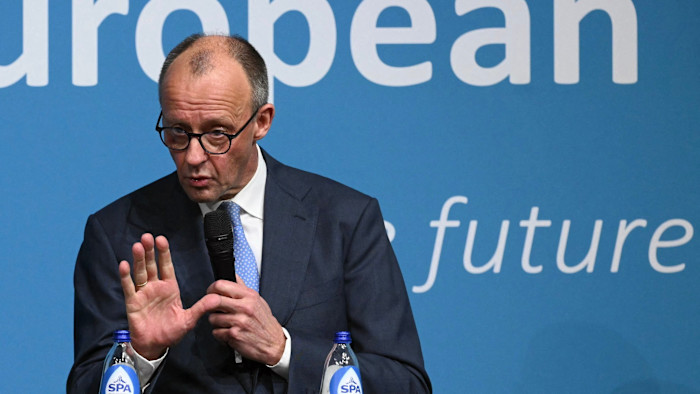
Yesterday the carbon price in the EU’s emissions trading system (ETS) slumped nearly 8 per cent, following remarks by German Chancellor Friedrich Merz about a potential relaxation of the framework, which covers major industries from steel to aviation.
The system was intended not merely to cut emissions but to support companies’ transition to carbon-free operations, Merz said. “If this is not achievable, and if this is not the right instrument, we should be very open to revising it, or at least to postpone it,” he said on Wednesday.
 Merz addressing business leaders in Antwerp on Wednesday © AFP via Getty Images
His words got a warm reception from his audience: hundreds of representatives of European industry gathered at a major conference in the Belgian city of Antwerp, where the ETS was high on the agenda. While the system has been in place since 2005, it long provided generous allocations of free allowances that meant most of the companies covered didn’t face meaningful costs (indeed, some reaped tidy profits from selling their extra permits).
But now those free allowances are being phased out — and the ETS has emerged as a major target of corporate lobbying, at a time of severe concern about European industry’s broader competitiveness. Companies at Wednesday’s event issued a joint statement urging European leaders to “bring energy and carbon costs down”, complaining that “carbon costs are unique to Europe”.
This is not true: there are now 80 emissions trading systems and carbon taxes around the world, covering around 28 per cent of global emissions, according to the latest estimates from the World Bank. But in the vast majority of these other schemes, prices are far lower than in the European system. Even after Thursday’s price fall, EU carbon permits were trading at €72.80 ($86.37) per tonne — compared with Rmb80 ($11.59) in China’s carbon market.
The EU’s answer to this is the Carbon Border Adjustment Mechanism (CBAM), which is meant to level the playing field by imposing a carbon levy on imports. The CBAM is being introduced through a gradual phase-in that began at the start of this year, timed to go alongside the phase-out of free allowances for EU companies.
 Economist William Nordhaus has argued for the potential of international carbon pricing to lower emissions © YALE UNIVERSITY/HANDOUT HANDOUT/EPA-EFE/REX/Shutterstock
Brussels’ hope is that, as well as protecting European industry from unfair competition, this could catalyse carbon pricing around the world — putting into practice a concept long promoted by economists such as William Nordhaus as a potent weapon for global climate action.
Because any carbon price paid in the country of production can be deducted from the CBAM import levy, other countries have an incentive to introduce and strengthen their own carbon pricing systems, and collect revenue themselves rather than let Europe take it at the border.
There have been early signs that this dynamic is starting to play out, with countries from Brazil to Turkey introducing carbon pricing systems, and China expanding the scope of its scheme. But a significant weakening of the EU’s ETS could undermine that momentum.
Market movements suggest that traders are betting on just such a weakening. Yesterday’s fall brings the total permit price decline to 16.7 per cent since the start of this year.
The European Commission had already committed to undertake a review of the ETS this summer, as part of a landmark EU agreement in December on a legally binding target of reducing carbon emissions by 90 per cent from 1990 levels by 2040. Climate commissioner Wopke Hoekstra this week sought to quash speculation that this review would lead to a gutting of the ETS, attacking “intellectually lazy” criticism of the scheme.
 Wopke Hoekstra in Antwerp on Wednesday © AFP via Getty Images
It’s true that carbon pricing is a smaller driver of Europe’s industrial struggles than the continent’s energy prices, which are far higher than in the US and China (after controlling for carbon costs). Researchers at Dutch bank ABN Amro found that the ETS’s impact on profits would be no greater than the low single digits per cent for most companies covered over the next five years (though with a significantly higher impact in the aviation sector). But at a time when Europe is in a protracted panic over its economic competitiveness, any sort of burden for business risks becoming politically toxic.
The obvious question for this year’s review is whether and to what extent the Commission moves to slow down the phaseout of the free allowances (this may be what Merz meant by his suggestion of “postponement”).
But the EU has another lever to pull, if it wants to support its industry without undermining its chances of hitting the 2040 climate goal it has only just set. In Antwerp on Wednesday, European Commission president Ursula von der Leyen signalled a new focus on using ETS revenues to support green investment by companies.
“These resources come from the industry and they must be reinvested in the industry itself,” she said, noting that EU member states have been putting less than 5 per cent of their ETS revenues towards industrial decarbonisation.
Rather than removing the stick, in short, von der Leyen wants to offer businesses a bigger carrot to go with it. Yesterday she repeated this argument to EU national leaders gathered for an “informal retreat” at a Belgian castle. The prospects for carbon pricing to play a big role in tackling climate change — globally, as well as in Europe — depend in large part on whether she can persuade them.
Smart readsRecommended newsletters for you
The Climate Graphic: Explained — Understanding the most important climate data of the week. Sign up here
The AI Shift — John Burn-Murdoch and Sarah O’Connor dive into how AI is transforming the world of work. Sign up here