
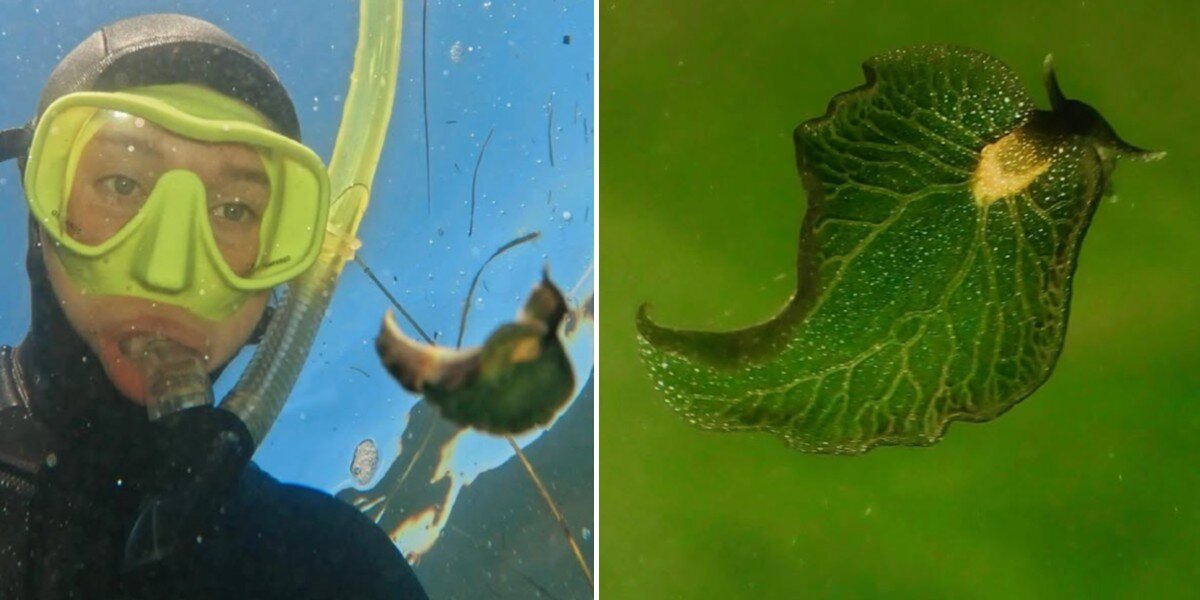
Jill Taylor, a puffin researcher based in Nova Scotia, Canada, spends many of her days snorkeling in the North Atlantic Ocean. As a result, she’s pretty familiar with the animals who live in those frigid coastal waters.
But the other day, Taylor’s friend Elli, another avid snorkeler, told her she’d come across some slugs during her swim whom Taylor had never heard of before. The slugs, called eastern emerald elysia, are native to the Atlantic coastline and are known for their stunning green coloring.
 Jill Taylor
Taylor was shocked to learn that eastern emerald elysia are one of the few animals in the world with the ability to photosynthesize.
Photosynthesis is the biological process through which plants and algae transform light into energy that helps them stay alive and grow. Plants and algae have a special part of their cells called a chloroplast that helps them process sunlight. When eastern emerald elysia eat algae, they absorb their chloroplasts and their photosynthesizing abilities.
“They actually steal the chloroplasts from the algae,” Taylor told The Dodo. “And with these chloroplasts, they incorporate it into their own cells, which allows them to photosynthesize.”
 Jill Taylor
Taylor knew she had to see these unique animals for herself. So last November, she set out on a snorkeling trip and dove without hesitation into the 37-degree Fahrenheit water.
As she was swimming, she came across a greenish-brown speck floating in the water. At first, she didn’t think much of it.
 Jill Taylor
“It kind of just looked like a piece of leaf or like a piece of debris,” Taylor said. “I almost swam right past it.”
 Jill Taylor
But Taylor quickly realized that the “leaf” she’d seen was actually an eastern emerald elysia. As she kept snorkeling, she came across a patch of bright green algae — covered in hundreds of the slugs.
The first eastern emerald elysia she’d spotted had been curled up, but these slugs were unfurled, revealing their remarkably leaf-like backs. She marveled at their almost neon green coloring, which comes from the chloroplasts they absorb.
“It literally looks like a leaf — and not just any leaf, but this bright green, absolutely gorgeous leaf,” Taylor said. “It looks like some kind of cool alien or something a child would have drawn.”
 Jill Taylor
Taylor couldn’t believe she got to see the unique, solar-powered animals with her own two eyes. She watched them feast on the algae and float around for a while before returning to shore, still feeling exhilarated.
“It was a very exciting day in the water, that’s for sure,” Taylor said.
