
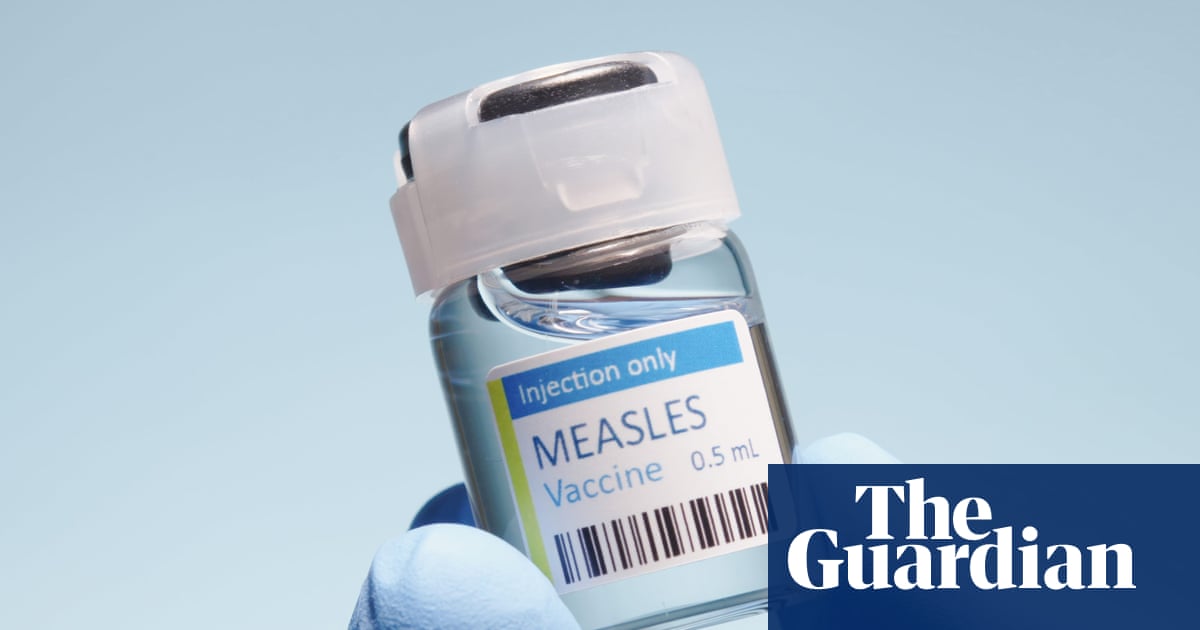
More than 60 children have been infected by a measles outbreak in north London, it has been reported.
Seven schools and a nursery in Enfield reported the cases, with some children treated in hospital, according to the Sunday Times.
There are concerns the outbreak is linked to low levels of MMR vaccination in the capital. For every one infected person, measles can spread to up to 18 unvaccinated people.
Dudu Sher-Arami, Enfield’s director of public health who is writing to every parent in the area, said the outbreak posed a serious threat to the wider capital and there was the potential to cause a “much greater and bigger pan-London outbreak” because residents travel across the city.
She told the Sunday Times London has “one of the lowest, if not the lowest, vaccination uptake rates” in the country.
Sher-Arami said: “It is possible for it to grow. We know that measles has got some very nasty complications. It can cause deafness. It can cause brain damage and one in five children can need hospital treatment.”
Temporary vaccination clinics are being held in schools and throughout Enfield, an area in which more than a fifth of children are not inoculated against measles, mumps or rubella by the age of five.
A government campaign promoting childhood vaccination is expected to be launched next week with adverts on social media, YouTube and radio to counter vaccine scepticism. Measles usually starts with cold-like symptoms followed by a rash a few days later, according to the NHS. Some people may also get small spots in their mouths.
Last month, the World Health Organization (WHO) declared the UK is no longer considered to have eliminated measles, as transmission was re-established in 2024.
It comes after a plateau in vaccination coverage and a surge in cases, with 3,681 cases recorded in the UK in 2024.
From 2021 to 2023, the UK was considered to have “eliminated” the disease.
WHO recommends at least 95% of children should receive vaccine doses for each illness to achieve herd immunity.
According to UK Health Security Agency figures 91.9% of five-year-olds had received one dose of the MMR (measles, mumps and rubella) vaccine in 2024-25, unchanged from 2023-24 and the lowest level since 2010-11.
The data also showed 83.7% of five-year-olds had received both MMR doses, the lowest level since 2009-10.