
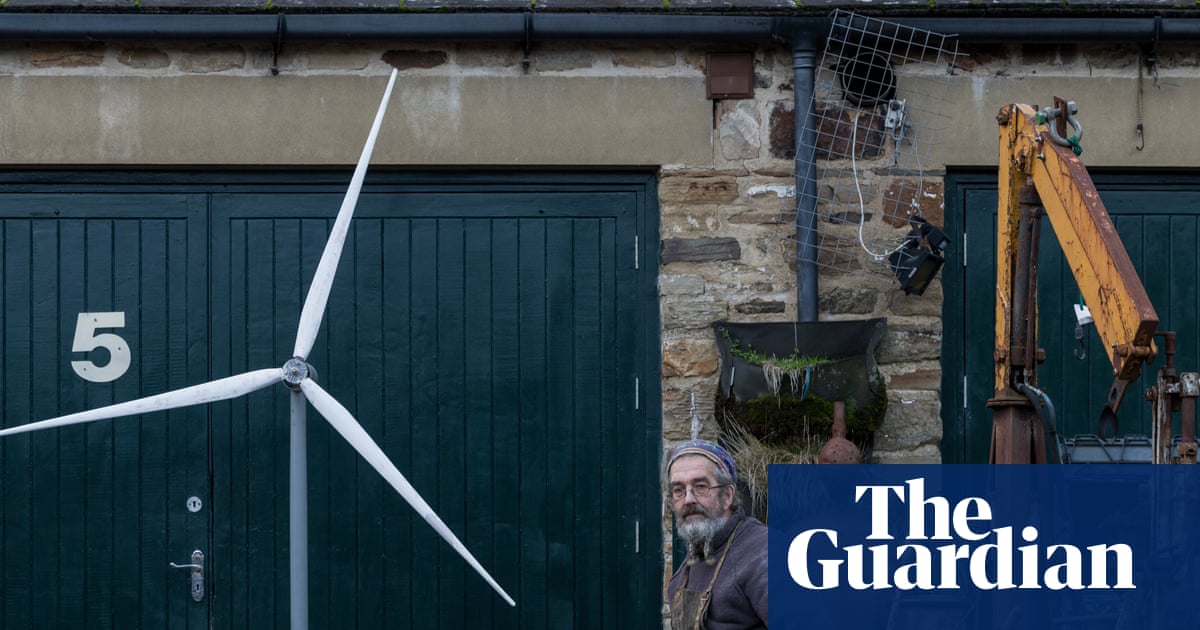
Instead of a slingshot, the Davids are brandishing a sculpture and a coffee table book. Their Goliaths are a Norwegian energy company and a UK energy secretary with renewable targets to meet.
A fierce battle has begun over one of England’s tallest windfarms, proposed for deep peat moorland overlooking the Yorkshire Dales national park, in what residents say will mark the irrevocable industrialisation of their rural landscape.
A local sculptor has constructed a scale model of one of Hope Moor windfarm’s 20 turbines, whose blade tips will reach 200m – as high as the “skyscraper” in Deansgate, Manchester, which is the tallest building outside London.
“It’s all very well talking about 200m but it’s hard to visualise it,” said Michael Kusz, who lives in Reeth, North Yorkshire. He has based his model on the model railway 00 gauge; a model person at this scale is 22mm tall.
“I’m absolutely horrified,” he said of the proposed windfarm, which would power 81,000 homes and constitutes a key part of the Labour government’s renewable energy targets and planning revolution. “I’ve been on walks where you can have a 360-degree view with nothing man-made and it brings a profound depth of relaxation I’ve never experienced before. There are so few places in Britain where you can connect to the natural world in its own state.”
The battle over Hope Moor is set to be repeated across the country as the government’s unprecedented drive to generate 95% of electricity from low-carbon sources by 2030 clashes with local people’s fears for wildlife, landscape and countryside.
This week, the UK’s energy secretary, Ed Miliband, announced contracts for 157 new solar farms, 28 new onshore windfarms, eight offshore windfarms and three tidal projects. Together with other offshore windfarms announced in January, they will generate enough clean power to supply 16m homes.
Labour lifted the “ban” on onshore windfarms in 2024. Among the onshore projects approved this week is Imerys in Cornwall – the largest onshore windfarm in England for a decade at 20MW. But that will be dwarfed by 100MW Hope Moor.
In the pretty village of Barningham, County Durham, on the other side of Hope Moor, rebellion is coalescing around a coffee table book produced by Sir Anthony Milbank, the bird-loving former owner of one of two large moorland estates where the windfarm is proposed.
The book describes the bountiful wildlife – from breeding curlew and nightjars to rare black grouse and hen harriers – found on the moor and was published in tribute to Sir Anthony, who died in 2016. His son, Sir Edward Milbank, is one of the two landowners who will profit from the windfarm planned by Fred. Olsen Renewables.
Suzy and Tim Wilson moved from Warwickshire three years ago, convinced that Barningham, where Suzy grew up, and its surrounding moorland wildlife was in safe hands next to the national park and the North Pennines National Landscape.
Campaigner Suzy Wilson. Photograph: Gary Calton/The Guardian
“We live here because of this – it’s priceless. It’s paradise. It’s heaven,” said Suzy Wilson on a walk across the moor, where we saw rare black grouse and heard endangered curlew calling. “We want to share it with people. There’s a carpet of sphagnum moss. In the spring, it’s heaven – all the curlew and oystercatchers, and the grouse are doing their little dance.”
The moorland where the windfarm is proposed is outside protected national parks but much of it is designated by Natural England as blanket bog, a priority habitat for conservation, with extensive areas of “deep peat”, classified as deeper than 30cm.
Locals question the logic of damaging this carbon sink with large concrete turbine bases and access roads in the quest to reduce carbon emissions. “It’s a complete joke,” said Simon Thompson, who has lived in the moor-edge village of Newsham since he was 11 and now owns a caravan park. “The fact they are digging up peat to save carbon emissions is ridiculous. The size is ridiculous. The location next to the Yorkshire Dales national park is ridiculous. It just doesn’t make sense.”
Local campaigner Simon Thompson. Photograph: Gary Calton/The Guardian
An application for 54m-high turbines on the same moorland was rejected in the high court in 1999 when the judge supported the planning inspector who concluded that the “special character” of this area of “high landscape value” would “be seriously harmed”.
But to speed up renewable projects, schemes such as 100MW Hope Moor are designated a “nationally significant infrastructure project” (NSIP), meaning that the planning decision is not made by local councils but by the national Planning Inspectorate – with Miliband having the final say.
While onshore turbines once reached 100m in height, newer more efficient turbines currently in planning are closer to 200m. “Turbines of this scale are becoming increasingly typical for new schemes and it is unlikely that the proposed turbines would be among the tallest onshore turbines by the time they are constructed,” said a Hope Moor windfarm spokesperson.
Locals Chris Thurgar-Dawson and Christine Gonsalves are both Labour voters. “It’s easy to say: ‘It’s green, full-stop’. We’re not against green energy and our friends who are Tory supporters agree with green energy, but when we heard about the scale of it – it’s off the scale,” said Gonsalves. “It’s the scale and where it’s being built that’s the problem.”
According to Hope Moor, the turbines will deliver £500,000 to the local community each year for 30 years.
“It’s as if everybody is motivated by money,” said Gonsalves. “The people who live here aren’t necessarily motivated by money. They are motivated by nature and the countryside.”
Opponents of the scheme, who have formed an action group and plan to tour their region with the model turbine, insist they are not nimbys. “Of all the people we’ve spoken to, only one has mentioned the impact on house prices,” said Tim Wilson.
Instead, local concerns include the new access roads required, the pylon and cable routes to connect into the grid, the impact on “pristine” water supplies, and noise and flicker from the turbines.
Local Steve Myers, an academic researcher, has conducted a sightlines analysis that concludes the turbines will be widely visible from the Yorkshire Dales and even the Lake District in clear weather. Hope Moor said: “These factors will be assessed comprehensively through a detailed, robust, evidence‑led environmental impact assessment (EIA), which will be presented at future stages of public consultation, alongside how potential impacts will be minimised.”
But Myers also fears the “scoping” – deciding what will be examined by the environmental impact assessment – will be determined before the community can give its view.
“We will hold two stages of public consultation later this year to gather local views and feedback, which will help shape the project and inform the environmental assessments,” said the Hope Moor spokesperson, who pointed out that scoping is administered by the Planning Inspectorate, not the developer. “There will be many opportunities for the public to have their say on their proposals and nothing at this point in the project is fixed.”
Kelly Wyness, senior project manager for Hope Moor, added: “Hope Moor windfarm is a proposal to strengthen energy security by delivering home‑grown renewable power. It will provide long‑term investment in the land and the traditional practices that have shaped this landscape for generations.
“At a time when rural skills and land‑management traditions are under increasing pressure, the project offers a modern, balanced approach – combining renewable energy generation with the active stewardship of the moors. Alongside clean energy, Hope Moor aims to support established farming and moorland management practices, sustain traditional skills, and enhance habitat restoration.”
For locals, the prospect looming over their working landscape is already spoiling their enjoyment of it. Simon Thompson said he used to walk on the moors to clear his head but hasn’t done so since the windfarm was proposed. “I’ve been walking up there for years, among the buzzards and hares. But my mind is no longer clear when I go up there, it’s just focused on this all the time.”