
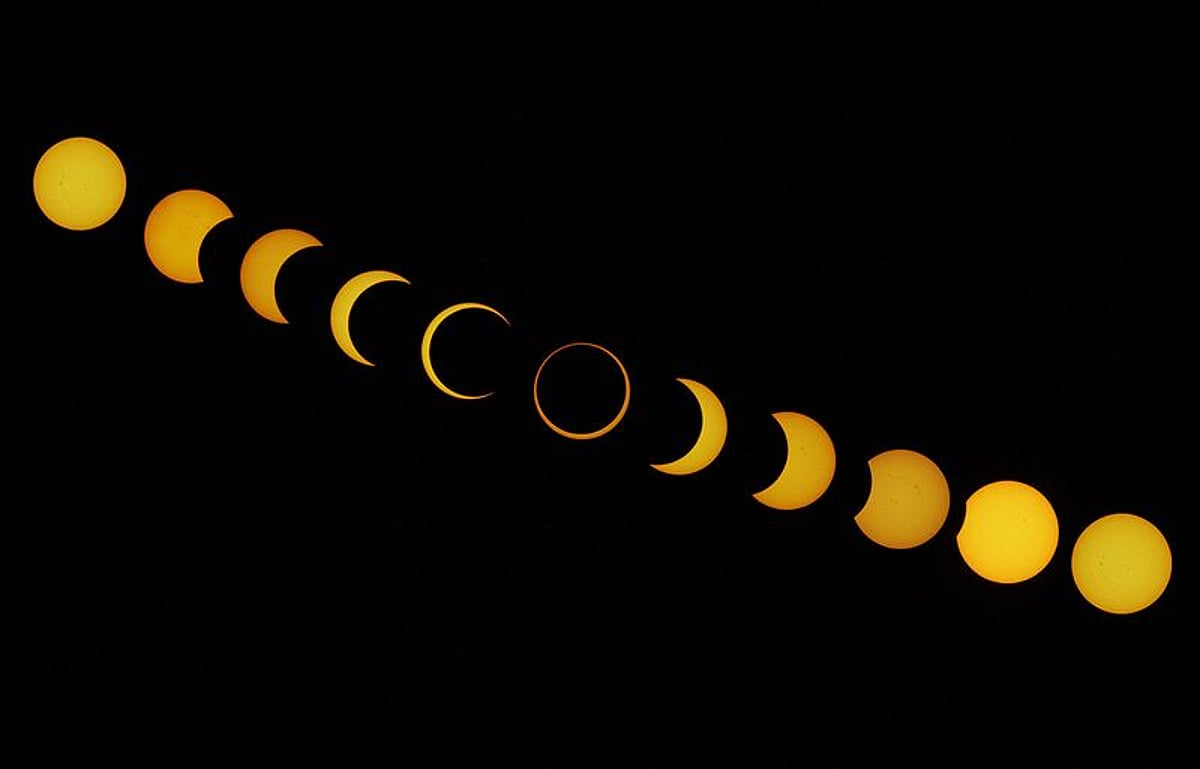
The new moon causing this eclipse also marks key lunar calendar events: it ushers in the Chinese New Year of the Fire Horse and, with the crescent expected to appear on Feb. 18, signals the start of Ramadan for Muslims in the UAE and around the world.
What is an annular solar eclipse?
A solar eclipse happens when the Moon aligns precisely between the Earth and the Sun during a new moon. In a total eclipse, the Sun is fully obscured, but in an annular eclipse, the Moon is slightly smaller than the Sun, creating the famous “Ring of Fire”.
As per NASA, this eclipse will block around 96% of the Sun’s centre, leaving a glowing edge. Later in 2026, a total solar eclipse will occur over parts of Greenland, Iceland, and northern Spain, coinciding with the peak of the annual Perseid meteor shower.
Will it be visible from the UAE?
The February 17 annular eclipse will not be visible from the UAE. The full “Ring of Fire” will only appear in a remote region of Antarctica, where just a few research stations and observers will be able to witness it.
Residents in the UAE, along with most of the northern hemisphere, will not see any part of this eclipse, as the Sun will remain below the horizon during the event.
A partial solar eclipse will be visible from southern Africa and parts of South America, while future eclipses in 2026—including the total solar eclipse on August 12—will be visible closer to the UAE, from Europe and Greenland.
Key facts about the Feb. 17 eclipse
An annular solar eclipse occurs when the Moon is too far from Earth to cover the Sun completely, leaving a brilliant “Ring of Fire”.
Partial phases will be visible just after sunrise from southern Chile, Argentina, and parts of South Africa.
The eclipse begins at 07:01 UTC, with maximum eclipse visible in Antarctica.
Safety: Only view the Sun using eclipse glasses or certified solar filters, even during the annular phase.
Cultural significance: This new moon marks the Chinese New Year of the Fire Horse and, with the crescent moon expected to appear on Feb. 18, the start of Ramadan.
Where will it be visible?
The full annular eclipse will be visible only from a remote Antarctic region, including research stations like Concordia and Mirnyy. Observers elsewhere in Antarctica, the Southern Ocean, southern Africa, and parts of South America may see a partial eclipse.
“It’s possible that only a few people will view this eclipse from within the annular zone. It’s a challenge to reach, and there are only two inhabited locations within the shadow,” said eclipse meteorologist Jay Anderson.
How to witness the eclipse
Due to its extreme remoteness, few people will see the annular eclipse in person. Options include:
Research stations in Antarctica (limited access)
Cruises or flights intercepting the eclipse track from southern Australia
Partial viewing from southern Africa or sub-Antarctic waters
The eclipse path stretches 2,661 miles (4,282 km) long and 383 miles (616 km) wide, crossing mainland Antarctica and ending off the Davis Sea coast. The antumbral shadow producing the “Ring of Fire” will take around 59 minutes to cross Earth, from 11:42 to 12:41 UTC.