
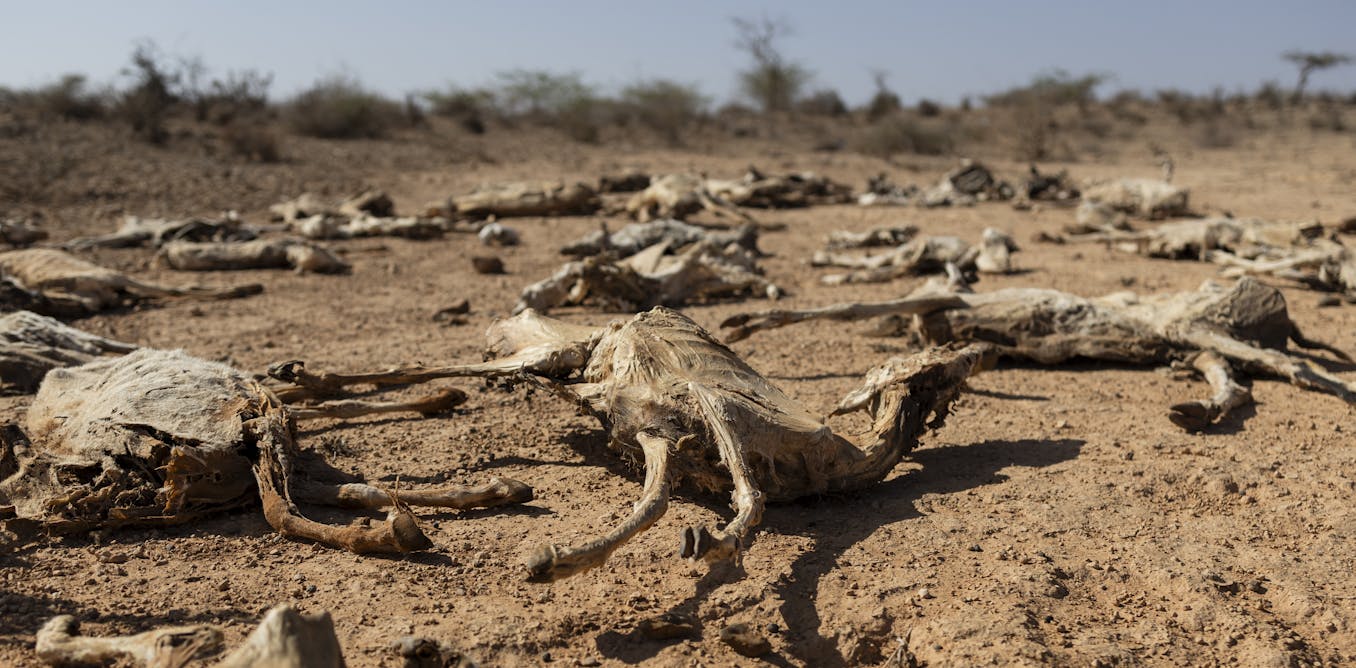
More than 295 million people globally experienced hunger and starvation in 2025 because of conflict, displacement, climate change and economic disasters.
The bad news is that things are going to get a lot worse. My latest research has found that by 2100, climate change could drive more than a billion people into food crises. This figure represents the total number of human beings alive today, as well as those yet to be born, who will experience at least one episode of severe food insecurity before the end of the century.
Read more:
Malawi faces a food crisis: why plans to avert hunger aren’t realistic and what can be done
I’m a quantitative ecologist – I study nature using data and computer models to understand how the environment and people respond to big pressures like climate change, pollution and land-use change.
I developed an artificial intelligence (AI) model to predict how climate change alone could spark severe food crises. The model was calibrated using food insecurity data from the Famine Early Warnings Systems Network. It also used past and future temperature and precipitation data which was available for large regions of the world. Usually, predictions also rely on detailed socio-economic data (like incomes, prices, policies, or household behaviour), which is not always available and which is also difficult to forecast decades ahead.
The model found that, if the world continues to emit a high level of greenhouse gas emissions, over 1.1 billion people globally, including more than 600 million children, will have been exposed to at least one severe food crisis by 2100.
Africa is expected to bear a heavy toll, with more than 170 million people predicted to be exposed to food crises – the worst of which would be starvation – in 2099 alone – a number equivalent to the current combined population of Italy, France, and Spain.
In contrast, if the world’s industry drastically cuts carbon emissions, with societies transitioning towards sustainability, this would more than halve the exposure. This highlights how policy choices determine whether hundreds of millions face crises or far fewer are affected.
Predicting food crises from climate information
To develop the model, I used monthly temperature data from a US agency, the National Oceanic and Atmospheric Administration, and monthly precipitation data from the Climate Hazards Centre at the University of California. I then combined this information with the economic and demographic projections for each country to work out how humans would be exposed to food crises
My research found that the number of human beings exposed to severe food insecurity is growing at an alarming pace. It nearly tripled from 50 million in 2011 to almost 150 million by 2020.
By 2100, the cumulative toll of climate change could be dramatic. More than 1.16 billion people will be exposed to at least one famine crisis. This is largely because many regions where climate impacts are expected to intensify (such as central Africa) also exhibit the strongest demographic momentum. This means that the burden of future hunger is likely to fall disproportionately on younger populations by 2100.
My study found that more than 600 million children can be expected to experience their first food crisis before turning five. More than 200 million newborns will be at risk within their first year.
The model, however, also showed that 780 million of human beings could be spared from food crises by 2100 if the planet shifted to sustainable development (development that does not destroy the environment or cause climate change) instead of heading towards inequality and conflict.
In fact, the AI model identified that the number of people experiencing food crises every year might drop by more than a half (from a yearly average of 89M in 2005-2015 to 42M in 2090-2100) if governments began, aggressively, to stop burning fossil fuels and expand green energy.
How Africa will be affected
The model predicted that most future crises will occur in already vulnerable regions, especially Africa and Asia. In Africa, food crises are projected to happen over a much wider area. The most critical hotspots will be in the Horn of Africa and parts of the Sahel.
These regions will form massive, neighbouring areas of high exposure across several million square kilometres of eastern and central Africa.
Read more:
To what extent does climate change affect food insecurity? What we found in Lesotho
There is some good news for Africa though. The model shows that if Africa reduces conflicts and cuts fossil fuel burning, exposure to food crises will drop rapidly after 2050.
This means that Africa has a much larger margin than Asia for reducing food insecurity by steering development towards mitigation and sustainability.
What needs to happen next
Climate change generates food-security risk, but policy choices determine whether the risk translates into a crisis, and how big the crisis becomes. Hundreds of millions of people can be spared from hunger if global policies promote decarbonisation and sustainable development.
This also means that if global industries and government fail to do that – and opt for inaction instead, or continue to mismanage the climate crisis – the consequences could be catastrophic.
Read more:
How climate change contributed to Madagascar’s food crisis
It’s important to remember that food security can’t happen just by growing more food. Societies can only be sure that everyone has enough food to eat if their food systems are set up so that they don’t fail during floods, drought or other climate crises, and if everyone in society is involved in some way in growing food.
Climate change will challenge all communities, but a coordinated global effort for equity, peace and adaptation can give societies the ability to respond. Yet the projections show we are running out of time, leaving us with an urgent responsibility to act now and provide tomorrow’s children with the food security they have a right to.