
Ocean plastic pollution is one of the greatest environmental challenges facing our planet today. The vastness of the oceans, combined with the complex nature of marine debris, makes it difficult to monitor and address effectively. However, recent advancements in remote sensing technology, specifically through the use of satellite-based sensors, are beginning to offer promising solutions. A study published in Earth System Science Data introduces a breakthrough database known as the Marine Debris hyperspectral reference Library collection (MADLib), which enhances the detection of ocean plastic by using light patterns. This study marks a significant step forward in our efforts to combat marine pollution from space.
The Challenge of Detecting Ocean Plastic
Tracking ocean debris has long been considered an almost impossible task due to the wide range of materials involved and their varying states of degradation. Plastics, the most common form of marine debris, come in many different shapes, colors, and sizes, each of which reflects light in unique ways. Some pieces float on the ocean’s surface, while others sink beneath the waves, making it even more challenging to detect. Traditional methods of monitoring marine debris, such as physical surveys and aerial photography, are limited in scope and effectiveness. However, as the study in Earth System Science Data reveals, new remote sensing technologies are allowing for more accurate detection of these materials, even from space.
Ashley Ohall, the study’s lead author from the University of Georgia, expressed hope for the future of remote sensing technology in this field:
“My biggest hope is that people see remote sensing as an important and useful tool for marine debris monitoring,” she said.
These technologies can analyze the way light reflects off debris, providing critical data about its size, type, and condition. The creation of the MADLib database, with nearly 25,000 reflectance spectra from over 3,000 debris samples, is a key milestone in this process.
MADLib: The Key to Improved Detection
The MADLib database is designed to tackle one of the most significant hurdles in marine debris detection, understanding how different plastics respond to light. Different types of plastic exhibit distinct patterns of reflectance across various wavelengths, from visible light to shortwave infrared. These differences are crucial in identifying the specific material of debris, which varies by polymer type and condition. MADLib includes data on 19 different polymer types, including common materials like polypropylene, polystyrene, and high-density polyethylene.
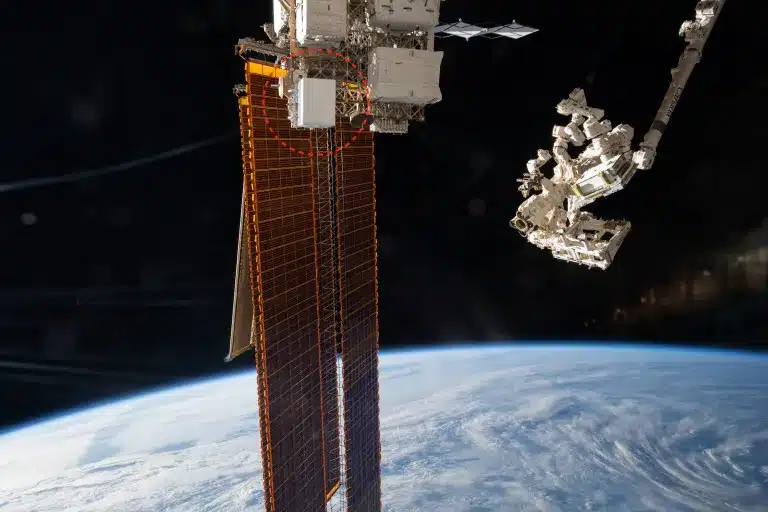 NASA’s EMIT, shown in the red circle, was launched to the International Space Station in 2022 to map minerals. Its data is now advancing fields from agriculture to water science.
NASA
In an effort to build a comprehensive detection system, the researchers behind MADLib have categorized their data into several types of debris. This includes variations in size (micro- and macro-debris), weathering conditions (pristine, naturally weathered, and laboratory weathered), and environmental state (dry, wet, floating, or submerged). The ability to classify debris based on these factors allows for the creation of specialized algorithms that can detect ocean plastic more effectively.
Kelsey Bisson, co-author of the study, highlighted the importance of such systems:
“Detecting marine debris is the kind of incredible challenge that NASA can help solve,” she said.
By leveraging space-based sensors, such as the Environmental Mapping and Imaging Tool (EMIT), combined with data from MADLib, scientists are one step closer to developing the tools needed to track marine debris on a global scale.
Advancements in Satellite Technology
The integration of satellite technology with remote sensing systems like MADLib is transforming the way scientists can monitor ocean pollution. Satellites can cover vast areas of the ocean, providing valuable data on the distribution of debris that would be impossible to gather using traditional methods. However, space-based detection also faces challenges. For instance, light reflectance patterns vary based on the depth of debris, floating plastics produce different signals compared to those that are submerged. This means that separate algorithms must be developed to distinguish between these types of debris.
The development of algorithms that can process these complex reflectance patterns is crucial for improving the accuracy of satellite-based plastic detection. The study suggests that future research should aim to include a broader variety of debris types and conditions, particularly floating plastics, which are more easily detected from space. This would further refine detection algorithms and enable more targeted cleanup efforts.
The Potential for Global Impact
The ultimate goal of this research is not just to improve the detection of ocean plastic, but to create a global framework for managing and reducing marine pollution. Remote sensing technologies, combined with databases like MADLib, can provide valuable insights into where debris is concentrated, which could inform more effective cleanup strategies. By tracking the movement of plastic waste across oceans, it may be possible to pinpoint pollution sources and develop policies that reduce the amount of plastic entering the marine environment.
Bisson’s statement underscores the importance of this connection: “Humans have a visceral connection to the ocean and its health.” Our oceans are not just vital ecosystems; they also play an essential role in regulating the global climate. Addressing ocean plastic pollution is therefore not only an environmental issue, but a global health and sustainability challenge.