
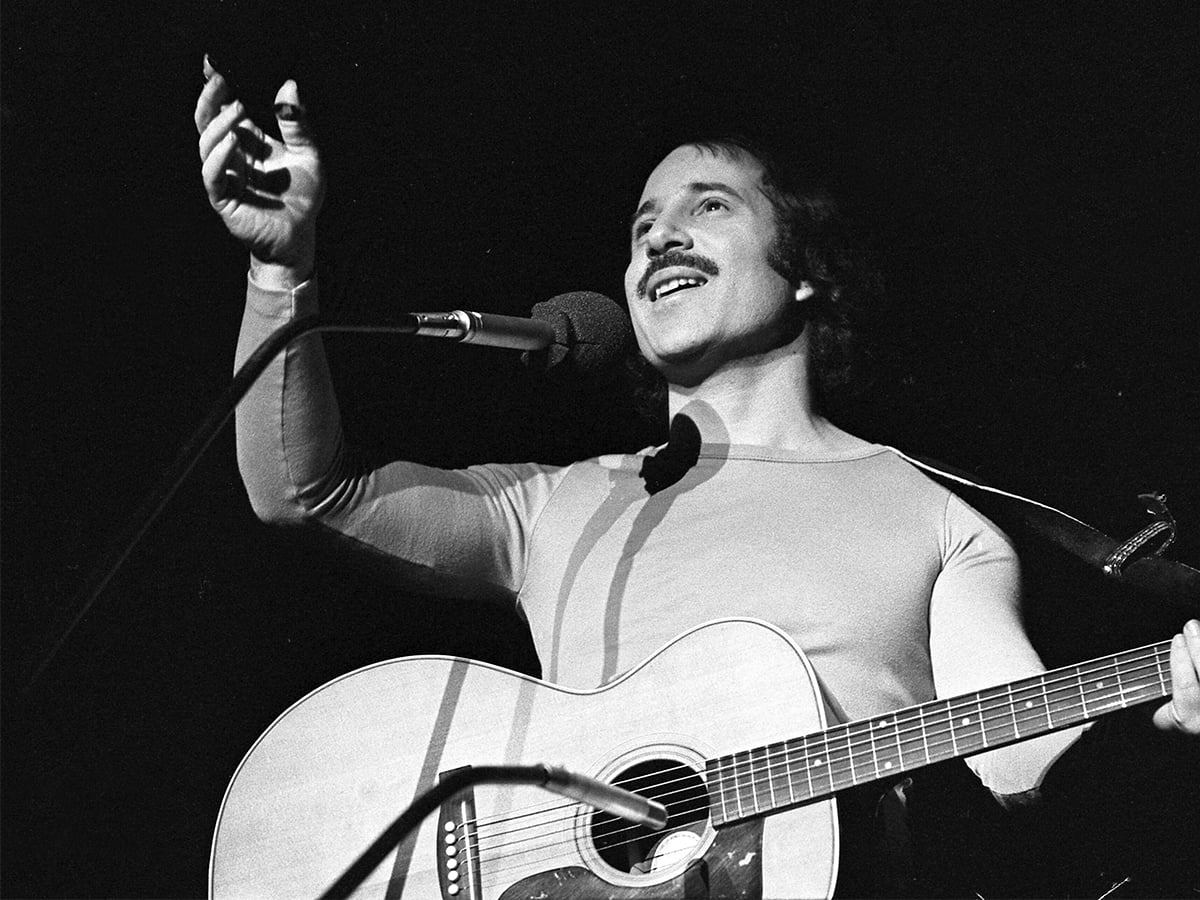

(Credits: Harry Chase, Los Angeles Times)
Sun 15 February 2026 18:34, UK
Walking outside on a sunny day might be good for one’s mental health, but it’s not necessarily the best way to get the creative juices flowing, because when a 21-year-old Paul Simon wrote arguably his greatest song, ‘The Sound of Silence’, he was locked in his own bathroom, sitting on the edge of the tub with the lights out.
“I’d turn on the faucet so that water would run,” Simon later said of his songwriting process at the time, “I like that sound, it’s very soothing to me. And I’d play in the dark”. Cut off from half his senses, he wrote, “Hello, darkness, my old friend”, and the rest was history.
Toward the end of 1965, an overdubbed electric version of the song became the first number-one hit for Simon & Garfunkel, and catapulted its songwriter into the conversation with Bob Dylan as one of the exciting new voices in popular music.
The experience would have been surreal enough had Simon still been living in New York, but when ‘The Sound of Silence’ began its ascent up the US charts, he was in London, having extricated himself from the States in the wake of the initial poor sales of S&G’s debut album.
Despite his obvious talent, he hadn’t felt entirely part of the community of folkies in Greenwich Village, for he was a New Yorker but came from Queens and so was treated at times like an outsider, a second-class citizen. By contrast, he’d found a much warmer atmosphere in the coffee houses of the UK, and might well have stayed longer had the sudden success of ‘The Sound of Silence’ not changed the outlook for Simon & Garfunkel’s career prospects.
 (Credits: Far Out / Felix Stahlberg)
During a concert at Tufts University in 1967, Simon recounted this period to the audience and how his return to New York in December of 1965 had affected him.
“I had to make this adjustment from being relatively unknown in England to being semi-famous here,” he said, “and I didn’t really swing with it. It was a very difficult scene to make, and I was writing very depressed-type songs until around June of [1966]. I started to swing out of it, I was getting into a good mood, and I remember coming home in the morning about six o’clock over the 59th Street Bridge in New York, and it was such a groovy day…so I started to write a song that later became the ‘59th Street Bridge Song’ or ‘Feelin’ Groovy’.”
The vibes of ‘Feelin’ Groovy’ were just what he needed on that summer’s day, and while the eventual Simon & Garfunkel recording of the song was never a hit, a 1967 cover version by the band Harpers Bizarre reached number 13 on the US charts, immortalising the tune as one of the classics of the Summer of Love.
Had Paul Simon been a typical songwriter from the era, with three or four memorable songs to his name, that might have been all well and good. Unfortunately, as the years passed, ‘59th Street Bridge Song’ began to feel more like a slightly embarrassing anomaly in comparison to his endless catalogue of revered and thought-provoking work. It was a cute snapshot of a moment in time, dated by its own slang, but not a song the singer had much nostalgia for, despite its rosy origin story.
Eventually, after a few decades of being asked by passersby on the street if he was “feeling groovy?”, Simon came to loathe the song that had once helped him navigate the life-changing aftermath of ‘The Sound of Silence’.
Simon had hinted at his antagonistic relationship with ‘59th Street Bridge’ in the past, but it was during a 2018 concert in Portland, Oregon, that people really came to understand how much he seemed to regret its existence. While playing ‘The Cool, Cool River’, he forgot the lyrics and informed the audience that he was going to switch gears, declaring, “I’m going to penalise myself. I’m going to sing one of my songs that I loathe”, and started playing the familiar opening bars of ‘Feelin’ Groovy’ to cheers from the crowd.
Three years later, in 2021, Simon told Stephen Colbert that one line in the song, “Life, I love you. All is groovy”, really made him “cringe” more than any other, and that he dreaded any time he heard it, mustering an “Ugh!” after he forced himself to repeat it.