
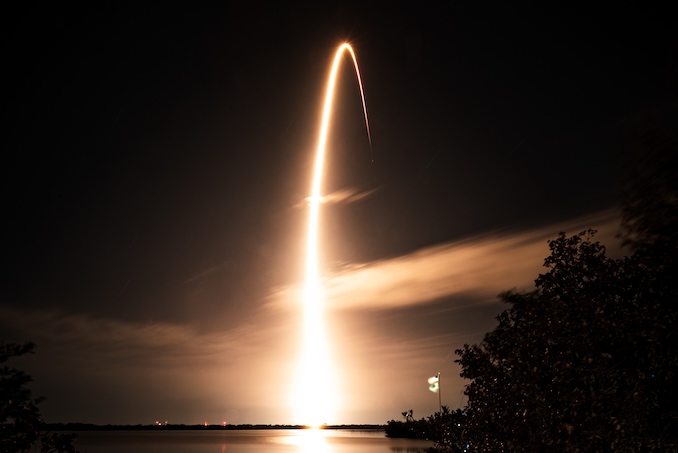
 A SpaceX Falcon 9 rocket lifts off from Space Launch Complex 40 (SLC-40) at Cape Canaveral Space Force Station on the Starlink 6-103 mission on Feb. 16, 2026. Image: John Pisani/Spaceflight Now
Update Feb. 16, 3:22 a.m. EST (0822 UTC): SpaceX landed the Falcon 9 booster on the droneship.
SpaceX kicked off the President’s Day holiday in the United States with a Falcon 9 rocket launch from Cape Canaveral Space Force Station, overcoming some challenging weather conditions.
The Starlink 6-103 mission added 29 broadband internet satellites to the company’s low Earth orbit megaconstellation of more than 9,600 spacecraft. This was SpaceX’s 14 Starlink launch of the year so far. The company confirmed a successful deployment of the satellites about an hour after launch.
Liftoff from Space Launch Complex 40 happened at 2:59:40 a.m. EST (0759:40 UTC). The Falcon 9 rocket flew on a south-easterly trajectory upon leaving the launch pad.
The 45th Weather Squadron forecast just a 20 percent chance for acceptable weather during the launch window. Meteorologists are tracking potentially severe weather heading into the state over the course of Sunday and heading into Monday.
“As the low slides eastwards to move off the Georgia coast late tonight, south-southwest winds will increase during the day, even outside of any precipitation,” launch weather officers wrote. “Models have come into better agreement with the timing of a band of pre-frontal showers and storms, currently moving through the Florida Panhandle, reaching the Spaceport just before the opening of the primary window.
“Showers and storms are expected to linger for a few hours into the window before sliding south of the area. While this activity loses intensity as it arrives, strong wind gusts will still be possible. The primary concerns will be the Cumulus Cloud Rule, Surface Electric Fields Rule, and Anvil Cloud Rules, though additional thunderstorm-related rules are likely.”
SpaceX launched the mission using the Falcon 9 first stage booster with the tail number 1090. This was its 10th flight after launching previous missions, like NASA’s Crew-10, CRS-33 and Bandwagon-3.
Nearly 8.5 minutes after liftoff, B1090 landed on the drone ship, ‘A Shortfall of Gravitas,’ positioned in the Atlantic Ocean. This was the 142nd landing on this vessel and the 572nd booster landing to date.