
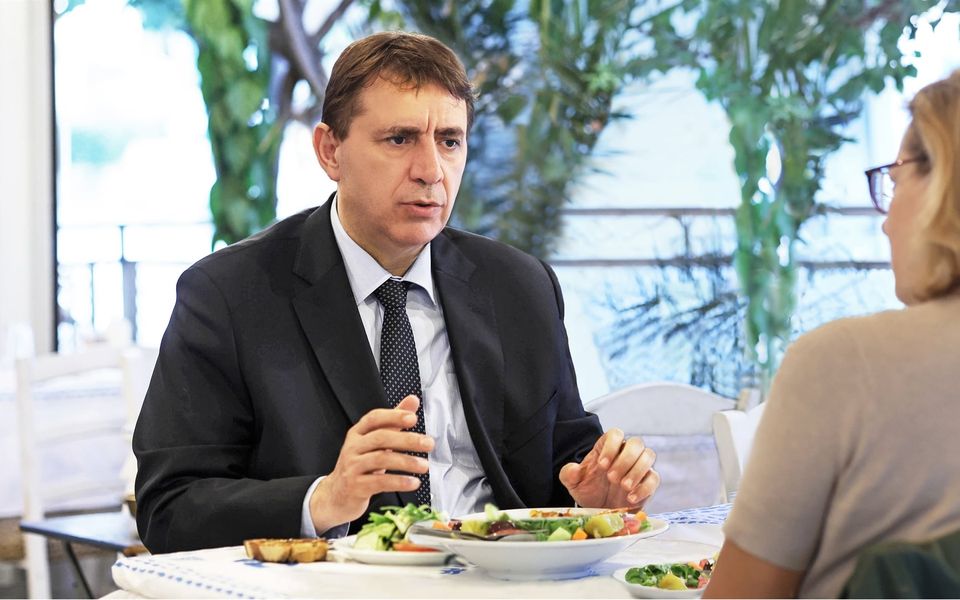
The first time I met Thracian entrepreneur Christos Giordamlis was while reporting on a major wildfire that tore through the Dadia Forest in northeastern Greece in the summer of 2023. The flames had spread to the industrial zone outside the port city of Alexandroupoli, which is also where the headquarters of his firm, Prisma Electronics, is located.
The danger was averted thanks to the heroic efforts of residents, the Army and the fire service, which spared the area from being burned to cinder. Apart from the Giordamlis family’s plant and a couple of others, the rest of the facilities in the area were basically decrepit empty shells with no fire safety whatsoever. They had been built by entrepreneurs who took advantage of the incentives offered by a development law in the 1990s, which sought to bolster investments in Greece’s remote border regions by offering generous subsidies. When those incentives ceased to exist, most of them pulled out or left due to transportation costs, which became unforgiving during the economic crisis.
By contrast, the facility run by the three Giordamlis brothers not only remains in place, but has also succeeded in producing technology made in Greece. On November 28, it launched the first nanosatellite designed and built in Greece, the MICE 1, from the Vandenberg base in California, aboard a SpaceX rocket. The satellite was fully designed and manufactured in Greece and is intended for use in shipping, as well as in demanding conditions, such as in the aftermath of natural disasters.
So, from Thrace to space – it’s an impressive trajectory and a touching sign of dedication to a part of the country so many others have given up on, possibly driven by the refugee experience.
“Both my parents hailed from farming stock, since their families were given fields to cultivate when they settled here after the population exchange [with Turkey]. But they were also fans of education, so both my brothers and I studied,” Giordamlis tells Kathimerini.
He got a degree in electrical engineering from the Thessaloniki Technological Institution (TEI), “just as it was becoming apparent that computers were about to change everything,” and then left for England, where he studied management and marketing. His eldest brother, in the meantime, had opened an IT firm in Thessaloniki. An opportunity appeared to create something together in their hometown in 1991 and they went for it.
“Our first headquarters was beneath our family home in the city. We started out by importing components and assembling computers, serial cards, modems and so on. We experienced firsthand the entire transition toward the internet revolution. Taking advantage of the development law of the time, we too relocated to the industrial zone, which in 1997 seemed poised to become a serious industrial park. The completion of the Egnatia Highway in 2000 reduced the six-hour journey between Alexandroupoli and the country’s second-largest city, Thessaloniki, to just three hours and was a major boost,” he recounts.
The course after that was fraught with challenges, however. “We faced the first major floods in Evros in 2007, which wiped out many businesses, followed by the global economic crisis in 2008. Then we had the Greek crisis in 2010, the Covid pandemic, the immigration crisis and the wildfires,” he says. “The Alexandroupoli area alone lost a tremendous number of businesses – it went from having 400 productive businesses to just 150. We saw capable people lose their jobs and homes.”
Flexibility
How did they survive these successive blows? Partly because they stayed flexible, says Giordamlis. “For example, even though we started out in computers, when China entered the game with far more competitive prices, we pivoted to industrial automation, to scales and telecommunications systems that we manufactured in our own factory. We partnered with Democritus University to develop patents, allowing us to break into a new world: the Internet of Things, a network of physical devices equipped with sensors and software so they can connect and communicate with one another via the internet.
“We survived because we chose to invest in our own technology and to make full use of the state’s development laws, as well as national and EU research funding, through partnerships with the country’s universities and broader scientific communities. We ultimately ended up working on fully automated, sensor-based information environments that operate 24 hours a day with no employee involvement at all, allowing management to monitor production with real-time data that helps anticipate issues and improve performance,” he adds.
Prisma Electronics eventually evolved into an incubator, “a professional haven for young men and women from the area who were educated and talented, and who wanted to stay,” says Giordamlis. “We even managed to open a small branch in Athens, while we also decided to turn our attention to shipping during the crisis, as our country truly excels in this area.”
Breaking into the sector wasn’t easy. “When we started knocking on the door of shipping firms in 2011, we had to convince them that we were moving away from the time when a ship, isolated from the rest of the world, relied primarily on the skills of its crew, and entering a new phase in which, thanks to new technology, shore-based support becomes decisive. From faxes and telexes, we have now reached the point where we can measure fuel consumption minute by minute and detect when a generator or a pump is not functioning properly,” he says.
At the same time, the brothers began exploring the space sector through collaborations that would take the company beyond national borders. “That was when we started producing electronic equipment for this field. We were able to grow and to work with giants such as Airbus and Naval Group, which builds the Belharra frigates. For these frigates, we developed certain systems that were manufactured in Alexandroupoli, refined in Saint-Tropez, and then sent to the shipyard in Brittany,” says Giordamlis.
Missions
Prisma Electronics has now turned its attention to the convergence of space and shipping, where a new regulatory framework is driving major changes and transformations.
“The creation of systems and satellites is becoming both extremely demanding and absolutely essential for any country that respects itself, from defense and disaster prevention to telecommunications and beyond. As a company, we have been part of both large- and small-scale efforts undertaken in Greece in this field over the past 10 years.
“We managed to participate in space missions, including a major satellite that was sent into orbit around the sun. We manufactured parts of its electronic systems ourselves, here in Thrace. Taking part in such innovative projects gave us unique know-how. And when, in 2022, the Greek government decided to seriously address the issue of space, we submitted a proposal, which was approved for funding, and we signed a contract with the European Space Agency,” he says.
What is the next frontier for the Thracian company?
“Our goal now that the nanosatellite has been launched is to use the data it provides to improve even further. By 2030, when ships will be required to upgrade their systems, we want to be ready with new products. The preparation process has been a tremendous learning experience, and we are very proud that we succeeded. Essentially, we are talking about zero-risk, zero-error manufacturing – everything has to be built perfectly. And it is all done in Thrace.
“We named it MICE, from the initials of Marine Identification and Communication System, but also because it is small, just over five kilograms. Greece has incredible potential and talent. What it lacks is the consistency and organizational discipline needed to carry through policies and projects that require a 15- or 20-year horizon, such as those in the space sector,” Giordamlis says.
Evros
While things may be looking up for Prisma Electronics, Giordamlis is not so upbeat about the prospects of Thrace and the Evros region more generally. “It’s not doing well at all; it’s shrinking enormously,” he says.
“Alexandroupoli has basically become a tourist city, when there should be incentives to attract businesses as well. Competitive infrastructure is also needed if we are to become a hub. Right now, we have a train running on outdated tracks that carries military equipment from Alexandroupoli to Thessaloniki once a week. What we need is a modern railway linking Alexandroupoli with Thessaloniki and the Balkan hinterland, along with a modern suburban rail system to help retain populations in villages that are being abandoned. The port also needs upgrading, but above all, it needs a plan. American interest gives the region only temporary value, while on the other side, the Turks are steadily implementing a strategy to deliver multiple projects quickly. In our case, there is no shortage of ideas and proposals, but there are no concrete studies to turn them into reality. The airport handles a limited number of flights and mainly connects us to the capital. How can a region move forward without reliable transportation and access to jobs?”