
In 1886 young, obscure Georges Seurat set down a challenge to Monet, leader of the avant garde, by displaying the sensational frieze of frozen figures composed from tiny dots, “A Sunday Afternoon on the Island of La Grande Jatte”, at the eighth impressionist exhibition. It drew howls of derision, and Seurat duly won the role of French painting’s new enfant terrible, launching the movement known as neoimpressionism. Five years later, aged 31, he was dead.
Less remarked, then and now, than “La Grande Jatte”, were Seurat’s beautiful, luminous Normandy seascapes, also on display in the 1886 show. But one critic praised “their burrowed, jagged, aligned cliffs, their waves in the distance reborn, and the huge amount of air circulating between the sky and the water . . . Their calm immensity shines through.” So it does in the Courtauld’s radiant Seurat and the Sea.
This is the first exhibition ever devoted to the seascapes which, it turns out, comprise more than half Seurat’s output. The majority are in this stunning, scholarly, revelatory account, which reorients our understanding of Seurat’s aims, sensibility, inventiveness and relationship with his peers, and is London’s most brightly enveloping winter show.
 ‘Le Bec du Hoc, Grandcamp’ (1885)
Two majestic paintings from the 1886 exhibition set the strange mood of luxuriance yoked to geometry: “Le Bec du Hoc, Grandcamp”, a beak-shaped promontory rising from a criss-crossed blue-green-lavender sea, shot through with reflective yellow dashes, and the austere “The Roadstead at Grandcamp”, racing boats arranged as a procession of triangles. Already Seurat, while acutely sensitive to subtle effects of colour and light, has left impressionism behind in favour of meticulously mapped, fixed compositions.
From 1886, “The ‘Maria’, Honfleur” is a striking close up of a passenger boat, its rigs, masts and darkened funnel cramming the surface, while “Entrance of the Port of Honfleur”, horizontal strips of shore, sea, sky, framed with a pier, lighthouse and tall tide signal mast, their forms mirrored in the water, is as tightly ordered. Golden light pulsates from the pointillist “points” of complementary colours; Seurat draws attention to the method by signing his name boldly in alternating dots.
 ‘The “Maria”, Honfleur’ (1886)
A soft-textured conté crayon drawing, not seen with the painting since they left Seurat’s studio in 1891, delineates positioning and also the range of tones, in black, white, grey. Everything is controlled, nothing left to chance. The novelist and critic Joris-Karl Huysmans, enjoying the Honfleur paintings’ “caressing lullaby of the sea” noted their detachment, lying “indifferently under skies without passion”.
One enigma is how, prioritising logic and precision, Seurat nonetheless captured delicate, evanescent effects — a red roof vibrating in the sun in “The Lighthouse at Honfleur”, sea turning from dark blue to emerald as it recedes beneath an abrupt diagonal white cliff in “Beach at Bas Butin”. A second puzzle is why this cerebral artist chose the most evanescent, unpredictable subject, changing veils of light over the North Sea, to make paintings built on measure and structure.
“Some say they see poetry in my paintings; I see only science,” he insisted. But the seascapes are iridescent harmonies, Seurat’s outlet for poetic effects compared with his rigid, hieratic figure painting. And in making the seascapes it seems he was as tyrannised by changing weather effects as Monet famously was — and perhaps more indebted to impressionism than he wanted to acknowledge. “The wind and therefore the clouds have bothered me,” he wrote to Paul Signac from Honfleur in 1886. “The stability of the first days should come back. What else can I say? Well, let us get drunk on light once again, it’s a consolation.”
 ‘Port-en-Bessin, A Sunday’ (1888) © Alamy
In 1888, Seurat intensified order and discipline by devising sequences. The Courtauld’s coup is gathering the Port-en-Bessin sextet — not united since their inaugural exhibition in 1889 — and the refined “Channel of Gravelines” quartet (1890), dissolving into mists of abstraction yet topographically faithful, recording shifting conditions across a day. To experience these works together transforms our responses.
Just a week ago “A Sunday”, the first Port-en-Bessin canvas, hung in the National Gallery’s show of Helene Kröller-Müller’s neoimpressionist collection. There, I found water and sky stilled into dotted patterns stifling. But within the sextet, creating a composite image of the port while playing with levels of artifice and abstraction, this picture of stasis — despite flags blowing, boats, masts, wave-shaped clouds are locked with the buildings into a static arrangement — compels. It connects to the modern port infrastructure depicted at assorted angles in “The Bridge and the Quays”, with a few frozen figures, and “The Outer Harbour” at high and low tide.
Surfaces throughout are enlivened with individual colour spots painstakingly applied, blending at a distance, most splendidly in the schematic final pair “The Semaphores and the Cliff”, a broad calm open sea shimmering beneath a stylised calligraphy of clouds, and MoMA’s “Entrance to the Outer Harbour”. Here wind fills the sails of a fleet of fishing vessels though water and grassy verges remain motionless; the drama is between mounds of green vegetation rhyming with turquoise patches of sea, and brilliant white sails. Large in the foreground, these dwindle in the distance into carefully spaced dots.
 ‘Port-en-Bessin, Outer Harbour Low Tide’ (1888)
By “Gravelines”, time as much as place is the subject. This series opens in “Grand-Fort-Philippe” on a pale expanse of sand, colour leeching away in dazzling morning light. Short straight noon shadows from clusters of moored boats fill “Direction of the Sea”, lengthening in late afternoon in “Petit-Fort-Philippe”, which is exhibited with its oil sketch; intriguingly, the prominent, disconcerting bollard, a surreal touch, is absent in the study.
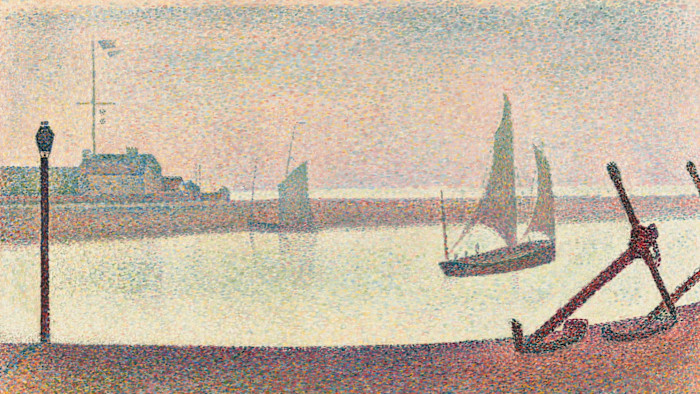
In the exquisite bands of green, purple-pink and yellow of “Evening”, the water is illuminated by the sun’s last rays while darkness falls on the quays between the vertical and diagonal markers of lamp post and anchors. It is a constricted, and constructed, space — accompanying sketches show various parts worked out separately — and ambivalent in effect: even as Seurat distances us from nature by his controlled arrangement of forms, he conveys a sense of the sea’s boundless immensity.
 ‘The Beach at Gravelines’ (1890)
The final work is the Courtauld’s own small oil on wood sketch, “The Beach at Gravelines”, not a preparatory study but done simply for pleasure. The sun-drenched sea, rendered in thick white and yellow with the bristles of a brush, blurs with the sky; a pool of water left by the tide reflects white clouds; twilight orange and red dots scattered on the shore and horizon add a final layer. Grains of sand prove the plein air credentials.
Pointillism influenced artists across decades, as diverse as Pissarro, Matisse and Bridget Riley. But it’s impossible to see this tremulous abstraction, painted months before Seurat’s premature death, and indeed the grand ensemble of seascapes here, without wondering what more he would have brought 20th-century painting.
To May 17, courtauld.ac.uk
Find out about our latest stories first — follow FT Weekend on Instagram, Bluesky and X, and sign up to receive the FT Weekend newsletter every Saturday morning