
NEED TO KNOW
Researchers Bruna Falcão and Omar Entiauspe-Neto published a study finding that at least 207 snake species in 15 families have cannibalistic tendencies
The research found a reported 503 cases of cannibalism
Examples of cannibalistic diets were recorded among mating pairs, related individuals, and combatant males
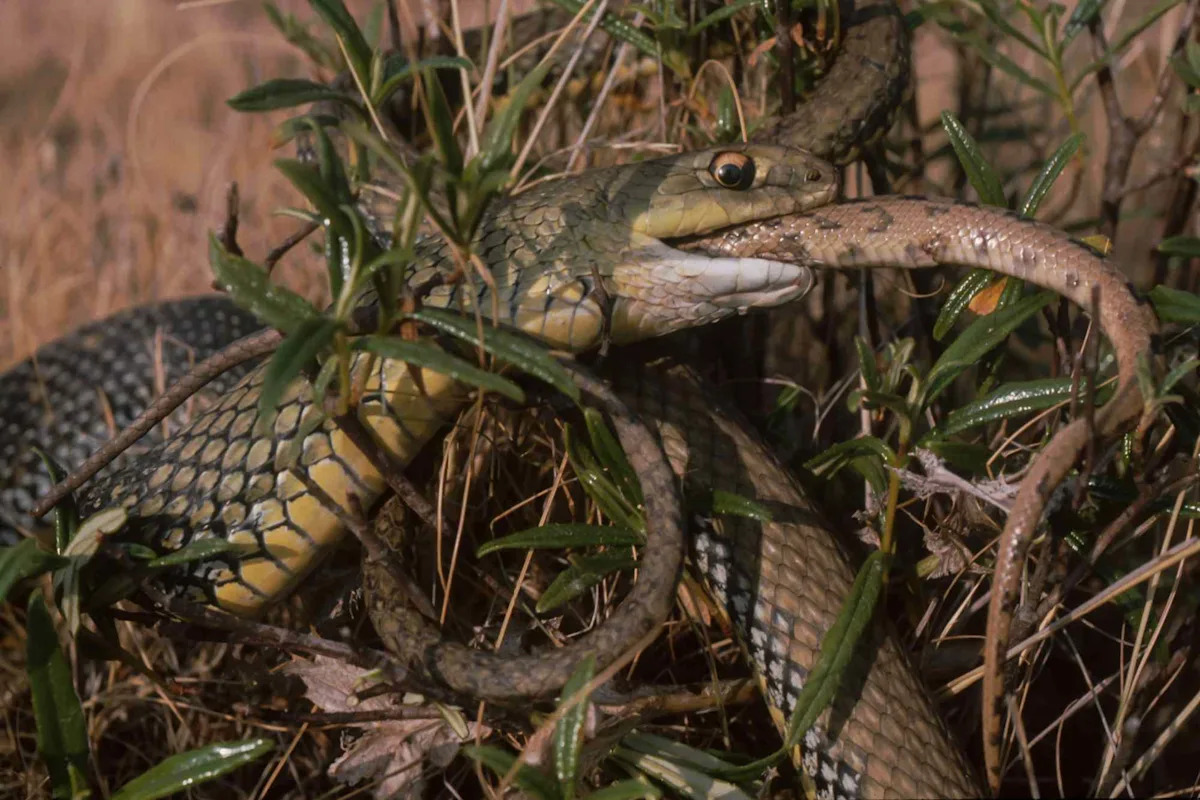
A new study reveals that numerous snake species are more cannibalistic than previously thought.
Researcher Bruna Falcão said there have been more than 500 documented cases of snakes cannibalizing one another. “[It’s] honestly astonishing,” Falcão, a master’s student at the University of São Paulo in Brazil, said, according to the Smithsonian Magazine.
“Each new record reinforced the idea that cannibalism in snakes is not an anomaly or a rare curiosity, but a widespread and ecologically relevant behavior that we had been systematically underestimating,” Falcão added.
Falcão and his co-researcher, Omar Entiauspe-Neto, a PhD student at the University of São Paulo, published a study in November 2025 that reported 503 cases of cannibalism across at least 207 snake species in 15 families. The research contained accounts of several types of snake cannibalism, including among mating pairs, related individuals, and combatant males.
Along with various types of cannibalism, variations were also found in snake species, based on geography and taxonomy.
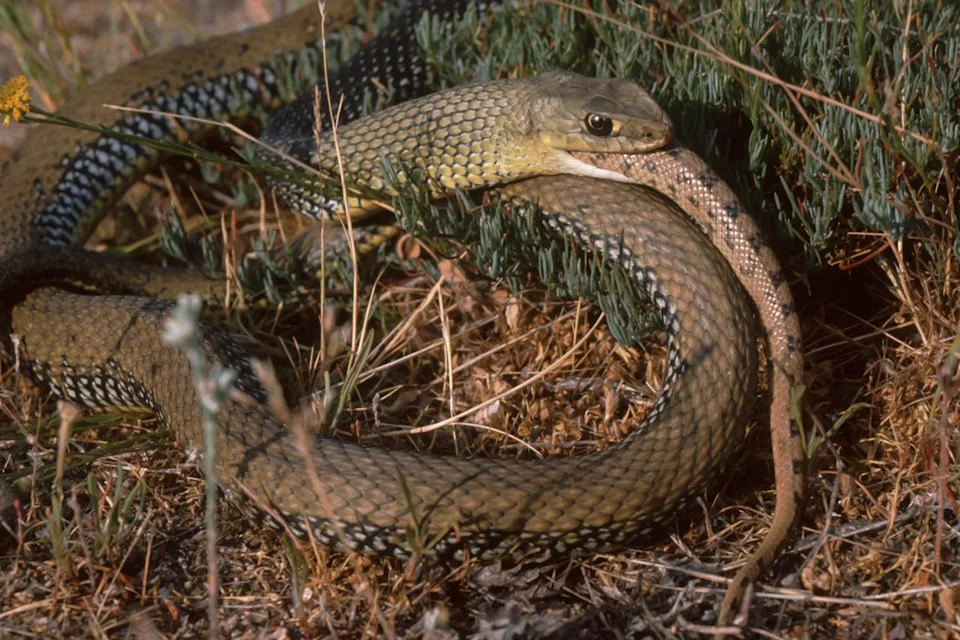 Montpellier Snake (Malpolon monspessulanus) eating another snake
Carlos Sanz/VWPics/Universal Images Group via Getty
As for which snake species are known for cannibalism, the elapid group accounts for 19% of the documented cases, the viperidae family, which includes vipers, accounts for 21%, and the colubridae group accounts for 29%, Live Science reported. The latter isn’t known to prey on snakes; therefore, researchers believe that the snakes resorted to cannibalism due to a lack of other food sources.
The elapids comprise 390 species of venomous snakes, including cobras, coral snakes, sea snakes, black snakes, brown snakes, and tiger snakes. The Viperidae family has 200 venomous snakes, such as the vipers, pit vipers, rattlesnakes, and adders. Thecolubridae family includes 2,000 species, including garter snakes, water snakes, vine snakes, and ringneck snakes.
Blind snakes are the only major snake group without documented cases of cannibalism. Entiauspe-Neto theorizes that this is because the blind snakes’ lower jaws have not evolved and remain unfused, preventing them from eating other snake species.
“None of us expected that … snakes could be so cannibalistic, and no one was talking about it,” Falcão said. “The more we were searching, the more cases we found.”
Falcão said that although this study reveals insight into the dietary habits, there is still more research to be done.
Never miss a story — sign up for PEOPLE’s free daily newsletter to stay up-to-date on the best of what PEOPLE has to offer, from celebrity news to compelling human interest stories.
This is a “welcome study that allows us to get a better understanding of the correlates of cannibalism in snakes,” a biologist and National Geographic Explorer, Xavier Glaudas, told Live Science. Glaudas was not involved in the study.
Read the original article on People