
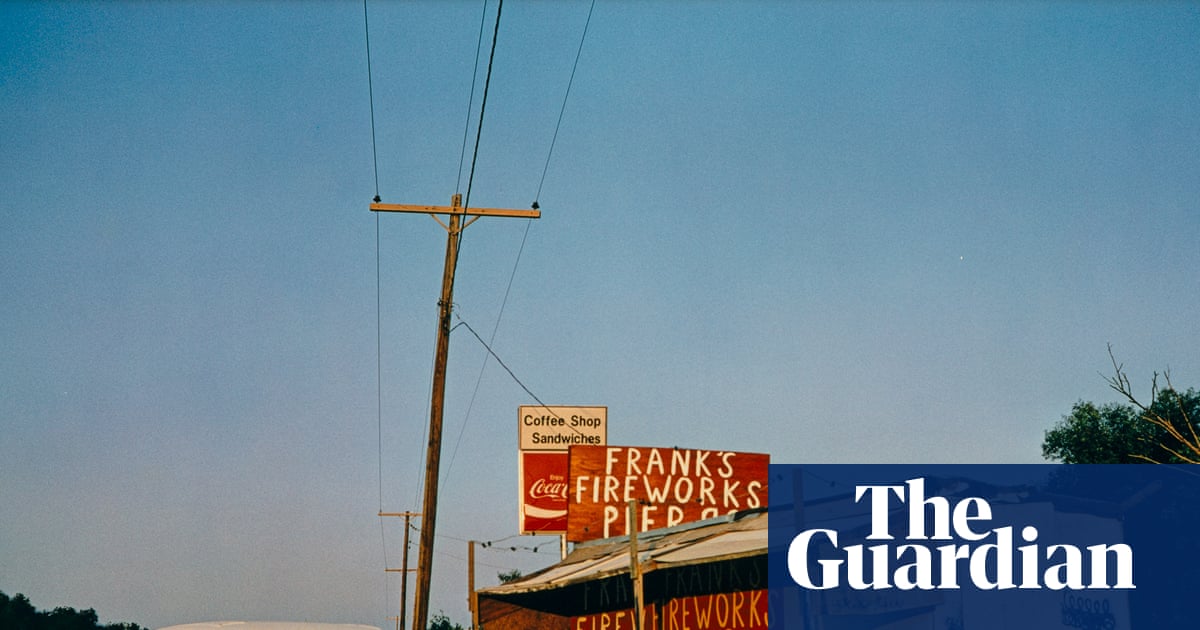
As a small child, Winston Eggleston was only vaguely aware that his father, William Eggleston, was a famous photographer. For all he knew other children also had parents who were friends with Dennis Hopper, or who spent hours tinkering on a piano between occasional, fevered photography sprees, or who had taken the world’s most iconic picture of a red ceiling.
“It’s all normal to you, because you don’t know anything different,” Winston recently recalled. “Looking back, I was lucky.”
But he was intrigued by the yellow boxes of Kodak film he saw lying around his house, and by an odd, sour-smelling paper on which his father occasionally printed photographs. These were materials for dye-transfer, a special technique used to print fashion and advertising photos of exceptionally vibrant color. As one of the first art photographers to embrace color photography – at a time when the art world regarded color as vulgar – Eggleston began using dye-transfer, in the 1970s, to give his photos a startling Technicolor pop.
When Kodak discontinued its dye-transfer products in the 1990s, the Egglestons began buying up any stocks they could find. They also began a difficult project: deciding which of William Eggleston’s thousands of photos might enjoy a final blaze of color-saturated glory. In the end only about 50 photos could make the cut.
Thirty-one of them are included in William Eggleston: The Last Dyes, an exhibition through 7 March at the David Zwirner Gallery in New York. The show may be the last ever exhibition of photographs, by Eggleston or anyone else, produced using dye-transfer. When I visited the Chelsea gallery on a ferociously cold and windy recent Saturday, more than a dozen people, some with children, had endured subzero temperatures to see them.
William Eggleston – Untitled, 1970. Photograph: William Eggleston/Courtesy Eggleston Artistic Trust and David Zwirner
Even after having had dye-transfer explained to me several times, I’m not sure I totally understand the technical aspects of the process. But the results speak for themselves: the brick reds, indigo blues, canary yellows, sunset pinks and verdant greens of Eggleston’s work dazzle against the white walls of the gallery. One photograph beckons the viewer down a dark, greenish hallway toward a bathroom glowing an infernal red, as if the toilet, seen from a long low angle, were the throne of Satan himself. (Unsurprisingly, Eggleston and David Lynch were fans of each other’s work.)
The texture of Eggleston’s photos is also expressed to vivid effect – dead leaves, the pebbled metal of a car interior, the sandpapery concrete around a desolate swimming pool.
The photos are a mixture of Eggleston’s “big hitters” and “stuff that had never been printed before”, Winston, 53, told me. He was speaking by video-call from his home in Memphis, at a property where his father also now lives; behind him was a framed print of one of Eggleston’s works. Winston wore a marled grey sweater, blue striped shirt and black baseball cap – a more casual iteration, perhaps, of his father’s southern-fried Savile Row aesthetic of dark suits and bowties worn undone like string ties.
For years Winston and his brother, William III, have been working with their father, now 86, to archive and preserve his work. The dye transfers were done by Guy Stricherz and Irene Malli, a married couple who are among the last remaining specialists of the expensive and laborious process. Each batch of 10 photos took six to eight months, sometimes longer, to print.
Like the dye-transfer prints, the photos of The Last Dyes, taken between 1969 and 1974, feel like documents from a world that was perhaps already vanishing – an American south of derelict drive-in theaters, rusted metal advertising and Oldsmobiles.
Yet when Eggleston debuted his work, at a notorious 1976 exhibition at Moma, it was novel to the point of polarizing. Color photography had existed for decades, but most serious art photographers worked in black-and-white, and they did not generally take photos of toilets or glasses of iced tea. In a book for the new show, the writer Jeffrey Kastner argues that the legend that the Moma show was universally panned has been overstated; it is true, though, that many critics were unimpressed with Eggleston’s snapshot-style photos of the everyday, which struck them as about as interesting as a random person’s vacation Polaroids.
William Eggleston – Untitled, 1972. Photograph: Courtesy Eggleston Artistic Trust and David Zwirner
Time has been kinder to Eggleston’s ability to see beauty in the ugly, tacky or mundane – to wage “war with the obvious”, as he has put it. He is now regarded as one of the most important living American photographers, and retrospectives of his work have drawn eager audiences in recent years in Berlin and Barcelona. Christie’s auctioned a lot of 36 of his photographs for almost $6m in 2012. (Although he listens mostly to classical music, his photos have also graced the covers of several rock albums.)
Eggleston’s photos tend to feel decontextualized. They do not have titles or captions, and he is hostile to interpretation. “Words and pictures [are] like two different animals,” he told the New York Times in 2016. “They don’t particularly like each other.” And while he has sometimes been willing to recall the origins of specific photos, he works quickly and takes only a single picture of each subject, so he can’t always remember their exact provenance.
Most of the 1970s photographs were taken in Memphis or during road trips around Tennessee, Mississippi and Louisiana. “Dad was not one of those artists who got up every day and went out working,” Winston said, wryly. “He worked very sporadically, in short bursts.” Winston was too young to have been present when Eggleston took most of the photos, though he can trace some of them.
As he spoke, he flipped through the new book, pausing at some of Eggleston’s most iconic pictures. A young woman in pink, gazing over her shoulder from a church pew? Taken at the funeral of the blues musician Fred McDowell. A man sitting next to a maternal-looking quilt, brandishing a revolver? He was a distant relative – or perhaps a family friend; Winston can’t quite remember – who worked as the nightwatchman of a tiny Mississippi town.
William Eggleston in 2019. Photograph: Tristan Fewings/Getty Images
The exhibition also includes a photo of a blue ceiling that echoes Eggleston’s better-known red one. It was taken at the same house – of a friend of Eggleston’s who was later believed to be murdered – and is equally striking. Although contemporaneous, it now feels like a smiling nod to the other photo.
“For many years, it was, ‘Should we print it?’ ‘Eh, it’s too derivative of the red ceiling,’” Winston said. “And finally, we’re like, well, of course we should print it! I mean, this is it – and I’m really glad we did.”
Decades of bourbon and cigarettes, plus experimentation with substances in his younger years, have somehow not limited his father’s longevity. But he has been forced to slow down, Winston said. He is not as mobile these days, which makes photography difficult, and has lived quietly since his long-suffering but beloved wife of a half century, Rosa, died in 2015. Their daughter Andra, a fashion designer, has a textile line inspired by his art.
The final photo in the new book is a proto-selfie that Eggleston took sometime in the 1970s: his head lies horizontally on a pillow, facing the viewer, eyes closed in calm repose. Eggleston is now, no doubt, thinking about his legacy. “He couldn’t be happier about the new show,” Winston said. “He loves the new catalogue. It’s funny, though – I don’t think that he’s totally accepted the fact that the dye-transfer is over.”
Winston has elsewhere described his father’s work as “democratic and neutral” – a description that echoes a title that Eggleston once gave his work, The Democratic Forest, and one that Eggleston’s attitude toward his work would seem to reflect. According to Winston, his father does not prefer any of his photos over any others. He likes them all equally, and leaves the editing of his collections to other people.
Winston once asked his father which of his photos, if forced to choose, he considered his favorite or his best. “His answer,” he said, “was, ‘Well, I guess I’d have to go into a room and turn the lights off, throw them all up in the air, and grab one.”