
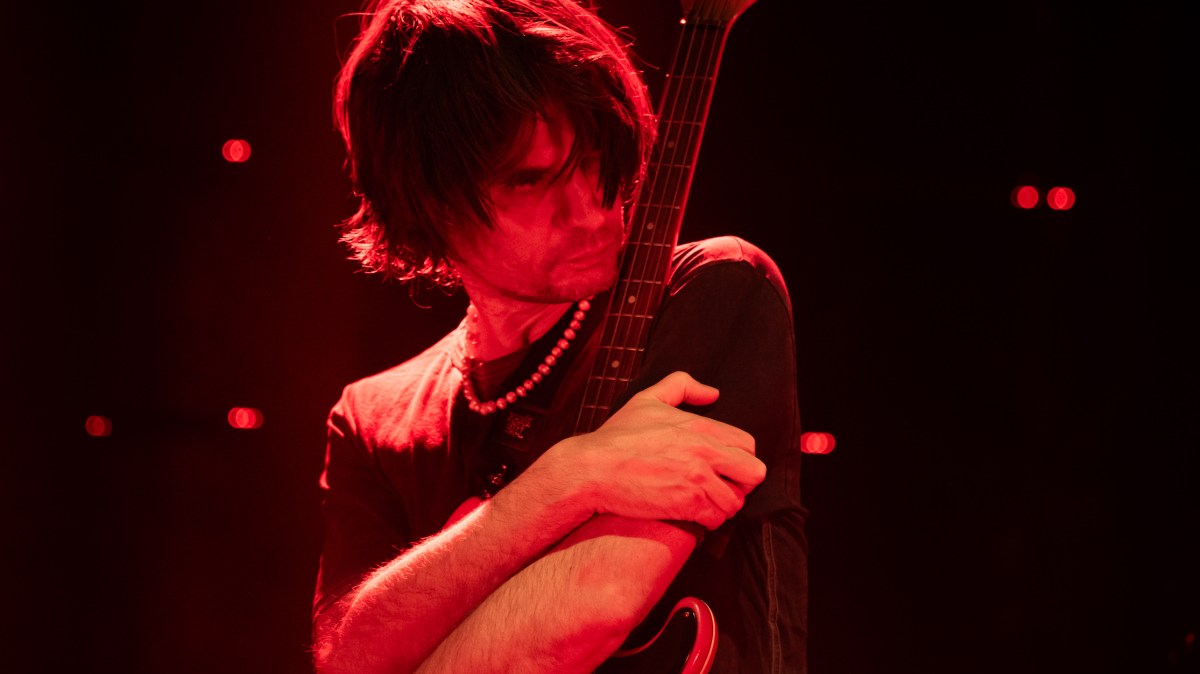
Jonny Greenwood is clearly eager to meet. We had agreed a rendezvous at a pub near Oxford station but as I stagger around the city’s interminable roadworks a familiar figure strides towards me, trademark hair flopping in the breeze. “Pub’s no good,” the Radiohead guitarist declares sadly. “I know a quiet café.”
So over herbal beverages we discuss the vast orchestral score that Greenwood, 54, had emailed me just an hour earlier, and which the Hallé Orchestra will be premiering in Manchester this month. “Finished yesterday,” he says, sounding proud and relieved.
Both feelings are understandable. Now called simply Violin Concerto, the work began life at the 2019 Proms bearing a more dramatic title: Horror vacui, literally “fear of empty spaces”. There certainly weren’t many empty spaces in Greenwood’s teeming score. He had written the piece for a solo violin and 68 other string players, all with their own staves — producing dense pitch clusters reminiscent of his avant-garde composer hero, Krzysztof Penderecki.
“I felt that Prom was really like a workshop because there was no time between rehearsal and concert to adjust anything,” he says. “So I went back to the score and just started again. I decided I would devote a year to rewriting it and see what happens.”
• Jonny Greenwood: why the future is classical
Three things strike me about the score he sends me. The first, most apparent when the violin soloist (Daniel Pioro in Manchester) leads a kind of “call and response” passage, is that Greenwood uses a classic “note row”. All 12 semitones are repeated in strict order, even if inverted or reversed, a composing technique pioneered in the early 20th century by Arnold Schoenberg. “Yes, finger on the pulse of classical music there,” Greenwood quips. “Only 100 years out of date.”
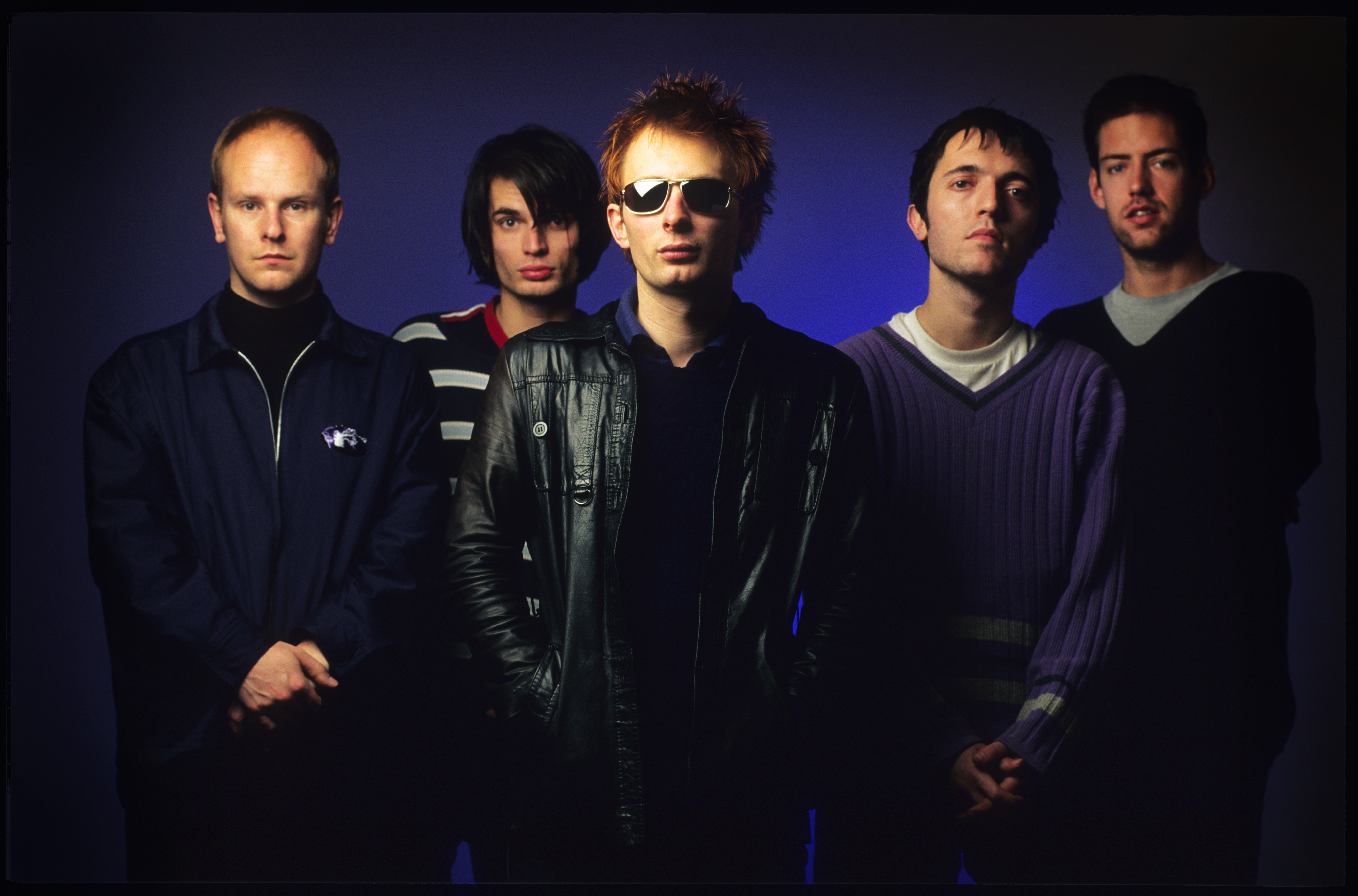
Radiohead in 1995, from left: Phil Selway, Jonny Greenwood, Thom Yorke, Colin Greenwood and Ed O’Brien
GIE KNAEPS/GETTY IMAGES
The second is that sometimes the conductor is instructed to move the baton in a slow horizontal sweep. As the baton points to individual musicians they start to play. “I wanted to get away from the inflexibility of the bar line,” Greenwood says, “but also to give the conductor scope to be more musical — not just beating time but playing the orchestra like an instrument.”
And the third point of interest? Greenwood says that when he wrote the piece he had the names of all 68 orchestral players on the wall in front of him. “I always feel that I’m writing not for an orchestra but about an orchestra,” he says. “I am inspired by talking to orchestral musicians. They are all individuals. They all have their own personalities.”
The teenage Greenwood was an orchestral player. “Yes, back of the violas in the Thames Vale Youth Orchestra,” he says, “dreading the moment when the conductor would say, ‘Can we hear the violas on their own?’” He also did A-level music at Abingdon, the independent school in Oxfordshire where the five members of Radiohead first met. “I learnt how to harmonise Bach chorales and it’s been very useful,” he says.
He then enrolled on a music course at what was Oxford Poly. That didn’t last long. A few weeks into his course the band (then called On a Friday) landed an EMI recording contract and Greenwood’s music student days were over — officially anyway. In reality he never stopped absorbing musical influences, pop and classical, and he still hasn’t.
“I feel I got more experience of orchestral musicians in my early days with Radiohead than I would if I’d stayed at college,” he says. “We got string players involved in our sessions. I would write out stuff on manuscript paper for them to play, and they flattered me so nicely and gave me so much good advice that I thought, I shouldn’t be scared of this.”
• Radiohead: ‘The wheels had come off a bit. We had to stop’
From his teenage years he was hooked on the apocalyptic scores of Penderecki and the ecstatic, complex modes of Olivier Messiaen, and he is still smitten by 20th-century French music. “I love Henri Dutilleux’s string music,” he says. “So beautiful. And I’m still exploring harmony. I’ve just been trying to get to grips with Neapolitan sixths. I guess I’m always dithering between David Bowie’s advice to get slightly out of your depth, because that’s when you do your most interesting work, and Clint Eastwood’s remark in Dirty Harry: ‘A man’s gotta know his limitations.’”
What are his limitations? “I still feel like I’m trapped in pop song thinking,” he says. “All my ideas seem to have a natural three or four-minute span, and I find it daunting to expand them. I guess that’s because I grew up in an era when if you wrote a song more than four minutes long you worried that you would turn into Genesis and end up singing about unicorns.”
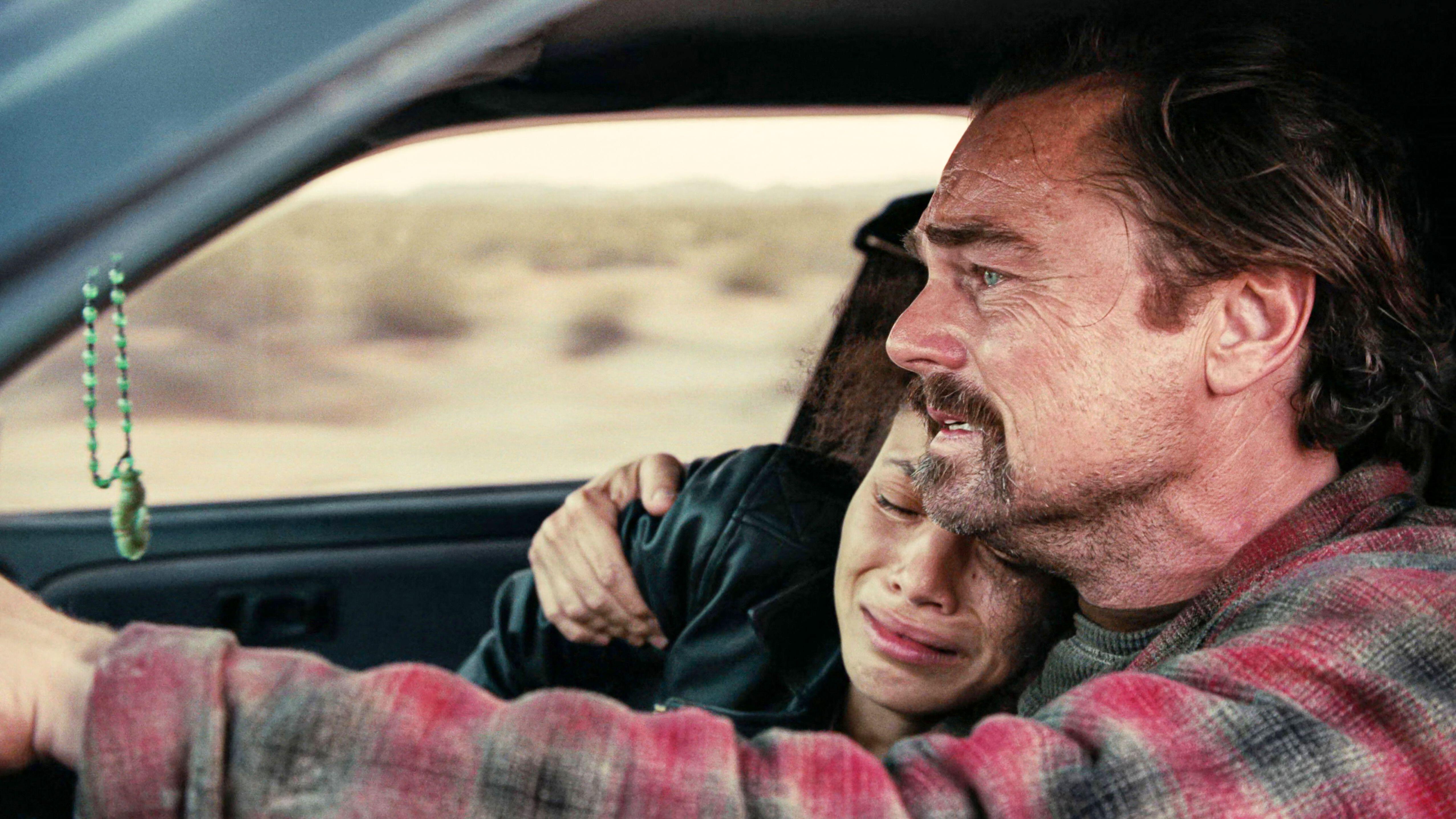
Greenwood’s score for One Battle After Another, starring Leonardo DiCaprio and Chase Infiniti, is nominated at next month’s Oscars
ALAMY
The chief outlet for Greenwood’s orchestral creativity has been film scores, particularly for the movies of Paul Thomas Anderson. He has now collaborated on six of the American director’s intense psychological dramas, from There Will Be Blood in 2007 to last year’s One Battle After Another. “The bit I like best,” Greenwood says, “is the start of the process, when you are talking with the director about underlying themes and how the music can enhance them — what sort of style and instrumentation and so on. You feel like you are in a sweet shop; you can pick anything, go in any direction. It’s a shame, in a way, when the process has to solidify and the music becomes fixed.”
Does he feel, as John Williams once said, that a film composer is like a magpie, pinching styles from across music history to suit whatever the movie requires? “Well, I do come across many creatively successful people who seem to have an encyclopaedic knowledge of their field,” he replies. “Paul [Thomas Anderson] is like that, he has seen thousands of films and analysed them all. And it feeds his own creativity.”
Isn’t that rather like saying there’s nothing new in art, just new ways of arranging old ideas? “Well, I had a teacher at school who said that if you steal ideas from one or two people that’s plagiarism, but if you steal from three or more that counts as inspiration. That’s good advice, I think.”
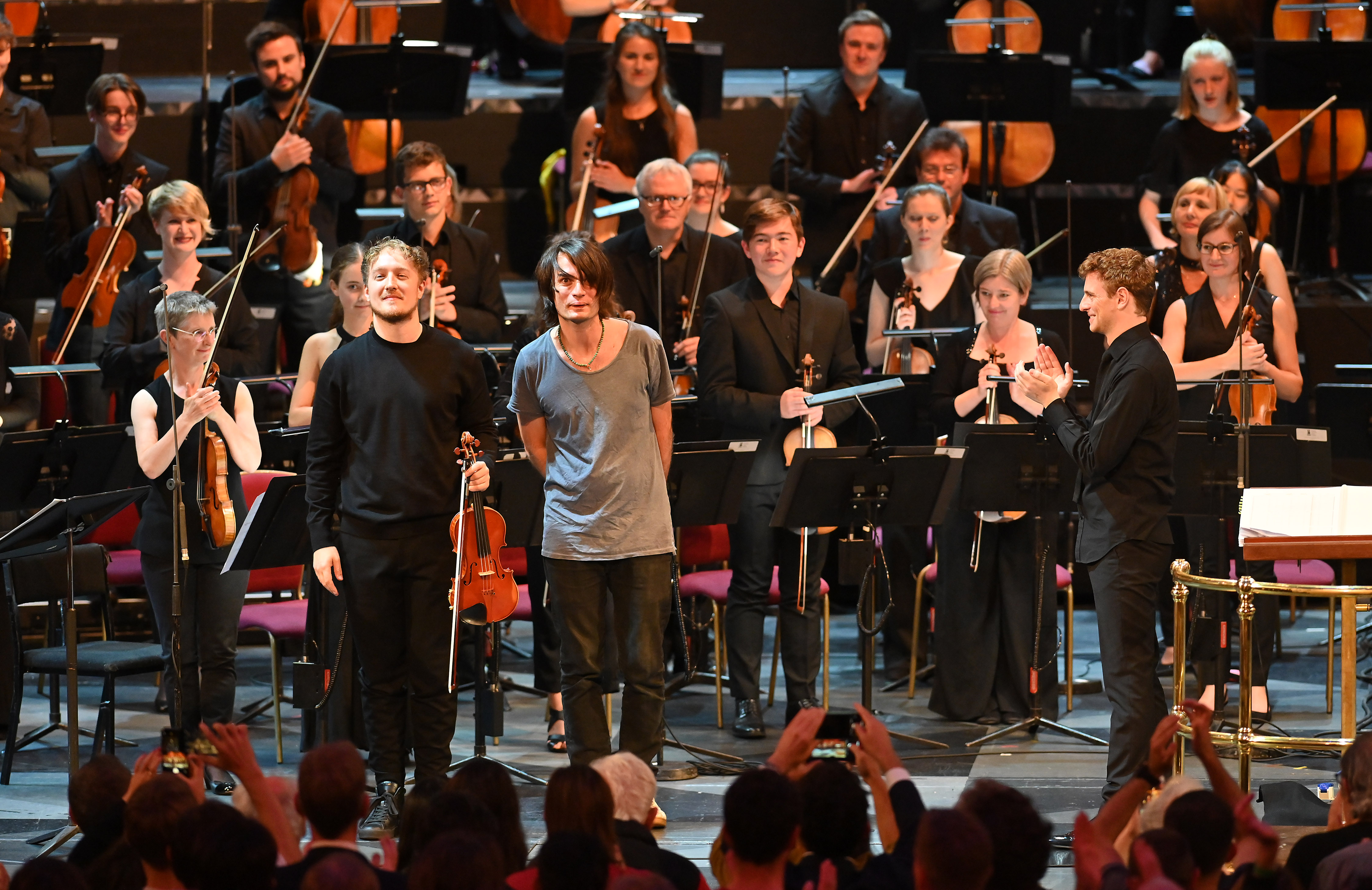
Greenwood curates a Late Night Prom culminating in the world premiere of his Horror vacui in 2019
MARK ALLAN
How specific is Anderson about what sort of music he wants? “He will say things like, ‘This is a big adventure scene so we need some big-ass strings at this point,’” Greenwood replies. “The nightmare is when he has used some amazing piece as his temporary working soundtrack and he wants you to write something similar. I remember for There Will Be Blood he was using part of Brahms’s Violin Concerto. We agreed that probably it would be best if I didn’t try to imitate that so he used the Brahms in the finished film.”
All this orchestral and film composition was put on hold last year when, after a seven-year hiatus, Radiohead reunited and embarked on a 20-concert European tour. Did Greenwood feel he was stepping back into an earlier version of himself? “It was great to revisit songs that we always felt were good and to find lots of other people now agree with us,” he says. “And it was really nice to be playing and listening to Thom [Yorke] again. But I found it strange not to be doing anything new on the tour. I guess we are all doing new music elsewhere now so that’s where our creative energies are going.”
• How Radiohead reinvented rock (with help from a composer)
So a new Radiohead album is unlikely? “I’ve no idea,” Greenwood says. “I mean, I’m surprised that the tour actually happened and that we all enjoyed it so much. But venues get booked so far in advance. To do another we would have to decide now, and even then it wouldn’t happen for 18 months.”
The tour wasn’t without its controversy. Pro-Palestinian activists called for a boycott, citing a gig Radiohead played in Tel Aviv in 2017. Greenwood in particular has longstanding links with Israel. He is married to an Israeli artist, Sharona Katan, whose nephew served in the Israel Defense Forces and was killed in the Gaza war. He also has a performing partnership with the Israeli singer Dudu Tassa. They have performed together in Israel and were due to give concerts in the UK last year until the threat of protests led to the dates being cancelled.
“It’s very hard to talk about this,” Greenwood says, “but I think music and art should be above and beyond political concerns. You know I made an album [Jarak Qaribak, released in 2023] involving Israeli, Iraqi, Egyptian and Syrian musicians? If I’m supposed to stop working with musicians because I dislike their governments then I wouldn’t work with any of them. The fact is, what defines us as musicians isn’t our nationalities. But that point doesn’t seem to get through.”
Aside from that issue, Greenwood’s life seems blissful. He divides his time between family homes in Oxford and Le Marche in Italy, where he explores old churches and their organs. “Some of them have double black keys, so F sharp and G flat are actually different pitches,” he exclaims. On a farm called Shufra di Shufra he has also established a successful olive oil business, about which he talks as passionately as he does about Neapolitan sixths and Dutilleux string quartets.
And the accolades keep on coming. His music for One Battle After Another is in the running for best original score at next month’s Oscars, the third time he has been nominated. Will he attend? “Not sure,” he says. “I went last time and they took me aside and said, ‘We’ve got something for you.’ I was expecting a lavish goody bag. They gave me a chocolate shaped like an Oscar.”
Jonny Greenwood’s Violin Concerto is performed at Bridgewater Hall, Manchester, on Feb 26, halle.co.uk