
A thick fog had enveloped Zallaq, the nearest town to the Bahrain International Circuit, in Wednesday’s early hours. Although the pea-souper had lifted well before the cars hit the track for the day, it was a pleasing – if not hackneyed – representation of the general feeling about testing so far. What do we really know about the state of play ahead of 2026, and will the second week of testing in Bahrain sufficiently elaborate upon the first? At the very least, ‘week two day one’ certainly supported the theories over F1’s performance hierarchy for this season.

The morning’s track action was relatively serene, all told. Most of the running seemed to be dedicated to validation of last week’s outcomes, plus the occasional shorter run interspersed within to continue evaluating progress made betwixt tests. It was all very tentative, especially when one takes into account that the F1 Commission meeting was under way during the early hours.
There were a few topics of conversation to be had following the – middle-management buzzword alert – ‘learnings’ of the first test. Concerns over this year’s starts off the line were aired, as 2026’s cars need to be held at higher revs (and for longer) to sufficiently spin up the turbo for a standing start. This was something that McLaren chief Andrea Stella had suggested was a safety concern, in line with the theory that any drivers who hit anti-stall off the line could be a standing target for a starting shunt on the grid.
Plus, we’d got to see the first runs on the softer grades of tyre, as Pirelli only took the C1, C2, and C3 to the track last week, and we continued to gather a few data points for the expected competitive order this season. That said, there’s still another two days for everything to change…
Russell quickest, as C4 compounds burst onto the scene
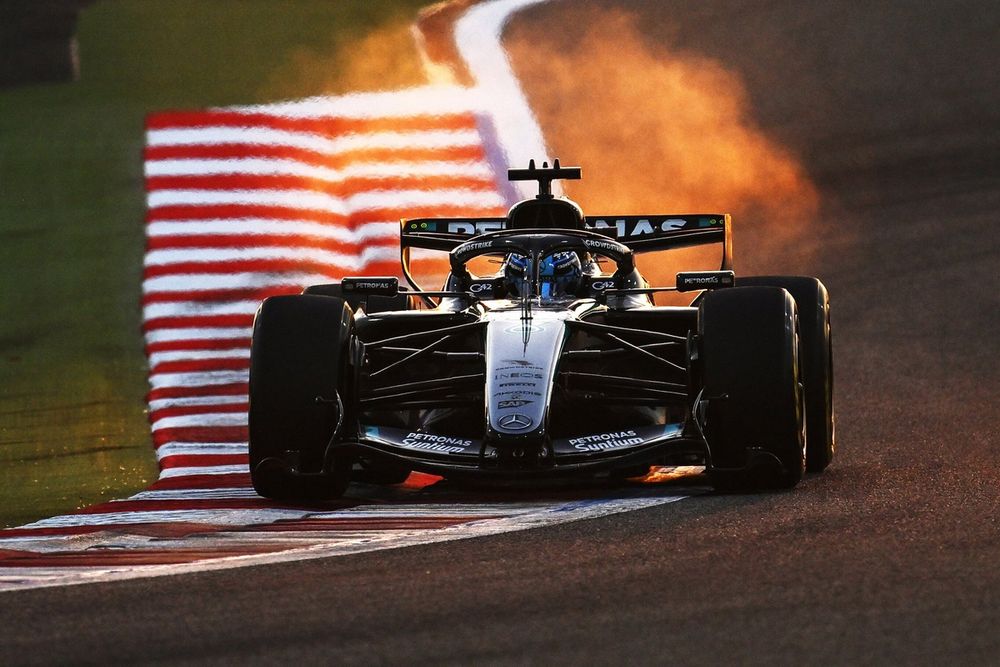
Russell took top spot by 0.01s from Piastri
Photo by: Sam Bagnall / Sutton Images via Getty Images
As the opening test was restricted to the three hardest Pirelli compounds, there were few performance runs across the grid as the majority of the teams sought to spend their time dabbling in the longer runs. Even on the C3s, however, the benchmark set by Kimi Antonelli from last week was already close to falling in the morning session as Charles Leclerc got within a tenth of the Italian’s time from the third day. The Monegasque had done his time on the prototype C3s, as the Italian rubber brand did a back-to-back test of the same construction from its Turkey plant.
The C4 and C5 tyres have also been made available for this week. Oscar Piastri then posted a 1m33.469s – still on C3s – just before sun-down to set a new high-water mark in the afternoon. A follow-up effort on the C4s did not yield an improvement on lap time after a couple of lairy moments at the rear axle, but the Australian’s time remained untouched for almost two hours before George Russell found 0.01s with half an hour left to run. Piastri’s additional attempt on the C4s could not enact a return to the top.
Read Also:
There were a sprinkling of improvements on the C4 compound, led by Isack Hadjar; before Russell posted his chart-topping efforts on the C3, Hadjar had claimed a purple opening sector, but lost the lion’s share of his eventual 0.8s deficit to Piastri’s then-headliner in the middle sector. Still, it was enough to elevate the Red Bull driver into sixth in the times, putting him ahead of Lewis Hamilton. Carlos Sainz also put together a run on the C4s, enough to secure ‘best-of-the-rest’ status with eighth overall.
On the note of tyre allocation, all but one team has taken at least one set of C4 tyre – Mercedes being the outlier, having only asked for the C1-3 compounds for the second week. Cadillac, Alpine, Aston Martin (which does not have any C1-C2 tyres) and Williams were the only teams to opt for at least one set of C5s for this week.
Start solution trialled, more sprints in 2027?
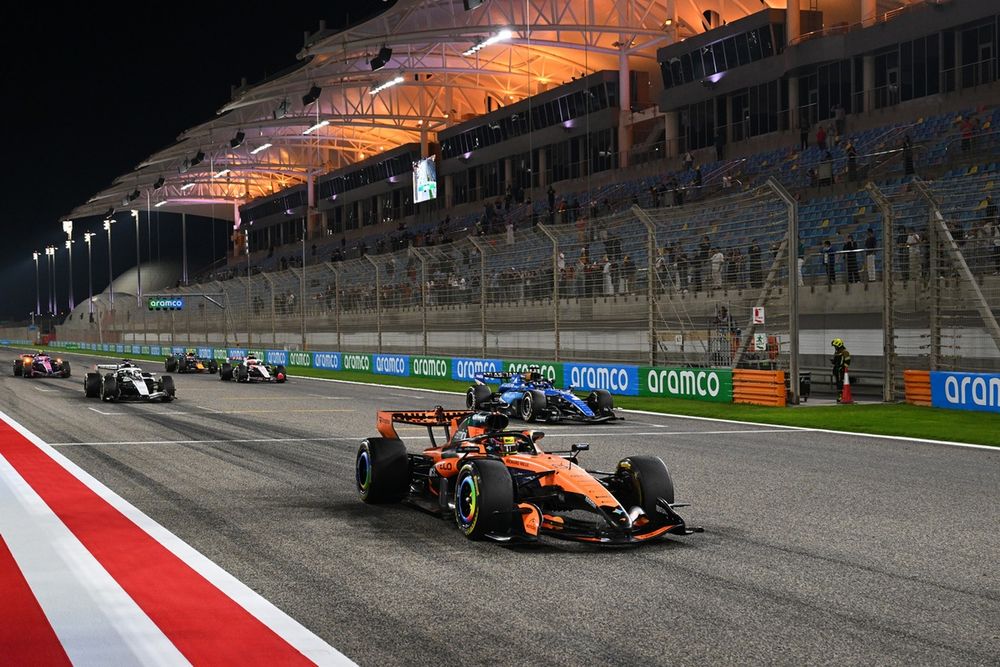
A trial of a new start procedure appeared to be a positive step for all drivers
Photo by: Mark Sutton / Formula 1 via Getty Images
One of the outcomes from the F1 Commission meeting, following discussions over start-line issues, was to implement a trial at the end of the day. To allow teams to get their turbos up to speed, an extra concession was made for the practice start once the clock had elapsed: once all cars taking to the practice start had lined up, there would be a five-second delay before the usual start sequence could begin. Including the light sequence, this gave teams around 10 seconds to hold the revs to ensure the turbocharger could deliver the requisite torque off the line.
Read Also:
In theory, a ‘normal’ start would be a significant disadvantage to those who qualified at the back; while those at the front could sit at their desired revs for well over 30 seconds, those who queue up last would only receive around five to six seconds of spool-up time.
All told, the test start seemed to go relatively smoothly: Oliver Bearman took part in the trial run, and gave his approval to the solution implemented by the FIA. Assuming there are no major objections, it is likely that this year’s starts will continue with an almost imperceptible delay.
“There’s been a review of starts and some discussion on how do we ensure that, firstly, they’re as safe as possible, so that’s the most important thing, and there were some concerns that were voiced previously,” explained McLaren’s Mark Temple. “This was a chance to put a number of cars together to go through what we expect the start procedure to actually be, and certainly from what I saw, it all looked pretty normal and pretty sensible.
“There were one or two cars weaving around perhaps more than they should have done for a kind of a practice start, but actually I think that kind of helps allay some of those fears. I think when everyone’s ready, everyone knows what they’re doing, and the procedures are followed, I don’t think it’s a big issue, I think it’s going to be perfectly reasonable. I’m sure there may be a little bit more fine-tuning, and there’ll be feedback from this one, from the drivers, from the teams, and that will be revisited.”
Many of the outcomes from the meeting were preludes to further meetings – which might be a familiar feeling to many readers – with a hint that F1 may consider upping the number of sprint races to 12 in the future, depending on commercial interest. Clarity has also been sought on the ongoing compression ratio saga, with a vote expected to determine whether to implement a further test at 130 degrees. Although compression ratio rules say that it must be no greater than 16:1, it is only able to be tested at ambient temperatures.
Aston Martin continue to find trouble
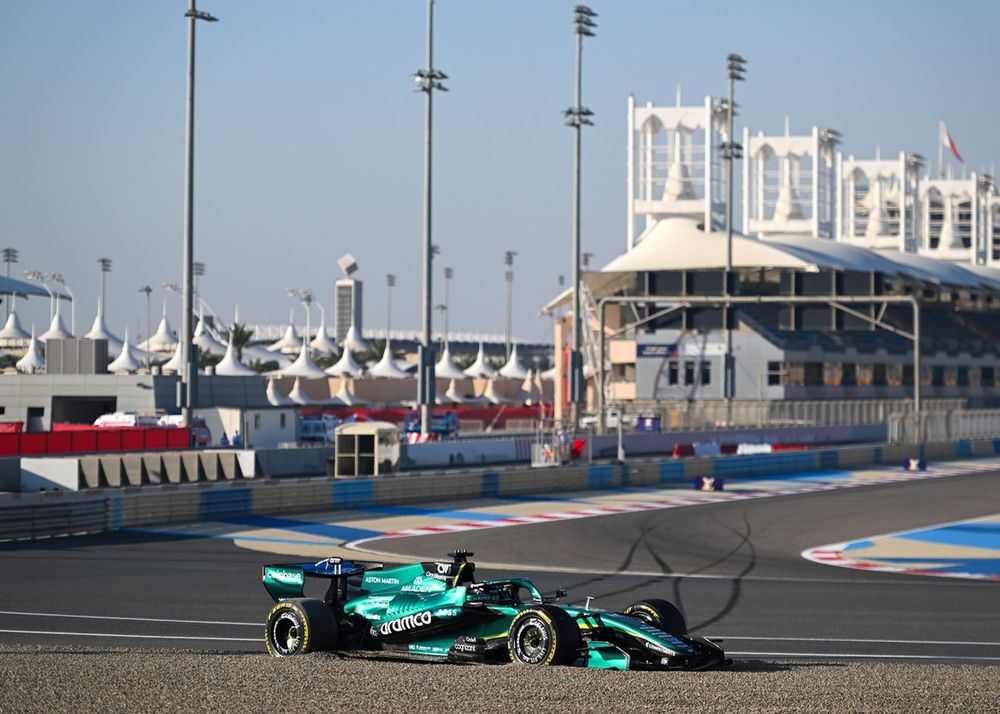
Stroll found himself beached after and off in the afternoon session
Photo by: Rudy Carezzevoli / Getty Images
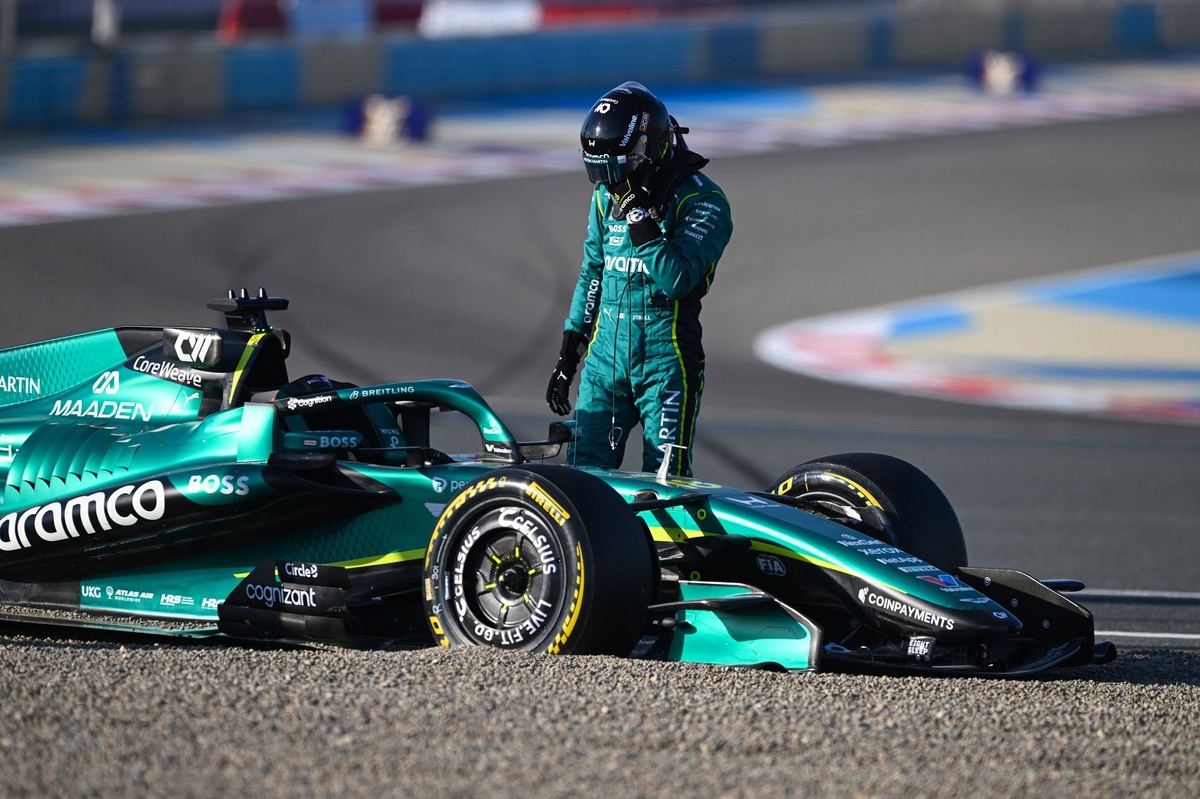
Neither Aston Martin driver went beyond the 30-lap mark on Wednesday: Fernando Alonso did 28 laps before calling it a day early with powertrain concerns, while Lance Stroll only managed 26 either side of throwing his AMR26 off the road at Turn 11. The Canadian put his car into the gravel, as the rear end slipped out from underneath him as the active aero switched back into corner mode, but the cause of the incident has yet to be formally identified.
For a team short on mileage compared to everyone else, this was not a particularly auspicious day. Alonso had hope that short- and medium-term fixes could be found to alleviate the wider concerns at the team, but verbal optimism could not necessarily disguise the disappointment on his face.
Chief trackside officer Mike Krack stated that the team being “late to the party” – both in terms of its design and its arrival in Barcelona – was a key element in its struggles with its new elements.
“I think in the first place we have to acknowledge that we were late to the party,” the Luxembourger explained. “We saw it in Barcelona, it was good we went to Barcelona but we were not really ready, we got the car going and then a similar thing happened at the beginning of this test here.
“We have a lot of little problems that prevent us from running and they are in all areas of the car. We have new electronics, we have a new powertrain, we have a new gearbox, we have a new suspension, so it is difficult to isolate one single area that would be the easiest. If you have just one item to fix that you can put all your efforts on that, so I think it is probably lateness that put us into a bit more difficult situation on the reliability side.
“But I said it earlier, if you do not accumulate the laps and I think we have like three times less laps than some of the best competitors, that puts you behind. You need to be realistic about it and then you need to catch up.”
What Aston Martin needs now are two trouble-free days. Otherwise, Melbourne is going to be an almighty struggle; while Alonso and Stroll demonstrated that some degree of midfield-adjacent pace is available, points would appear to be a lofty aim.
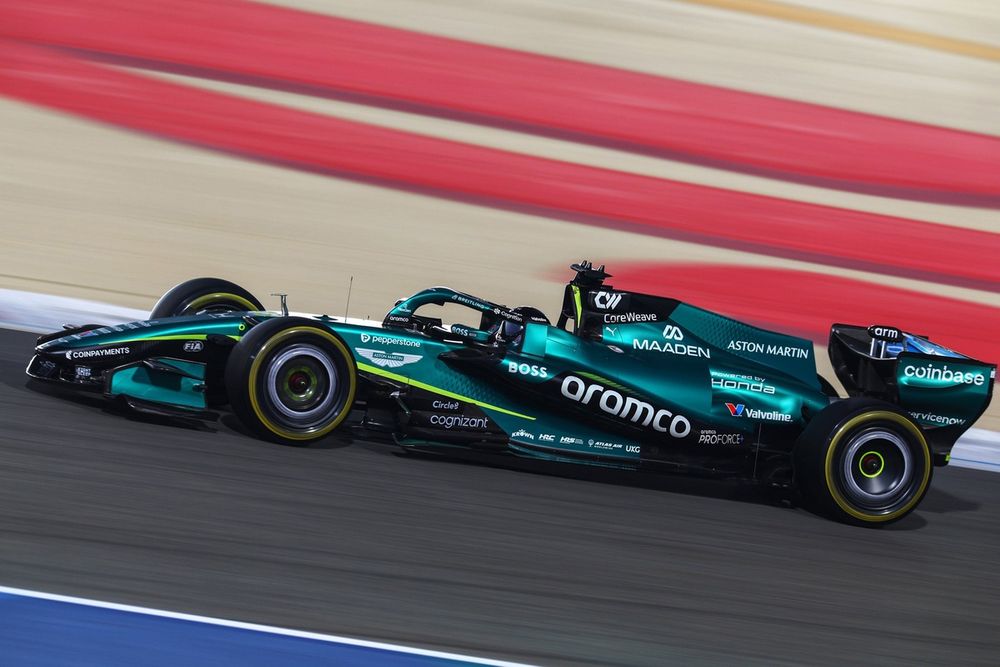
Can Aston Martin recover over the final two days of testing?
Photo by: Andy Hone/ LAT Images via Getty Images
We want to hear from you!
Let us know what you would like to see from us in the future.
– The Autosport.com Team