
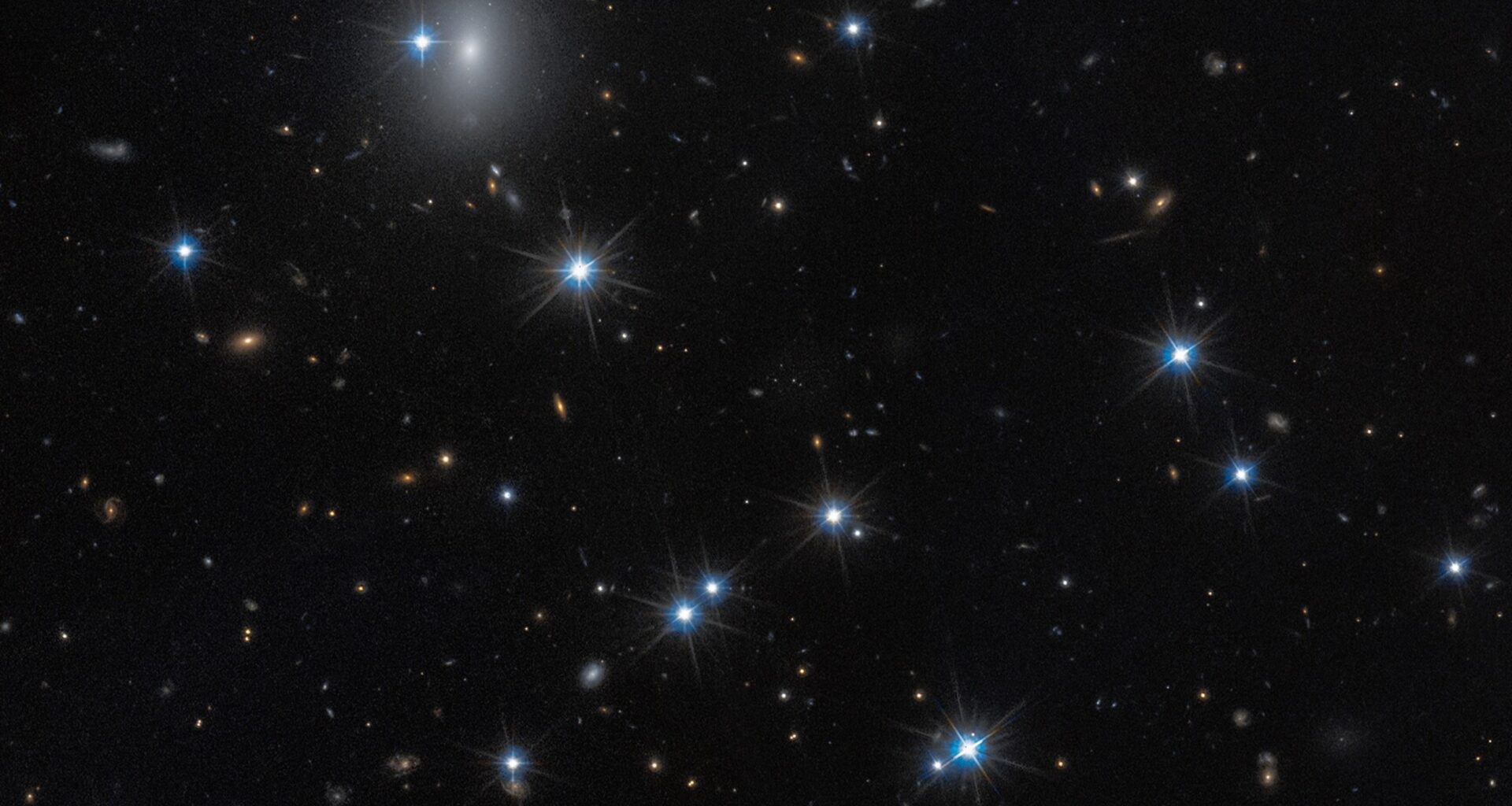
Today’s Image of the Day from the NASA/ESA Hubble Space Telescope features a galaxy that barely exists in the light.
Most galaxies blaze across the universe with billions of stars. They glow in spirals and clusters, lighting up the darkness. But some galaxies are different. They are faint and almost invisible.
Astronomers call them low-surface-brightness galaxies, and they are thought to be dominated by dark matter – the invisible material that does not reflect, emit, or absorb light.
One such object, known as CDG-2, may be among the most dark matter-dominated galaxies ever found.
A recent study published in The Astrophysical Journal Letters suggests that this dim system hides far more mass than its faint glow would suggest.
A galaxy revealed by its star clusters
Finding galaxies like CDG-2 is not easy. They do not sparkle with dense star fields or stand out in telescope images.
Instead, researchers searched for something indirect: globular clusters. These compact, spherical groups of stars often orbit larger galaxies and can act like signposts pointing to hidden structures.
David Li and his team at the University of Toronto used advanced statistical techniques to scan for tight groupings of globular clusters.
In the process, the scientists identified 10 previously confirmed low-surface-brightness galaxies and two additional dark galaxy candidates. One of those candidates would turn out to be CDG-2.
“This is the first galaxy detected solely through its globular cluster population,” said Li. “Under conservative assumptions, the four clusters represent the entire globular cluster population of CDG-2.”
Confirming a ghost galaxy
To confirm the discovery, astronomers brought in some of the most powerful tools available.
Observations from NASA’s Hubble Space Telescope, ESA’s Euclid, and the Subaru Telescope in Hawaii worked together to piece the puzzle together.
Hubble’s sharp vision revealed a tight collection of four globular clusters inside the Perseus galaxy cluster, about 300 million light-years from Earth.
Follow-up observations from Hubble, Euclid, and Subaru uncovered a faint, diffuse glow around those clusters. That soft light provided strong evidence that a galaxy was there all along.
The Perseus cluster is a crowded and chaotic environment. Galaxies there interact, tug, and sometimes strip material from one another.
In such a setting, a fragile galaxy can lose much of the gas needed to form new stars.
Almost entirely dark matter
Preliminary analysis suggests CDG-2 shines with the light of roughly 6 million Sun-like stars.
That may sound like a lot, but compared to the Milky Way, which holds hundreds of billions of stars, it is extremely small. Even more striking is how little of its mass is visible.
The globular clusters account for 16% of CDG-2’s visible content. Yet about 99% of the galaxy’s total mass appears to be dark matter. In other words, nearly all of what holds this system together cannot be seen.
Much of the normal matter that would have fueled star formation, mainly hydrogen gas, was likely stripped away by gravitational interactions within the Perseus cluster. What remains is a dim stellar remnant wrapped in a massive dark matter halo.
Globular clusters are key to this story. They are tightly bound by gravity and packed with stars. That density makes them more resistant to tidal forces that can tear apart looser structures.
Even when a galaxy is stripped down to almost nothing, its globular clusters can survive. They act as reliable tracers of these ghostly systems.
Searching for the invisible
Astronomy is changing fast. Modern sky surveys collect enormous amounts of data.
Missions like Euclid are mapping large portions of the sky with precision, while NASA’s upcoming Nancy Grace Roman Space Telescope and the Vera C. Rubin Observatory will push that effort even further.
With so much data, astronomers are turning to machine learning and advanced statistical tools to search for subtle patterns.
Instead of spotting bright galaxies directly, they can now identify the small clues left behind, like clusters of ancient stars. CDG-2 may be just the beginning.
If more galaxies can be detected through their globular cluster populations alone, scientists could uncover an entire population of dark matter-dominated systems hiding in plain sight.
Each new discovery sharpens our understanding of how galaxies form, evolve, and sometimes fade.
Image Credit: NASA, ESA, D. Li (Utoronto), Image Processing: J. DePasquale (STScI)
—–
Like what you read? Subscribe to our newsletter for engaging articles, exclusive content, and the latest updates.
Check us out on EarthSnap, a free app brought to you by Eric Ralls and Earth.com.
—–