
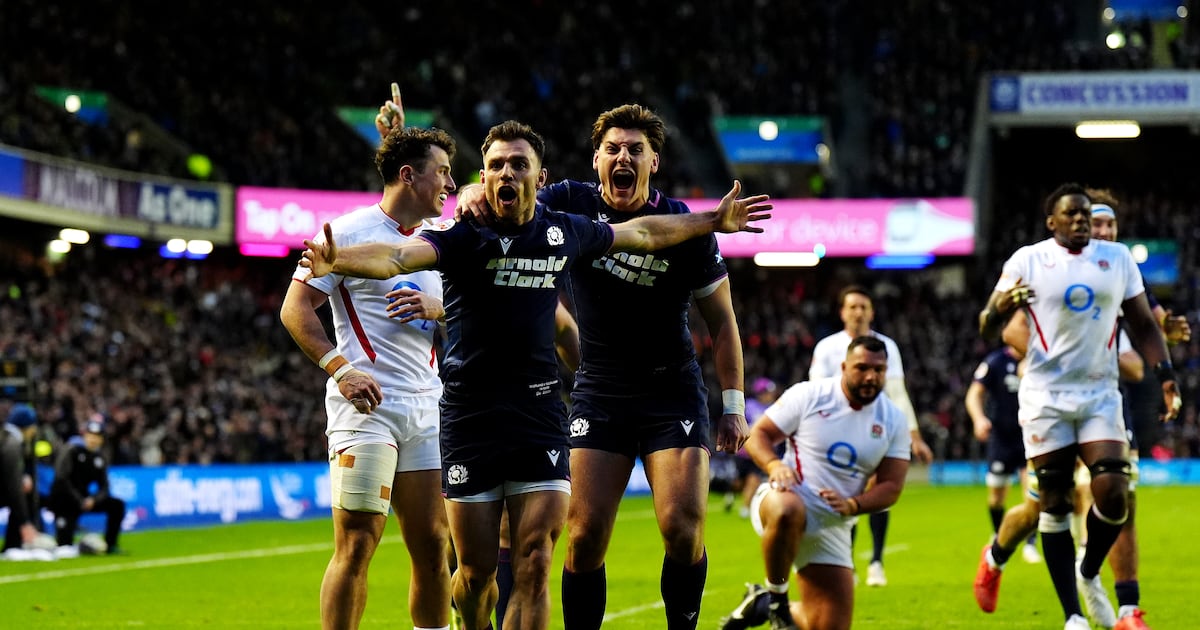
If imitation is the sincerest form of flattery then many an indirect compliment could well be heading Scotland’s way from Ireland’s training centre in Abbotstown.
While Gregor Townsend has an excellent record against England, particularly in Murrayfield, the nature of Scotland’s defeat to Italy in round one left few believing in their ability to cause an upset. Cue an excellent performance that ended English Grand Slam hopes.
Given the positivity emanating out of England’s winning run before then, combined with their own middling form, Ireland will still be considered underdogs ahead of the weekend’s trip to south-west London. Is there anything from what Scotland did tactically, though, that Ireland can also use to close the apparent gap between the sides?
Bombs away 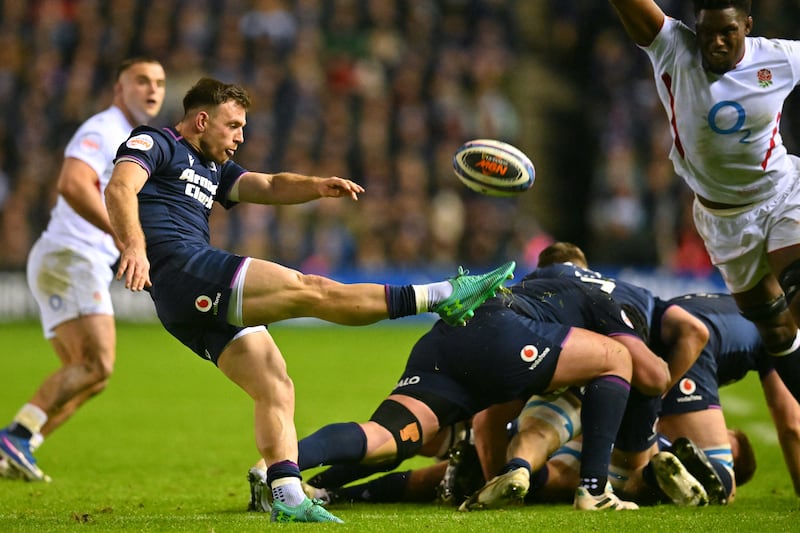 Scotland’s scrumhalf Ben White kicks the ball. Photograph: Andy Buchanan/AFP via Getty
Of all the areas where Scotland may have bettered England, the aerial game was not entirely predictable. Sides who kick for the most metres in Test matches come out on top 75 per cent of the time. Under Steve Borthwick, England rarely come off second best in this metric.
On Saturday, Scotland kicked for 868 metres to England’s 661. Both numbers are somewhat low given the sport’s direction of travel, but nevertheless Scotland’s ability build more territory from the boot was a significant factor in their victory.
Finn Russell regularly kicked long and on, inviting England to run, backing his kick chase while keeping England’s pack on the move. If Scotland did look for touch, Ben White at scrumhalf was excellent when finding length on his clearing box kicks.
The big area of surprise dominance, though, was the short kicking game. Between the two sides, 22 contestable kicks were launched skywards. Fourteen of those kicks resulted in Scotland earning possession, eight for England.
While not as easy on the eye as France in this area, Borthwick’s side is nonetheless effective at winning aerial contests and utilising speed to attack on transition.
Scotland by and large took those aerial victories away from England. At times through their own excellence in the skies. They were also proficient at getting bodies all around the jumper, leaving players in front and behind to pounce on any loose balls.
It should be said, though, that plenty of Scotland’s success came from English errors. Of the 12 times they emerged from a high ball with possession, eight came either from English spills or, in one case Henry Arundell taking out the jumper.
Which shows the variance of a kick-heavy strategy. By creating a situation where both sides have an significant influence on the bounce of the ball, there will be outings where those bounces don’t go your way – no matter how good aerially a side is. We may well have seen that variance simply swinging against England in a one-off match, as much as Scotland outcompeting them.
Ireland can of course improve their own aerial game and look for similar success to Scotland. Arundell is not a particularly strong aerial player and can be targeted. But it remains to be seen if England will compound one poor aerial display with another in quick succession.
Breakdown watchers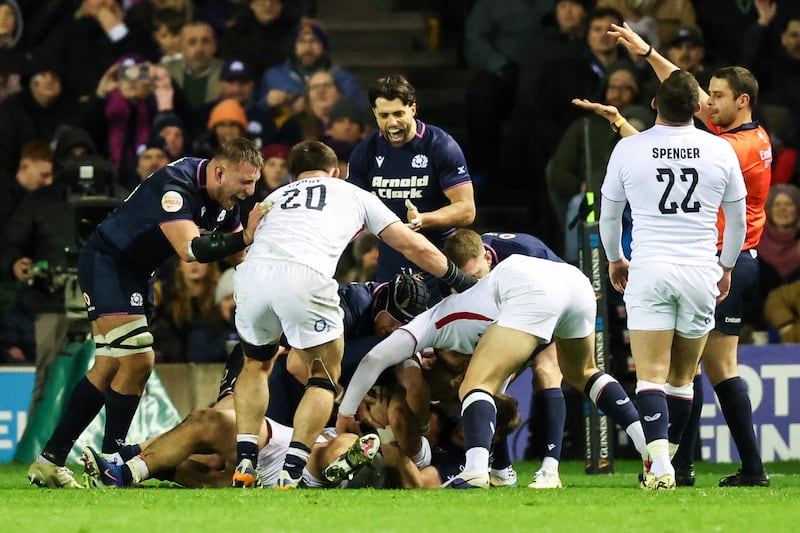 Scotland’s Matt Fagerson and Adam Hastings celebrate against England. Photograph: Ross Parker/SNS Group via Getty
The downside to Scotland’s willingness to take on England in the air, and the resulting high error count, was that even if play resumed with a Scottish scrum, they were under pressure. The English scrum was excellent on Saturday, Ellis Genge making mincemeat of his opposite man. How do you think the English pack reacted to seeing clips of Tadhg Furlong launched skywards by a vicious Italian drive?
England had penalties and kicked them into good attacking positions. What Scotland did in response was effective at limiting the damage on the scoreboard. Four breakdown turnovers on the day might suggest a desire to flood the breakdown and make a mess of England’s ball. If anything, Scotland did the opposite, selectively competing only at the right times, hence a decent number of successful turnovers.
England saw 62 per cent of their rucks last fewer than three seconds. Over the course of the 80 minutes, Scotland did not slow their ball. Instead, they prioritised having defenders on their feet and making two-man tackles. They won plenty of collisions. They also asked an English attack shorn of transition opportunities created by good aerial work to go to their plan B. Scotland were content to let England run out of ideas in front of a well-stocked defence, pouncing at the right time to win the ball back.
Huw Jones’ try off George Ford’s blocked drop-goal is a good example. This was well into England’s phase count but, despite the high defensive workload, Scotland still have 13 men on their feet. That limits Ford’s options for passing but, crucially, means more defenders on their feet close to the ruck. More runners to try and successfully block the kick.
Ireland are a barge team at rucks, they love spoiling breakdowns. So copying Scotland here would be change of tack. Given Ireland have historically won more collisions than they’ve lost against Scotland – they certainly have a stronger pack – then they should also back themselves in contact after watching Scottish success. In theory, this makes the defensive ploy an easier tactic to successfully copy than relying on kicking variance once again hampering England.
Balanced attack 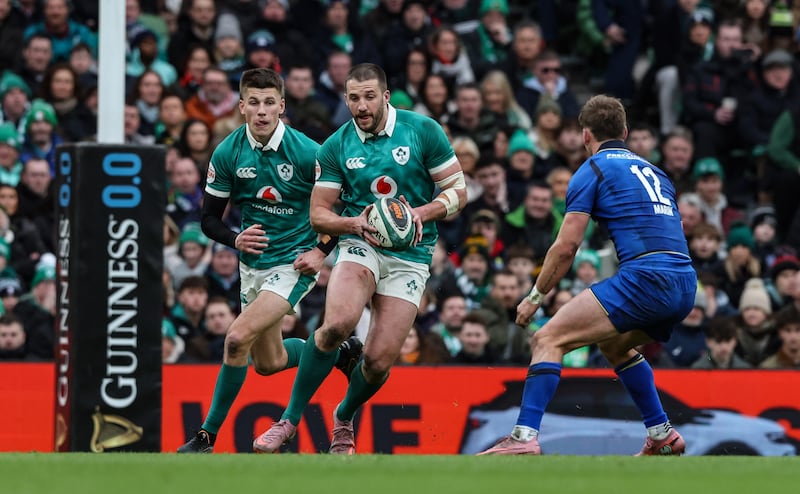 Ireland’s Stuart McCloskey in action. Photograph: Billy Stickland/Inpho
Scotland’s attack was generally excellent on Saturday. Their strike moves off set-play in particular, one try set up by flooding Tommy Freeman’s 13 channel and forcing him into an error.
The skill of Scotland’s midfield is undoubtedly important here. Ireland have their own strengths in this area with Stuart McCloskey arguably in career-best form.
Decision making was as important as execution. In the second half, Scotland were willing to go wide deep inside their own 22 because they spotted an opportunity with England putting Ford, their weakest midfield defender, into the 13 channel. They took a risk based on the picture in front of them, making plenty of ground. They were as happy operating in this manner as they were taking on England in the air.
Which is something that Ireland should look to replicate. In Paris, Andy Farrell’s group was criticised or sticking to a kicking ploy that led to virtually no reward until the game was up. Against Italy, they at times went in the other direction, playing empty phases in the wrong parts of the field when kicking could have been an option.
Scotland kicked 28 times, had 100 attacking rucks and made 186 post-contact metres. Not stellar attacking numbers but good enough on the day. Ireland had significantly more post contact metres against Italy but were guilty of overplaying. Accuracy and execution played into this, yet Scotland’s balanced approach certainly can be taken as inspiration.