
Kendra Pierre-Louis: For Scientific American’s Science Quickly, I’m Kendra Pierre-Louis, in for Rachel Feltman.
Your home is a death trap. It is a place where, if you’re not careful, your furniture can topple and crush you. You can burn yourself on the stove, choke on a meal, slip in the shower or drown in the bathtub.
And for people with Alzheimer’s or dementia the risk of experiencing serious accidents at home goes up. What happens, for example, if someone puts food on the stove to cook and forgets to turn it off?
On supporting science journalism
If you’re enjoying this article, consider supporting our award-winning journalism by subscribing. By purchasing a subscription you are helping to ensure the future of impactful stories about the discoveries and ideas shaping our world today.
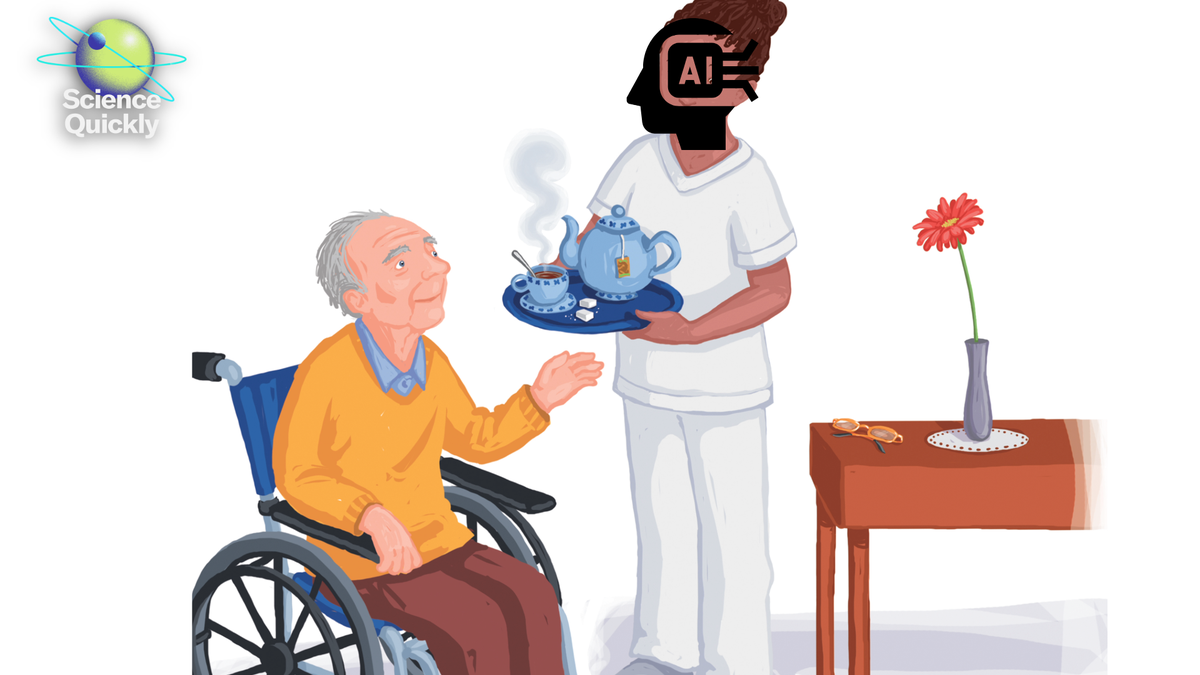
But what if homes were smarter, less deadly? Increasingly, researchers are looking at how AI may be able to improve homes for people with Alzheimer’s and dementia while also reducing the strain on caregivers.
Multimedia journalist Meghan McDonough is here with more.
[CLIP: The narrator speaks during the trailer for the movie Smart House: “Ben Cooper has won a computerized ‘Smart House’ for his family …”]
Meghan McDonough: This is the trailer for Smart House, a 1999 Disney Channel Original Movie. It was directed by LeVar Burton, of Reading Rainbow fame. It introduced scores of millennials like me to the concept of a science-fiction computerized house.
[CLIP: The narrator of the Smart House trailer continues speaking:“Complete with video wall projections, a state-of-the-art control room, floor absorbers and maternal instincts.”
The house speaks to Ben’s sister, Angie: “Biorhythm analysis indicates this is exactly the outfit you would’ve selected yourself.”]
McDonough: More than a quarter-century later we don’t yet have floors that suck up spills or holographic assistants—at least, most of us don’t. But we have artificially approximated the watchful eyes of a human caregiver, eyes that are always on in the background, without needing to take breaks or look away.
Today researchers are creating real-life “smart homes,” including for older adults with Alzheimer’s disease and other conditions that cause dementia. These houses are equipped with AI systems designed to do everything from preventing falls to identifying acute health issues.
This is just one of the many ways scientists are trying to leverage artificial intelligence to help care for individuals with dementia. So far these technologies are showing real promise in increasing quality of life for patients and reducing strain on caregivers.
But Smart House the film takes a dark turn when the house’s virtual assistant, named PAT, begins to overstep with her trained maternal instincts …
[CLIP: Nick Cooper, Ben and Angie’s father, speaks to PAT:“I want you to stop this now.”
PAT responds to Nick: “I’m sorry. I can’t do that, Nick. There’s nothing to fear. Mama’s here.”]
McDonough: Reflecting fears about AI that are still salient almost three decades later. And while PAT leans more fiction than science today’s technology does pose a range of both foreseeable and unforeseeable risks.
George Demiris: We have to be careful as we create these solutions that we address what could go wrong and also whether we sometimes might be creating new problems instead of a solution.
McDonough: George Demiris is a faculty member of the nursing and medical schools at the University of Pennsylvania. We’ll get to those risks he mentioned in a bit, but first, let’s take a step back and look at the scope of the situation.
Regina Shih: So about six to seven million people in the U.S. live with dementia.
McDonough: This is Regina Shih, an epidemiologist at Emory University’s School of Public Health and a board member of the National Alliance for Caregiving.
Roughly one out of 10 adults 65 and older has dementia, most commonly as a result of Alzheimer’s disease, according to a 2022 report.
If we don’t have some kind of medical breakthrough that offers a surefire way to prevent or cure these conditions, the number of people diagnosed with dementia each year is projected to double by the year 2060, according to a 2025 study in Nature. That adds up to nearly 14 million adults in the U.S. living with dementia in the not-so-distant future.
But what impacts are these conditions having on everyone else right now?
Shih: The National Alliance for Caregiving and AARP just recently put out a 2025 report called Caregiving in the US, and the report found that 27 percent of caregivers are caring for somebody with Alzheimer’s or another related dementia [or memory-related condition]. Those people with dementia often need hands-on, around-the-clock care as they progress into the later stages of dementia.
About a quarter—one in four Americans is a family caregiver, and that represents nearly a 50 percent increase over the last decade.
McDonough: More adults with dementia means more caregivers.
As it stands caregivers are already investing a great deal of time in supporting their loved ones.
Shih: Caregivers are spending, on average, about 27 hours per week on care.
McDonough: The care provided by millions of unpaid family caregivers amounted to $600 billion in the year 2021, according to an AARP report. For seven out of 10 working-age caregivers, they’re providing this support on top of doing their regular job.
Adding to their troubles many caregivers, Regina says, report challenges accessing affordable services. That is especially true for those who live in rural areas.
This all takes a toll.
Shih: Many of those care partners are cutting back on work. They’re leaving the workforce. And that results in impacts to their earnings.
McDonough: And the costs they’re forced to take on are not just financial, Regina says.
Shih: Family caregivers, especially to people with dementia, experience much higher rates of mental health, as well as physical, impacts.
McDonough: But what if artificial intelligence could lift some of the burden associated with that around-the-clock human care—and at a much lower cost?
Demiris:When we think about Alzheimer’s disease or dementia more broadly it’s not only how to identify, how to prevent it, how to treat it, how to develop the right medications but then also how to maintain quality of life for those diagnosed with it, how to support family members and others, and how to support clinicians in their clinical decision-making.
McDonough: Here’s George again. He’s the principal investigator for PennAITech, or the Penn Artificial Intelligence and Technology Collaboratory for Healthy Aging, which is funded by the National Institutes of Health.
Demiris:We’ve seen a lot of potential in what technology can do to improve quality of life for people as they may be experiencing cognitive or functional decline and promote their independence.
McDonough: That’s important because surveys show that older adults overwhelmingly prefer to age in place and receive any needed care at home.
Over the past five years PennAITech has overseen more than 50 research projects and upwards of $12 million in grant funding dedicated to artificial intelligence that supports aging well, George says.
One of these projects is from a company called BrainCheck. Its chatbot is designed to help patients with Alzheimer’s and dementia and their caregivers navigate care plans.
There’s also etectRx’s technology, which remotely monitors whether older adults are taking their medication on time.
And Health Tequity, the creator of a platform that analyzes information from a patient’s past health records and remote monitoring, along with population-level data, to create AI-powered “digital twins” …
Demiris:Where you could actually answer certain questions, such as what would happen if we were to change the dose of their blood-pressure medication, and use the AI tools to figure out and predict what that outcome would be.
McDonough: One intervention developed by researchers at Penn Nursing, called Sense4Safety, aims to prevent falls by observing individuals at home with technology previously used in video games.
Demiris:Depth sensors provide a silhouette extraction rather than an actual video image of the individual, so in that sense they can be more privacy-preserving. But that’s important for us to be able to extract important information about that person’s gait: their stride length, their gait speed, their overall balance. By capturing how a person walks in their apartment we can better understand how their gait may or may not change over time and whether the risk for falling increases.
The idea here is not to have a human at the other end look at those data points in real time …
McDonough: That’s precisely what the use of AI is meant to avoid, given the overwhelming burden of dementia-related care expected in the years to come.
Demiris:But rather to have the right algorithms so we can actually intervene where something seems to be different, so we can be more proactive and intervene before an adverse event happens.
McDonough: In other words this artificially intelligent system is intended to not only notice if someone with cognitive conditions falls but to help anticipate potential problems.
Demiris: If somebody has a certain routine to their daily living and slowly over time they seem to become more isolated, less active or in general experience some significant changes in their activities of daily living …
McDonough: The AI analyzes the data to get a better understanding of the shifts that are happening, with the goal of allowing nursing-home staff or caregivers to …
Demiris:Intervene earlier before something happens—before a fall happens or before social isolation and loneliness exacerbate to the point where it has significant health impacts.
McDonough: And the more data the algorithm receives, the better it becomes at continuously calculating the individual’s fall risk.
Demiris: So if there’s changes in their gait that indicate that that person is at a higher risk for falling, we can actually intervene through tailored exercises but also environmental modifications …
McDonough: Like improving lighting, for example, or fixing a loose rug.
To test the system George and his team installed Sense4Safety technology in the homes of 75 people 65 and older with mild cognitive impairment. All participants resided alone within senior living communities in the greater Philadelphia metro area.
Susan Palmer was one of them. She says she’s experienced falls in the past, and it’s made her want to be more careful.
Susan Palmer: A representative from Penn came and gave us a talk on it and what it entailed, and it sounded interesting, so I decided to sign up if I could be of any help. They put a camera in my apartment to track my gait.
Demiris: We observed them for one year, but we also had a clinical expert who would visit them every three months.
McDonough: On those visits the clinician observed their gait, measuring speed and stride length.
Demiris: What we found in our study was that the assessment that was done with the technology, so the AI-mediated assessment, correlated highly with the human expert.
McDonough: So the human and AI observations matched up pretty well.
George thinks smart-home sensors and AI tools like the ones used in Sense4Safety will ultimately become more low-cost and common and also mark a definite improvement on what tends to happen in our current care system.
Demiris: Right now we have a system that is very reactive. We, unfortunately, wait for a person to experience a fall, and then we’re trying to minimize the side effects of that event. And so having that type of technology could actually allow us to be much more proactive.
McDonough: And maybe its very presence could help serve as a reminder for patients and caregivers to be more proactive themselves.
Palmer: I have since signed up for PT [physical therapy] for balance, which helps.
McDonough (tape): And did you sign up because of this study?
Palmer: It had been on my mind. It just kind of tipped the edge a little bit that the study brought up the fact that balance is indeed a situation that older people get—can get into very easily.
McDonough: But while these technologies show tremendous promise for improving patients’ and caregivers’ lives, George and other experts we spoke to say they must be studied rigorously to ensure that they are not also potentially damaging.
Demiris: These systems cannot be designed only by computer scientists and engineers. We need to have teams of clinicians, social scientists, engineers, computer scientists, AI experts, ethicists to design the solutions because those are complex problems that require solutions that really touch upon a lot of different aspects of patient care.
Tiffani J. Bright: Science traditionally has focused on what works, but so much of science is finding out what doesn’t work.
McDonough: Tiffani J. Bright is an assistant professor at Cedars-Sinai Medical Center and co-director of its Center for Artificial Intelligence Research and Education.
Bright: My lab focuses on thinking about fairness and bias of AI—like AI’s great, but how do we use it in thoughtful and responsible ways?
McDonough: Tiffani says she’s always thinking about a core set of ethical concerns when it comes to AI.
One is data bias, which she says might come up with chatbots built specifically for patients with Alzheimer’s.
Bright: When you’re building these models you have to feed it a lot of data. When I’m trying to build that chatbot who’s gonna provide maybe patient education to that—like, about their condition and they’re having a conversation, they’re saying, “Hey, you know, you said you were feeling down today; well, let’s talk about that,” right, there’s a lot of training. And so we have to talk about who was included in that [training] set, what patients were and what patients weren’t.
McDonough: In other words a chatbot trained on experiences that don’t reflect those of the patient using it could provide inaccurate responses that would actually make things worse.
Tiffani also mentions data privacy as a concern …
Bright: Not only the data we’re getting but understanding the transparency: how is that—who owns it, how is that data being collected, and all of that.
McDonough: And informed consent.
Bright: When we do research, informed consent is drilled into our heads—like, day-one student: informed consent. But because of the great research that’s been done we’re also learning that Alzheimer’s and dementia isn’t a one-time thing; it’s a disease that has a process. And so when you think about asking a patient for consent today, what might that look like in six months, depending on the trajectory of their disease?
McDonough: In other words as a patient’s cognitive abilities decline how can we be sure that the consent they’re giving is adequately informed?
The last point Tiffani stresses is access.
Bright: We know that research goes where the dollars go, right? Access is where the dollars are. And so you think about these early detection systems with Alzheimer’s—well, who’s gonna have access? People who are around large medical centers, people who, you know, perhaps speak the major language, things like that. And so this is why we bring stakeholders in, this is why we have patient representatives.
McDonough: Paradoxically, the patients and caregivers who need this technology the least might end up being the only ones who can access it, at least in the early stages.
The experts I spoke with for this episode agreed that while AI has great potential to help caregivers and patients with Alzheimer’s and other conditions that cause dementia, it can’t do everything.
Here’s Regina again.
Shih: There’s no way we can replace the human interaction and empathy that is required in the delivery of family caregiving. And so I often say you cannot app your way out of hands-on care for people with dementia. Nothing replaces the hands-on care that is needed to help people eat and bathe and dress.
McDonough: AI, with rigorous study and testing, could make life easier for human caregivers and people living with these conditions. It just depends on how we choose to harness it—and how we choose not to.
Shih: I think there’s a lot of fear of AI, but we really have to take ownership in how we’re willing to let AI support our lives and how we want to live them. And that goes for all kinds of supports, not just how we support family caregivers or people with dementia.
McDonough: Here’s Tiffani again.
Bright: AI is great, but it’s not for everything. And so I think I would say to a caregiver—you know, I’ve been a caregiver, and I—so, you know—“If this tool gives you peace of mind, right, and then it still honors the dignity and respect of your loved one, then I think it’s worth exploring.”
Pierre-Louis: That’s all for today. Tune in on Friday, when we dig into what makes ice slippery.
Science Quickly is produced by me, Kendra Pierre-Louis, along with Fonda Mwangi, Sushmita Pathak and Jeff DelViscio. This episode was reported and co-hosted by Meghan McDonough and edited by Alex Sugiura. Shayna Posses and Aaron Shattuck fact-check our show. Our theme music was composed by Dominic Smith. Subscribe to Scientific American for more up-to-date and in-depth science news.
For Scientific American, this is Kendra Pierre-Louis. See you next time!