
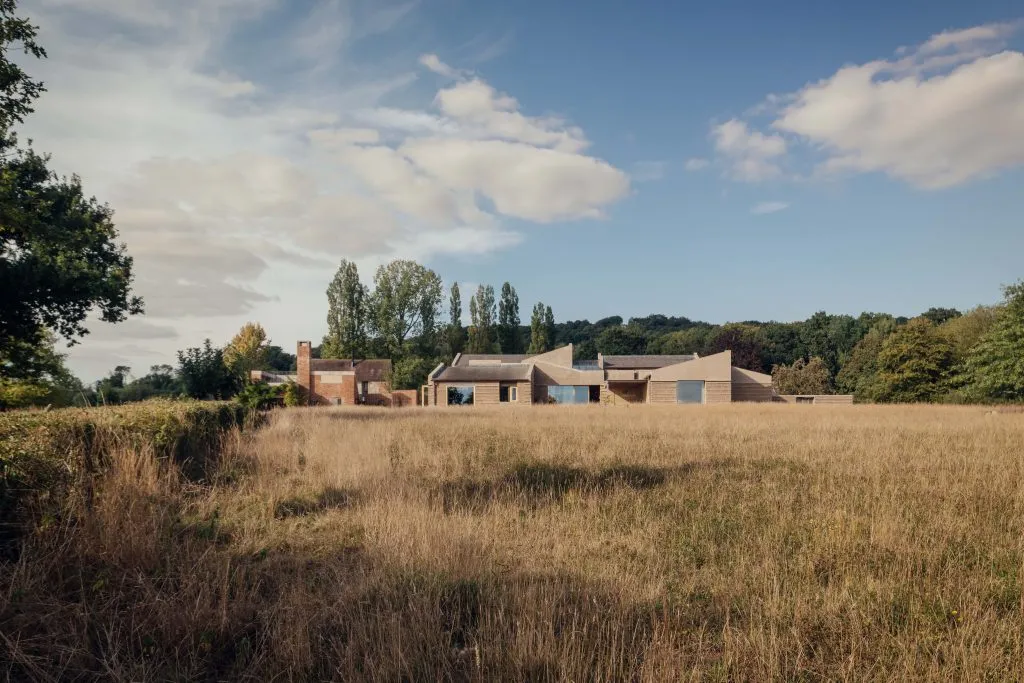
With Rammed Earth House, Tuckey Design Studio has positioned itself at the forefront of earth building in the UK. It is a home of sensual beauty designed with impressive climate literacy in a delicate orchestration of materiality, daylight, views and landscape.
With a 25-year track record in the retrofit and reuse of existing buildings (well before this became the almost mandatory approach it is today), Tuckey Design Studio, a practice known for its considered design work and increasingly for its eco-credentials, has completed its first new-build house. ‘We’d not previously done a huge amount of façade work,’ notes practice associate Emaad Damda.
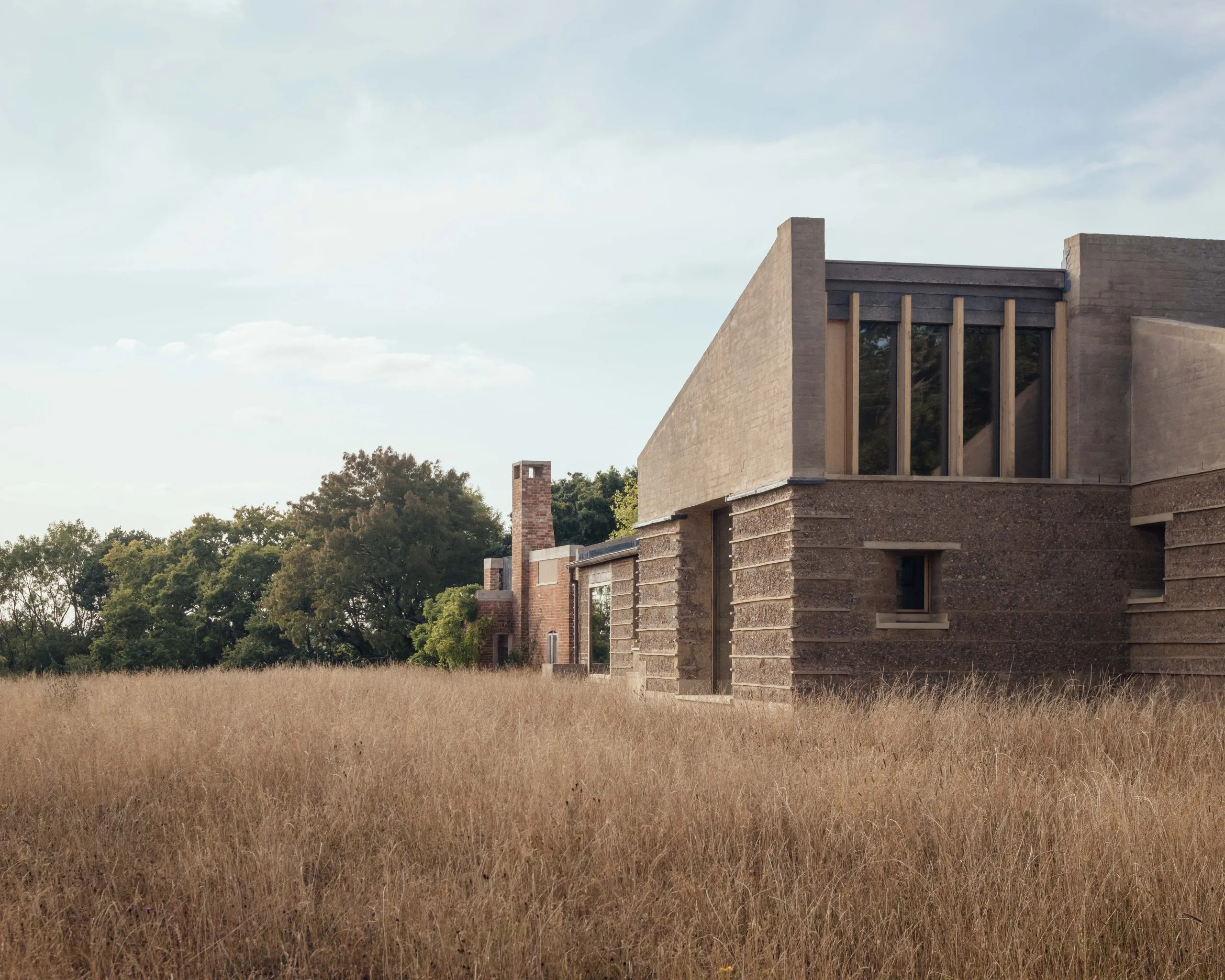
In terms of reuse, what can be more gratifying than the use of site-won materials? Located on the grounds of a former brickworks with a smattering of Victorian buildings, the Wiltshire site, in the Cranborne Chase National Landscape, is rich in clay. But the journey from the initial decision to explore rammed earth as the primary material for the walls to achieving the ideal mix with the appropriate compressive strength, erosion resistance, workability and desired appearance was arduous (and lengthy) and involved detailed input from UK and Austrian specialists in the technique.
Rammed Earth House is the product of considerable bravura on the part of both the clients – a retired couple seeking to build a home on their recently acquired 63-acre rural estate that would be intimate for two people but accommodate house guests and entertaining – and a tripartite design team: Todhunter Earle Interiors and landscape architect Pip Morrison were engaged prior to the architects.
Damda characterises this collaborative approach as a ‘productive tension’, which carried through the three-year build to include contractor Stonewood Builders. He explains that the clients’ boundless curiosity and enthusiasm (and attendance at every site progress meeting) prevailed whenever tensions surfaced.
Tuckey notes that he would be fortunate ever to encounter any other such clients. Tuckey’s own background in social anthropology (how people inhabit space) and interiors shines through, just as the rich texture and finish of the rammed earth walls meld with the clients’ carefully curated interiors, which include an eclectic mix of work by emerging artists and craftspeople and found objects – as well as a predisposition to wabi-sabi.
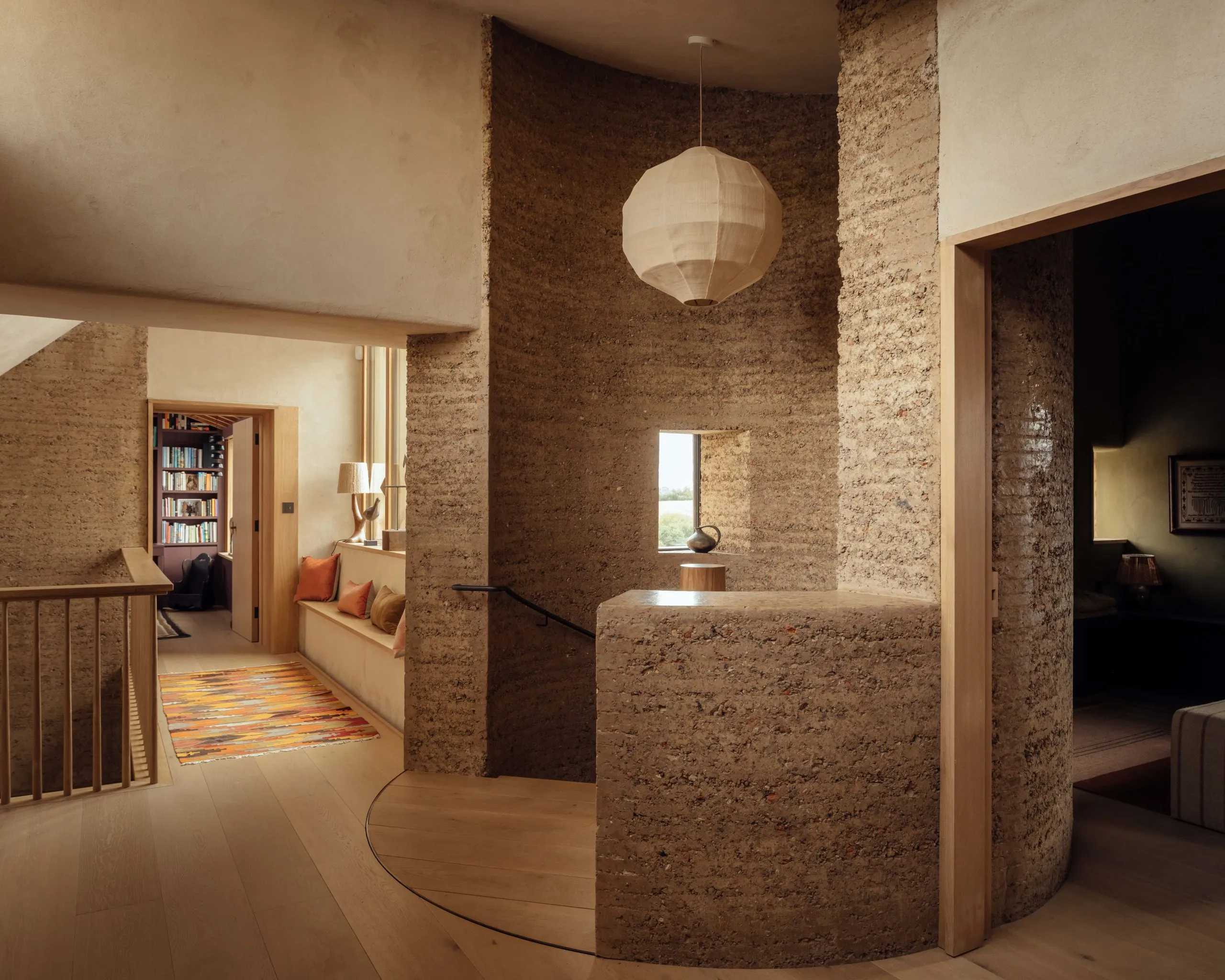
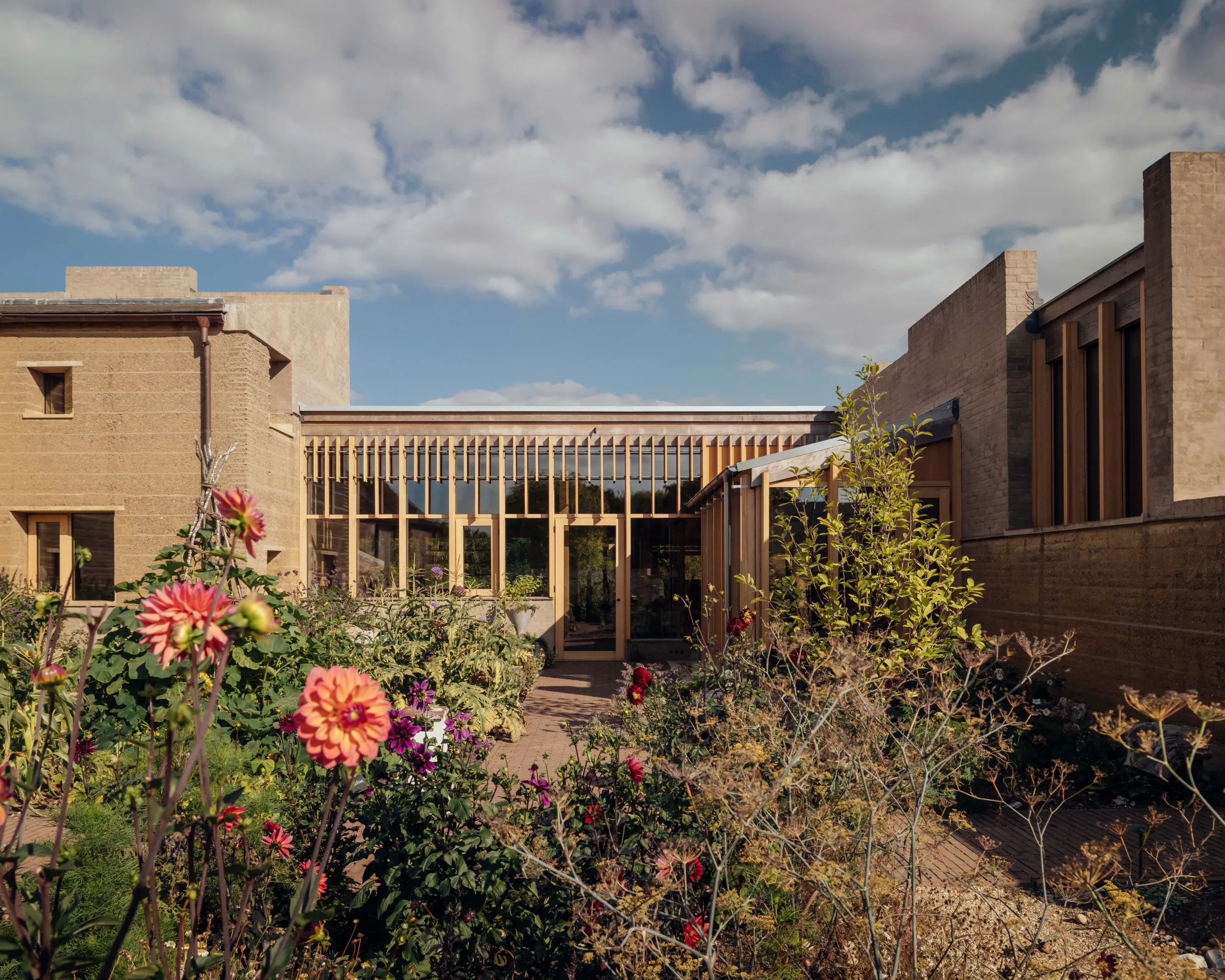
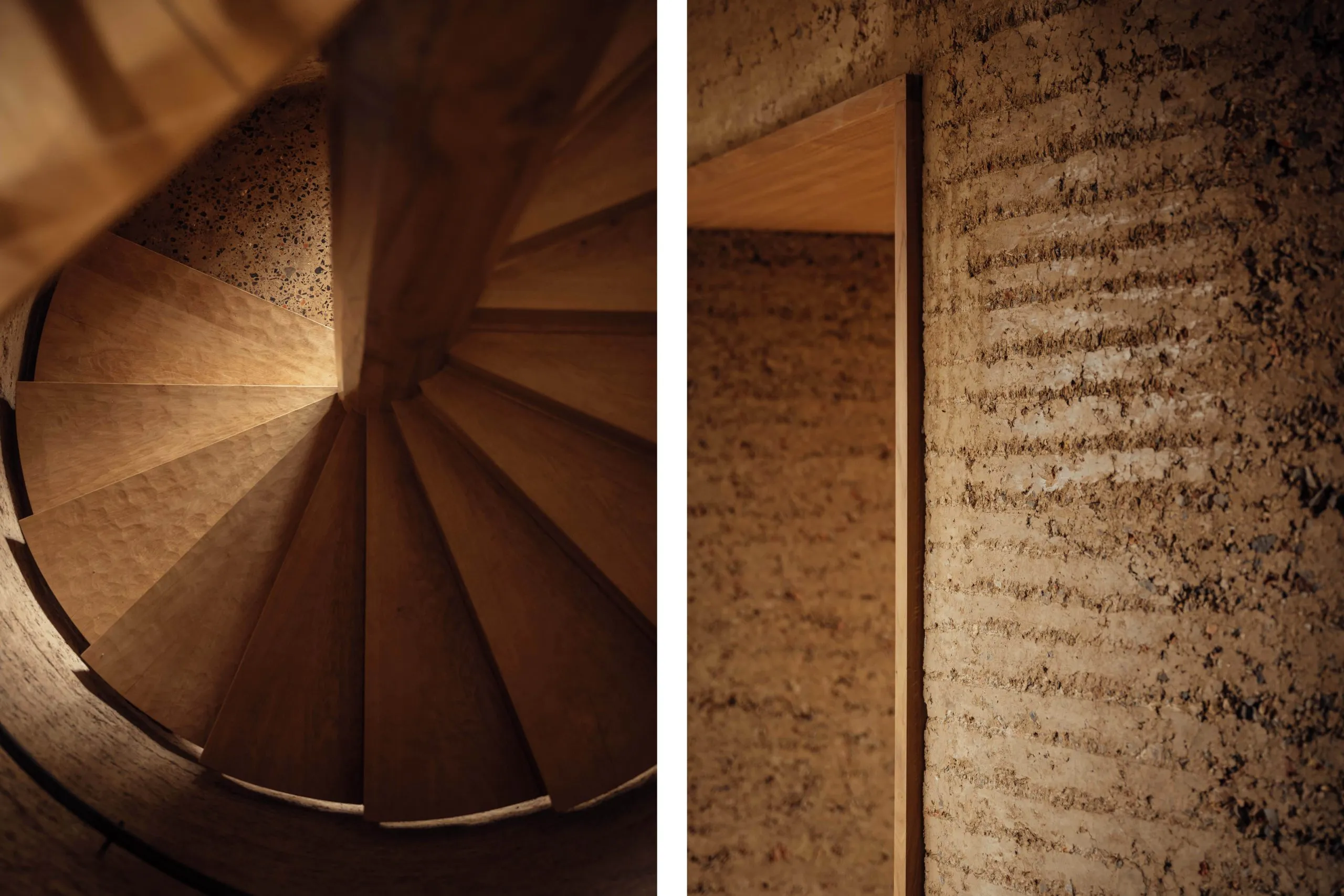
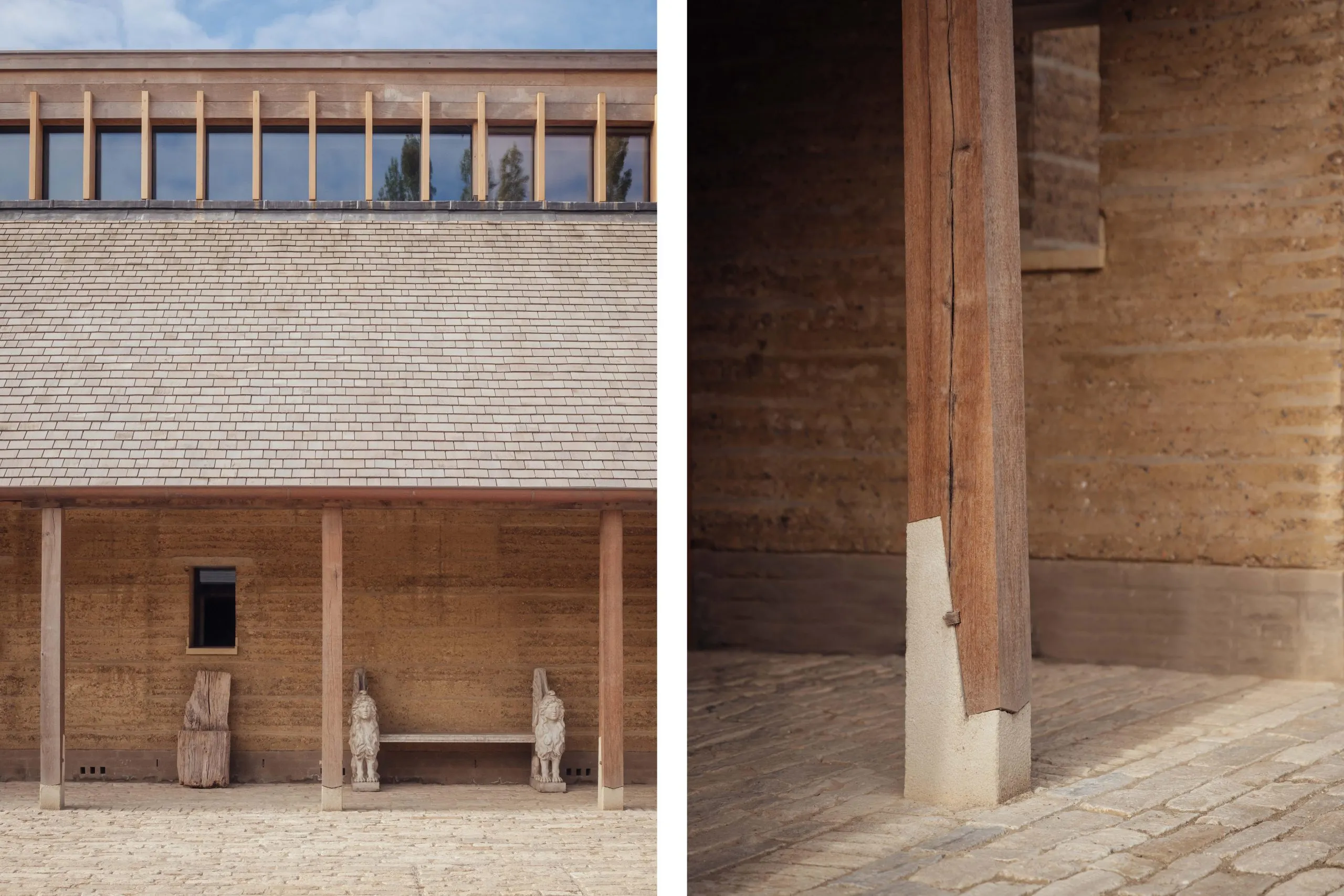
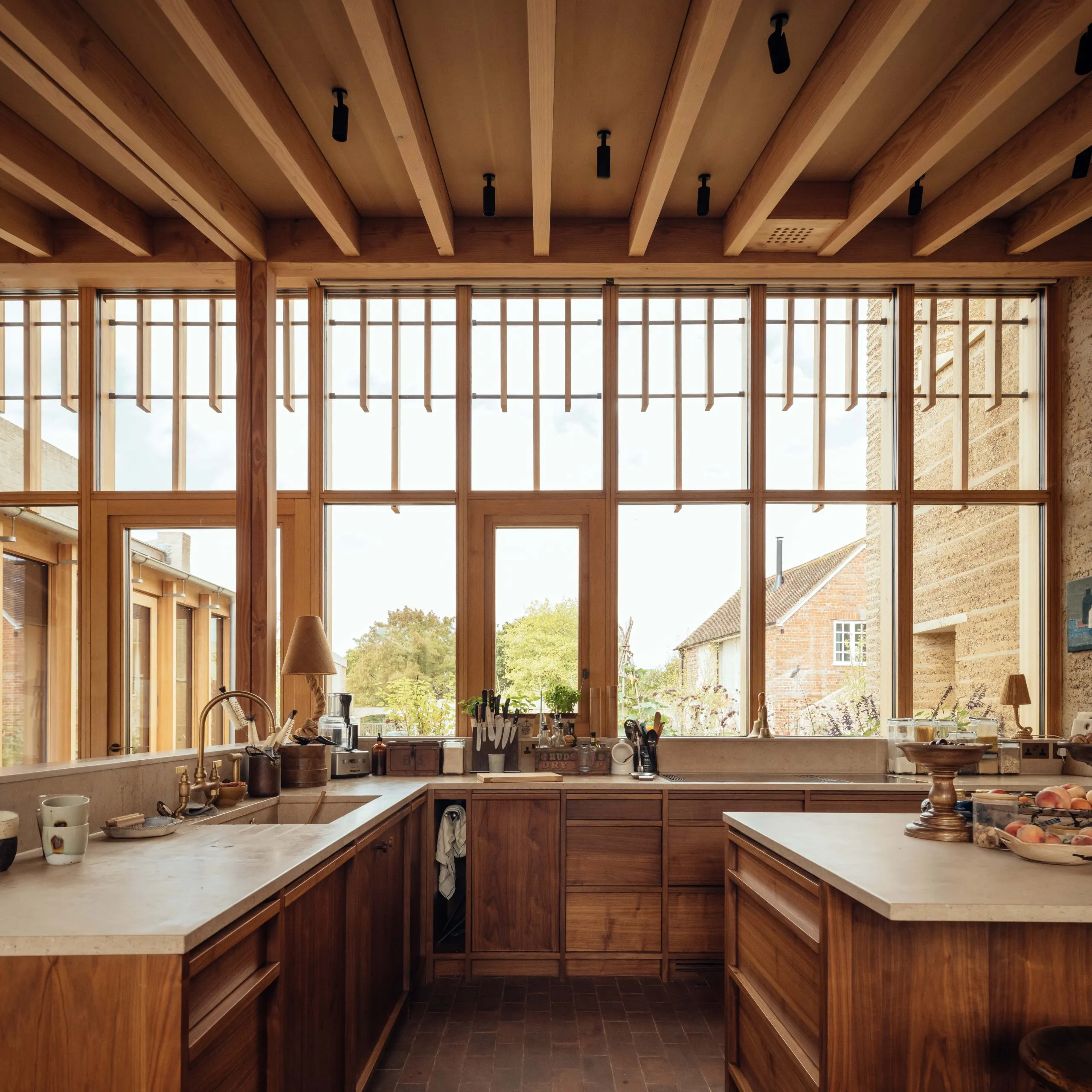
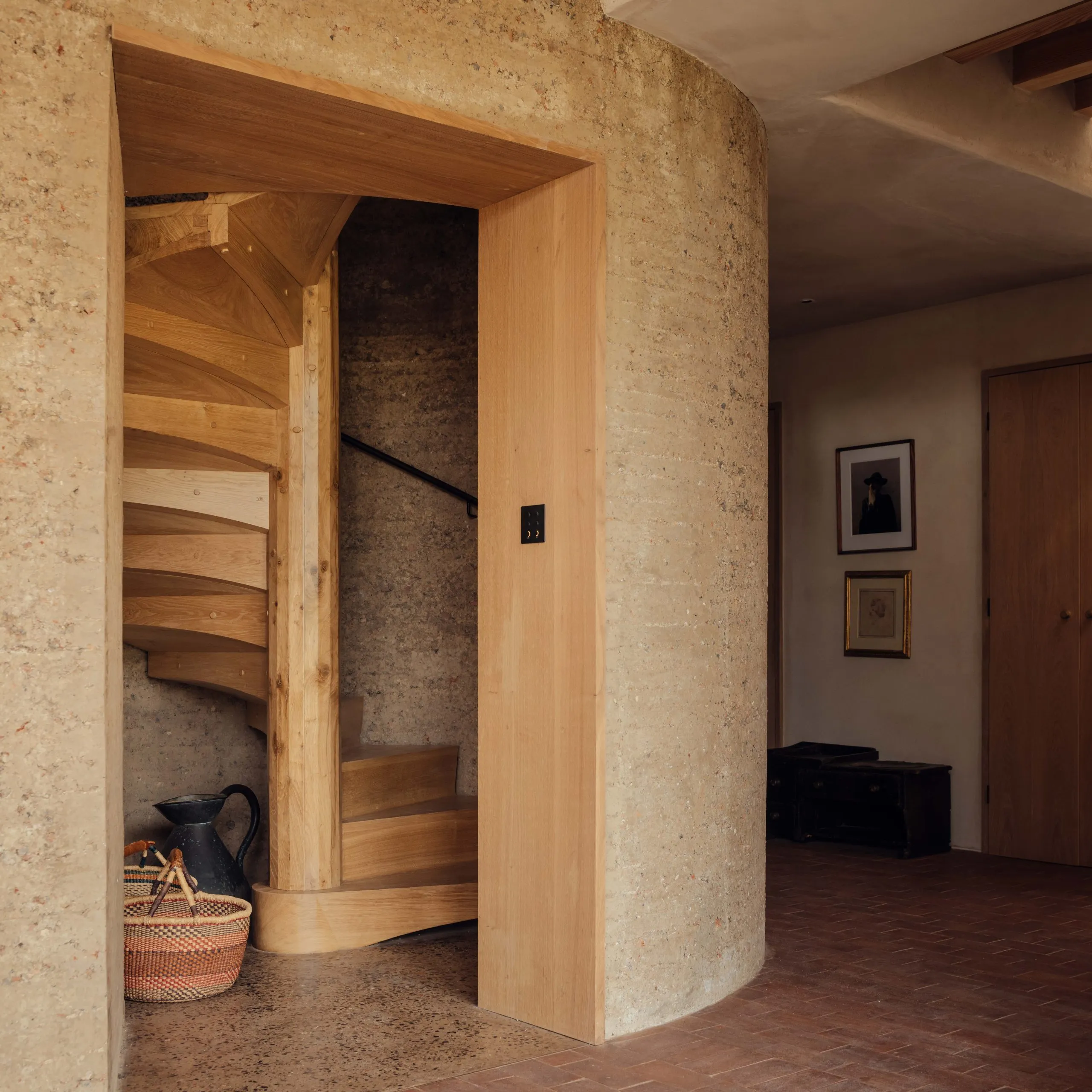
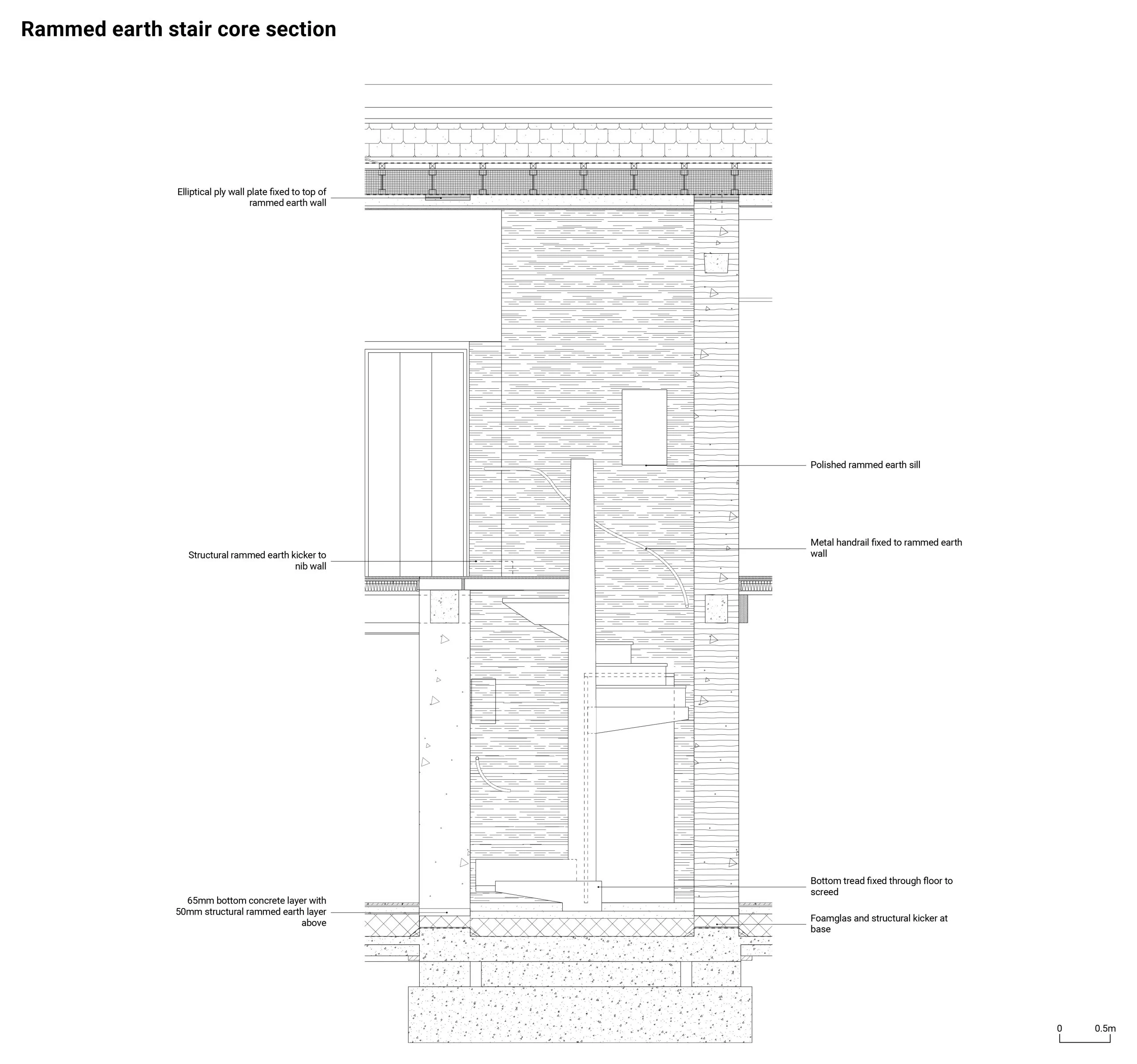
Yet Rammed Earth House does not feel like design by consensus. A tour de force rammed-earth spiral stair sits at the knuckle of the plan, simultaneously disrupting the plan’s coherence and enabling a seamless flow between the main entrance, boot room and the welcoming kitchen at the centre of this home. Delightful details such as asymmetrical stone bases that support greenheart columns reclaimed from Portsmouth Naval Dockyard contrast with the monolithic walls.
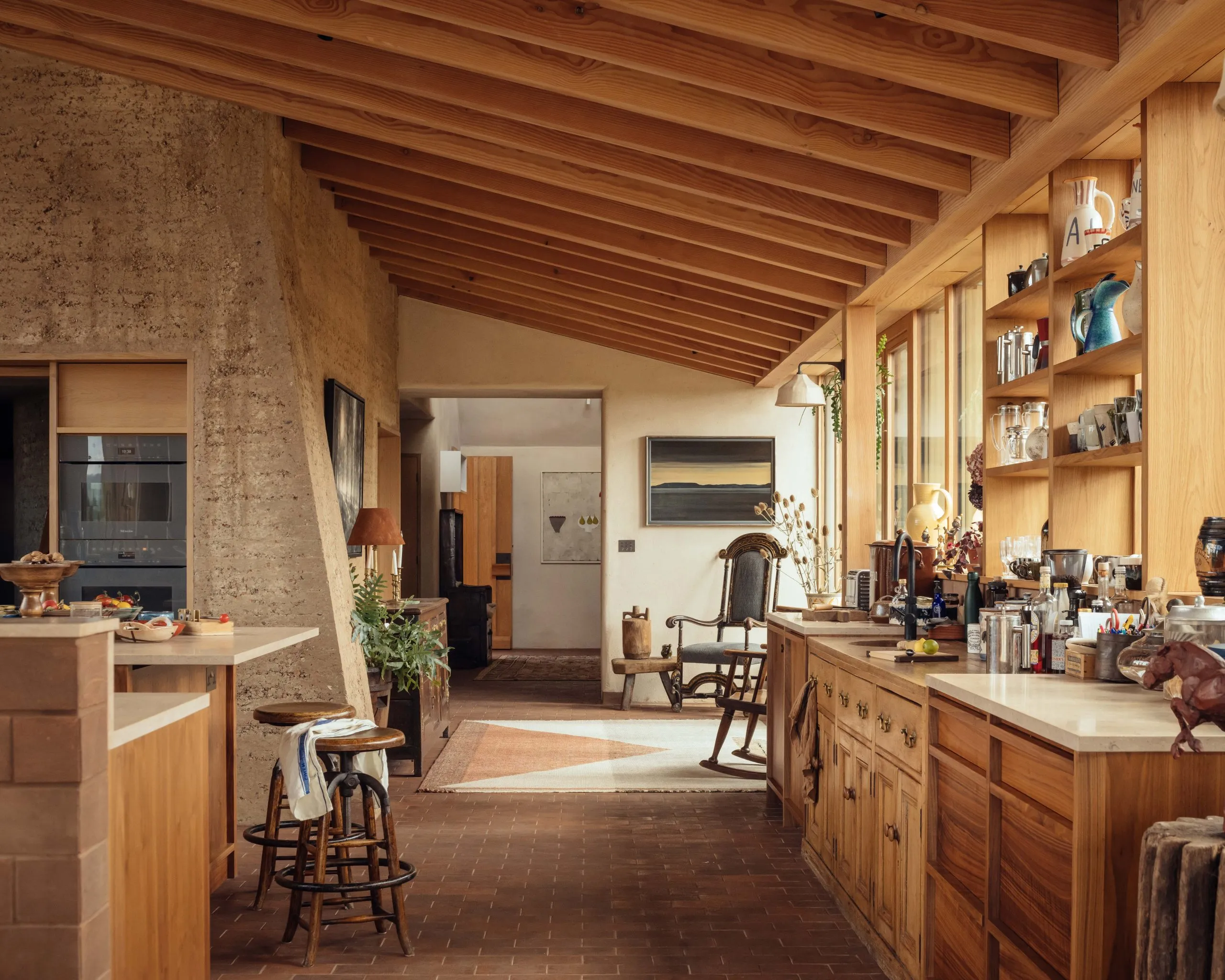
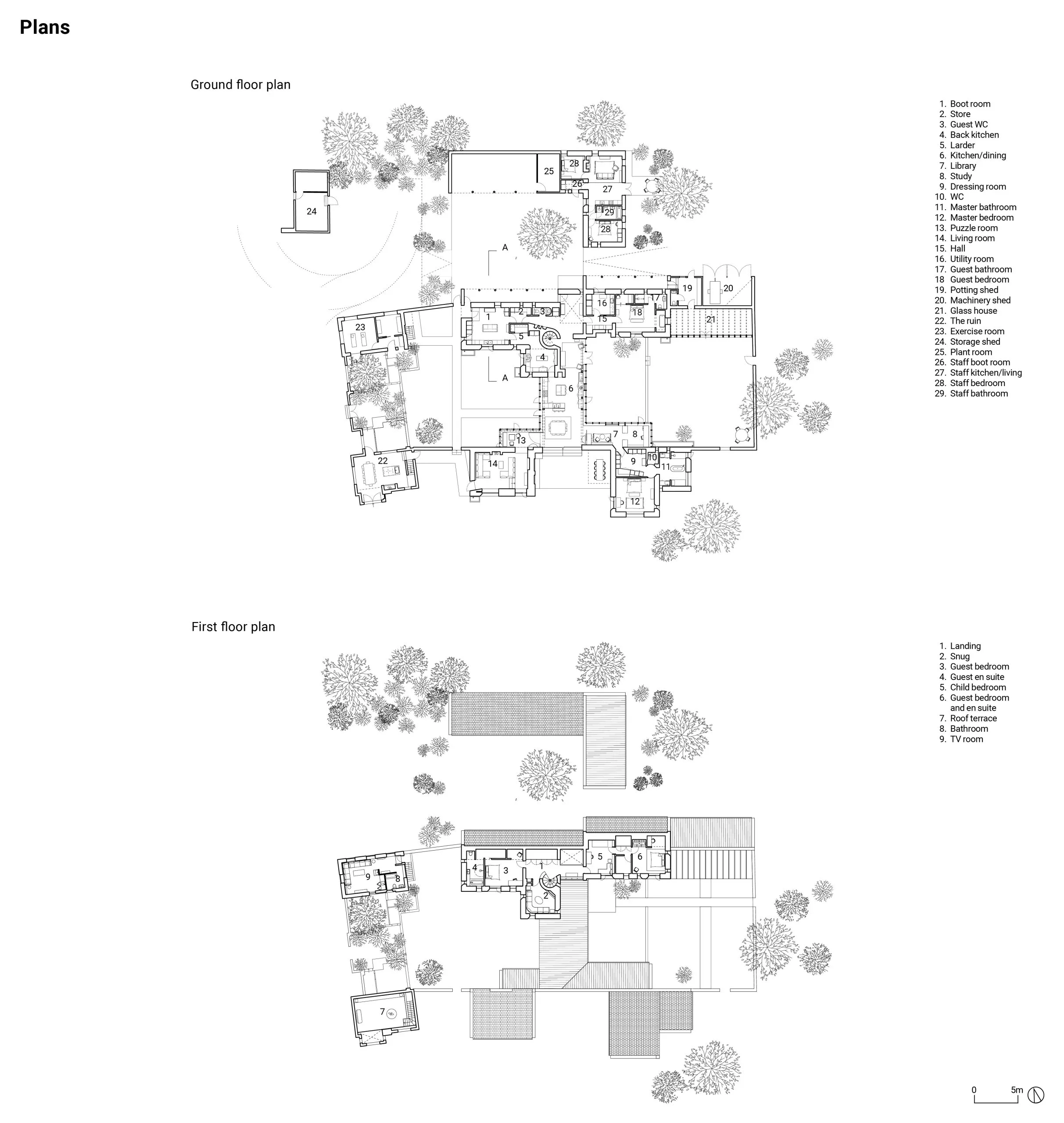
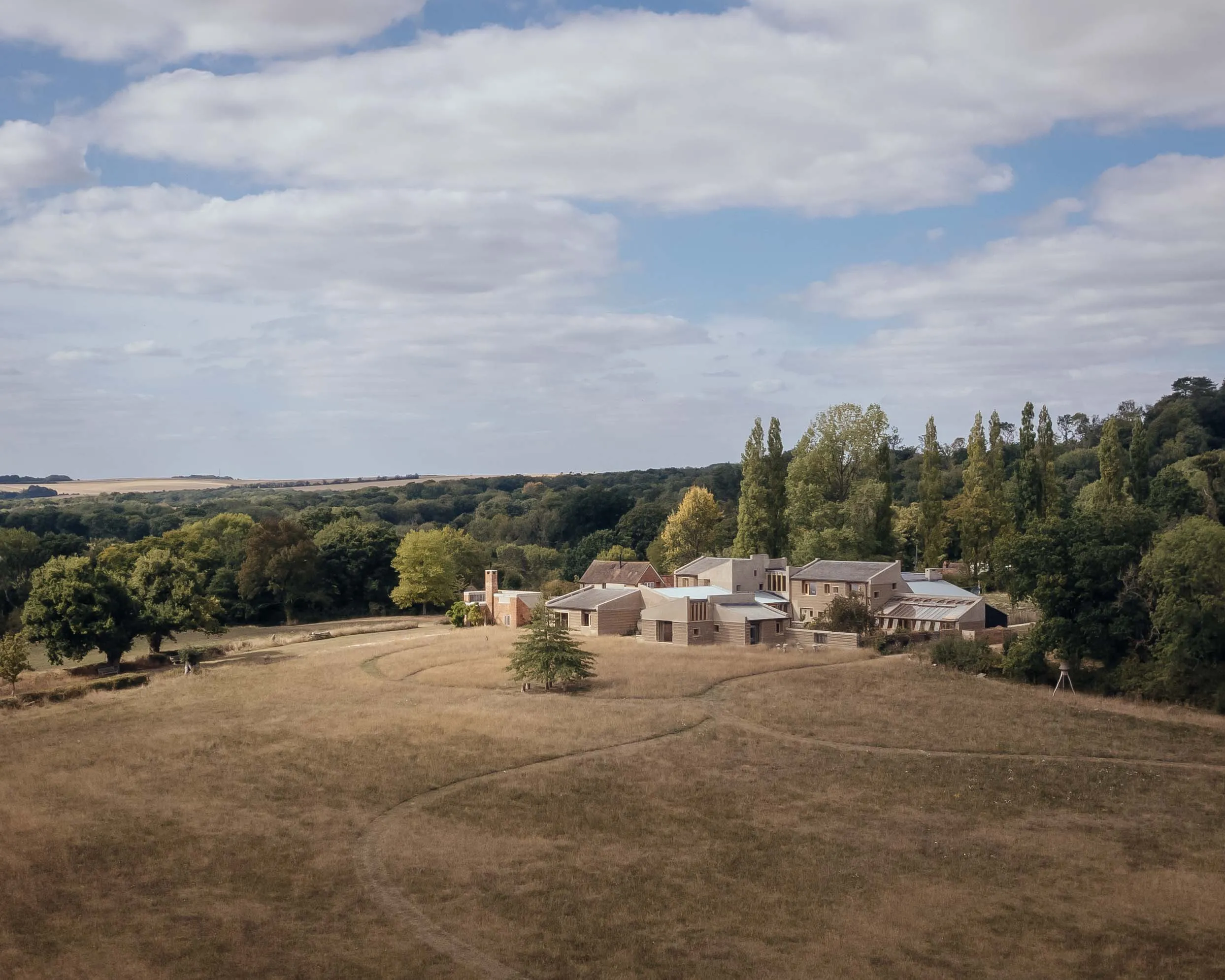
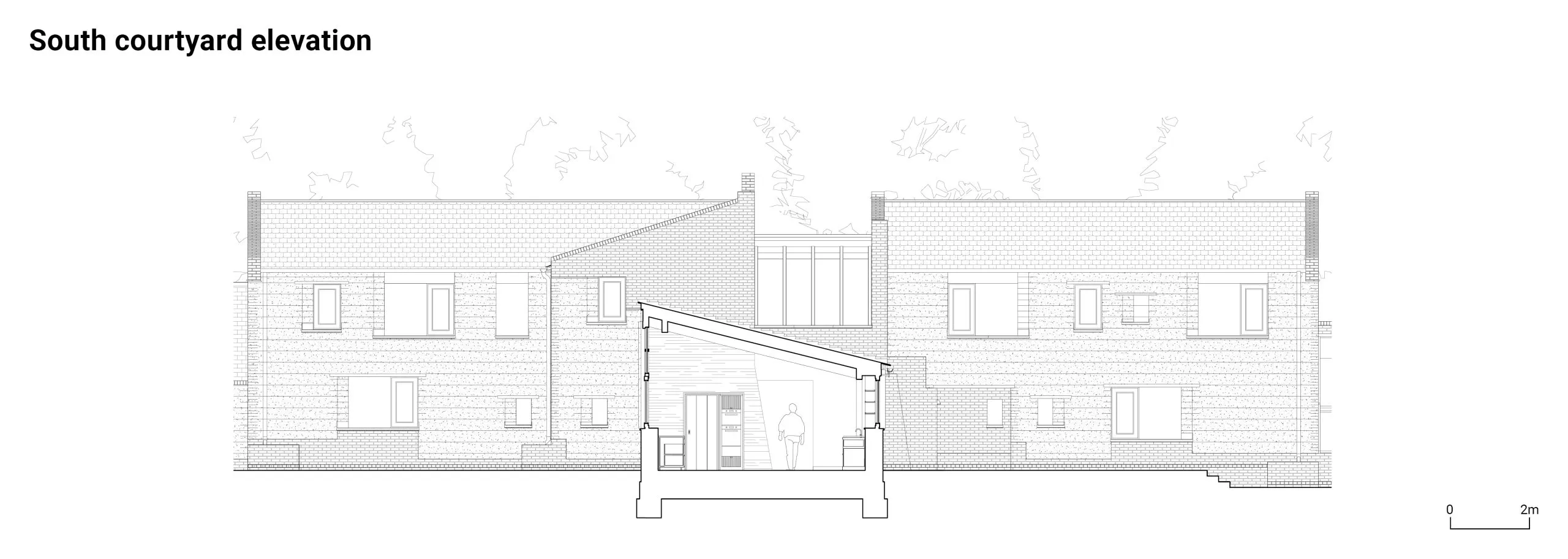
The house’s fragmented plan is the antithesis of the compact form which is normally de rigueur in sustainable design. Sitting within the remnants of a former brickworks on the site, Rammed Earth House unfolds around two generous walled gardens, separated by a timber kitchen wing that links the entrance, boot room and guest bedrooms to the north with the main sitting room and master bedroom to the south. These principal rooms project beyond the garden walls to the south to capture broad views of the countryside. Nearby Victorian outbuildings were stripped of unsightly additions and provide additional guest and staff accommodation.
Tuckey notes that plans of Wiltshire farmyards, as well as 11th-century Haddon Hall in Derbyshire, also built around two courtyards, were pinned up in the studio ‘to give purchase’ to the sprawling plan. The house has a rambling quality that encourages informality and impromptu discovery. This is also evident in the productive cottage gardens, which, on the early October day I visited, abounded with late-flowering and edible plants and dramatic seed heads. It is not entirely surprising to learn that the position of the house on the site was adjusted and refined with the input of a geomancer from America.
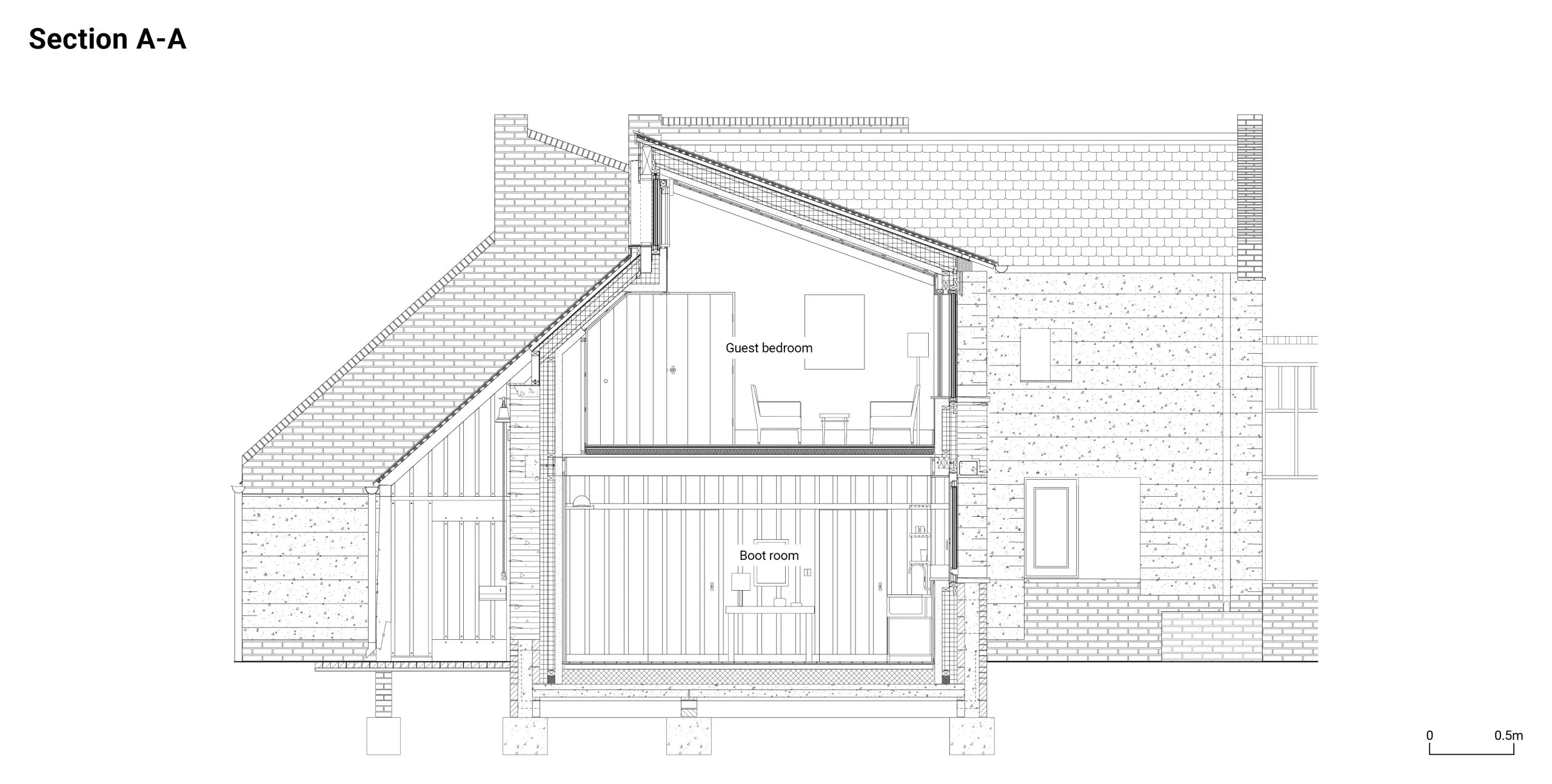
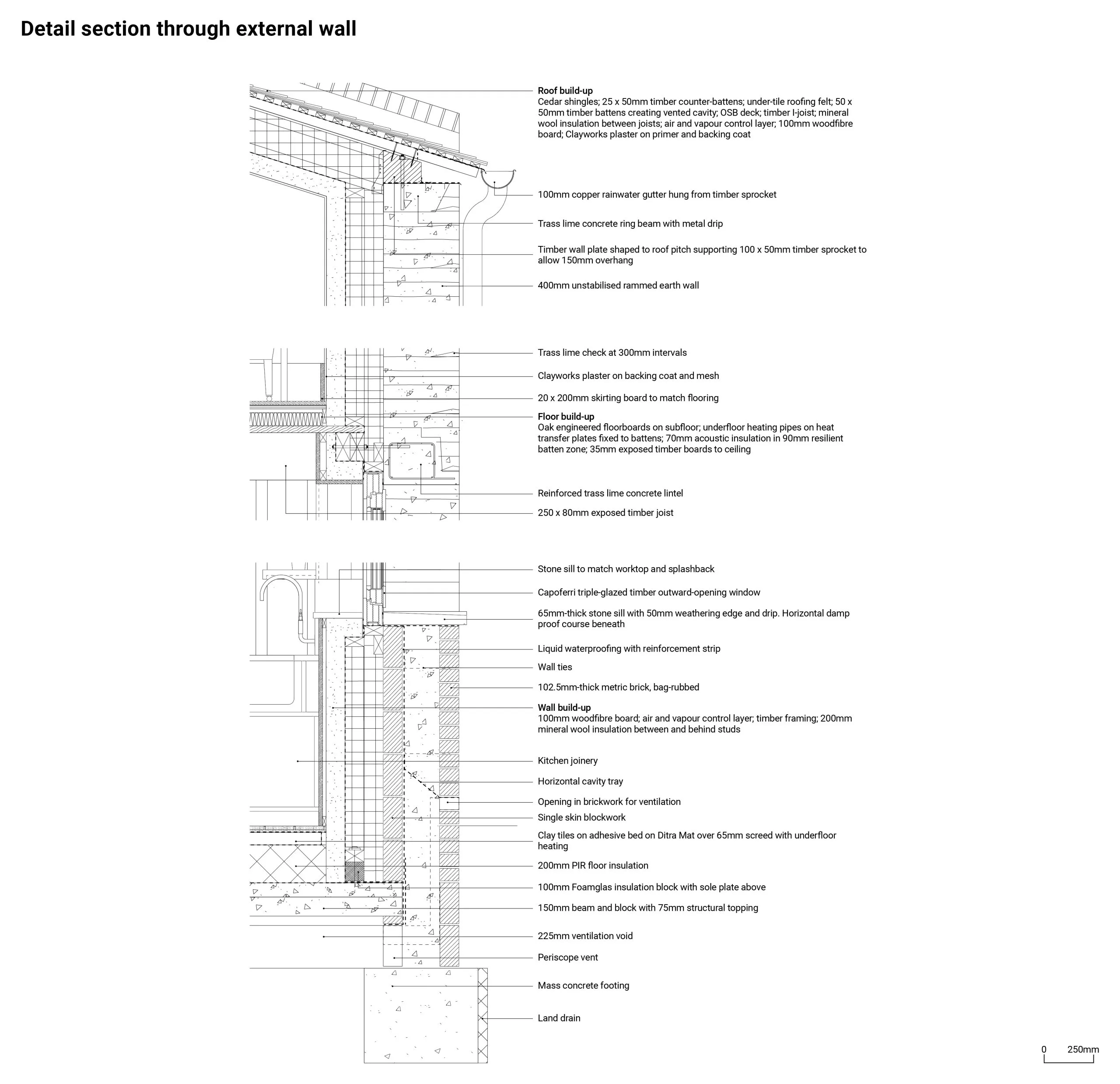
This is no traditional English country estate that imposes through grandeur and symmetry. Yet the solidity of the 700mm-thick walls (400mm rammed earth and 300mm insulation), which shape the look and feel of this 810m2 residence, lend an inviting gravitas. They incorporate numerous nooks, snugs and window seats. Chamfered windows (which are triple-glazed) channel both daylight and unexpected views.
The rammed earth walls are a mix of clay, crushed aggregates and brick from demolition waste on the site, as well as locally-sourced limestone aggregate of an intermediate size that was added because the site-won demolition aggregate did not bind sufficiently with the clay.
Early on, conversations took place to determine whether cement should be introduced into the mix for strength and stability (as at Waugh Thistleton’s Bushey Cemetery). ‘We don’t shy away from the fact that there’s a lot of concrete in the project, but we remained loyal to the initial ambition to build the walls with unstabilised rammed earth,’ observes Damda.
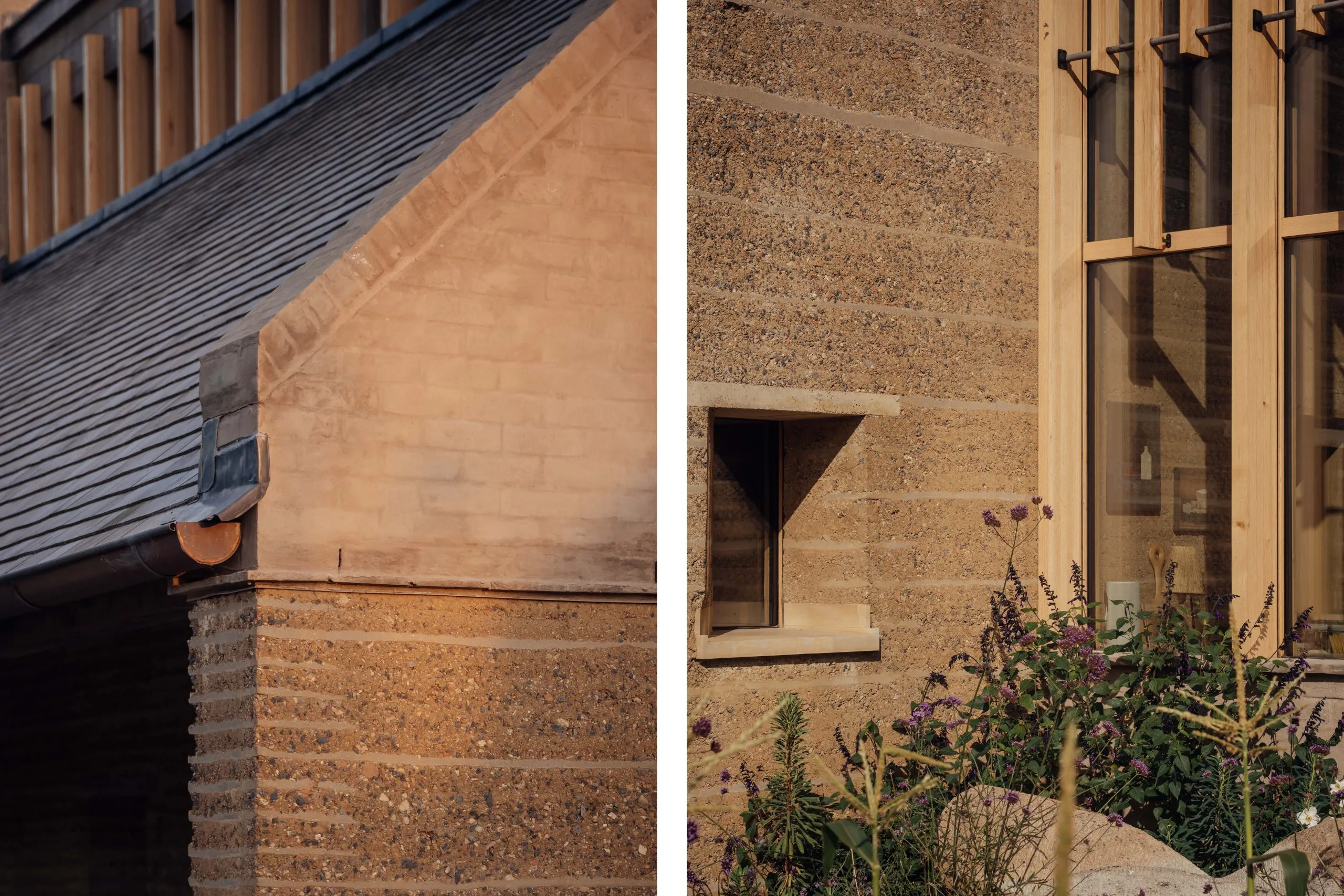
This is a deliberate and considerable achievement, which must be understood in the context of the concrete used elsewhere on the project, where it was deemed essential – in footings, in the suspended floor and in a ring beam that caps the rammed earth walls. It was not essential in the rammed earth walls themselves, which therefore remain completely circular in terms of environmental impact. The introduction of lime mortar checks at regular intervals slows the speed of water running down the façade and limits erosion, a crucial feature developed with the input of Austrian rammed earth specialist Martin Rauch of Lehm Ton Erde.
Another challenge was establishing a programme and budget for the rammed earth. Stonewood Builders divided the house into more than 20 sections that were transposed onto spreadsheets to estimate material quantities and build times. A team of 10 mixers and rammers and another six to eight formwork labourers were on site for about 18 months. The labour required for in situ rammed earth makes it expensive in the global north – and niche. At the same time, there is no denying Damda’s observation that this home is essentially ‘a super-high-tech house disguised as a mud hut’. The all-electric home is serviced by a ground source heat pump and a PV array powers about 15 per cent of the load. Despite its complex form, it achieves an impressive airtightness of 3.11 m³/hr.m² at 50Pa. In a seeming contradiction, the house is both airtight and breathable. A surprising move, which the clients were persuaded to agree to after it had been designed, was the removal of a fireplace, due to concerns about energy inefficiency.
Two queries ran through my mind as I visited: ‘how sustainable is this really?’ and ‘to what extent is it replicable at scale?’ At 494 kgCO2e/m² for the main house (excluding the outbuildings), the upfront carbon emissions are not far off the Net Zero Carbon Building Standard’s 2025 target (430 kgCO2e/m2), a considerable achievement for a house designed several years ago.
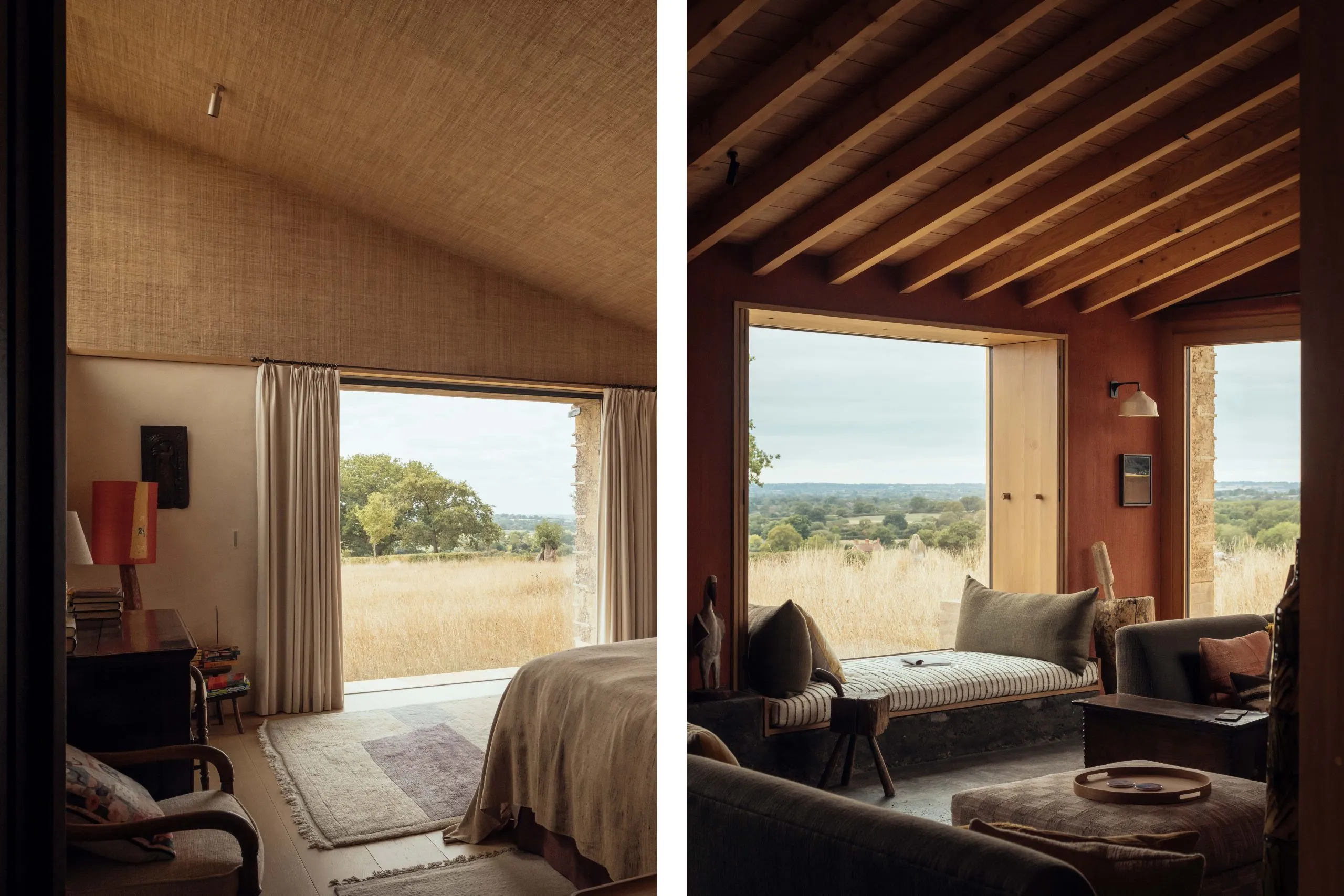
There is no doubt that Rammed Earth House is a landmark industry achievement, unique in its material use and ambitious in its environmental approach. As German rammed earth specialist Anna Heringer has written, ‘the crucial thing is to push the limits with each project […] It’s just not acceptable that a wall in CO2-neutral earth […] costs more than a wall of reinforced concrete’. Rammed Earth House pushes those limits and demonstrates much of what’s possible. It is also a visual and tactile delight – a joy to live in.
In terms of replicability, the use of site-won materials sets a precedent that is likely to be – and should be – more widely adopted. A potential terraced house application with prefabricated panels – which would reduce costs – is being studied. Asked about further rammed earth work, Tuckey responds that he’s ‘as keen as mustard – and, since the world is covered in clay, the odds are good.’
Architect’s view
The bulk of the material forming the rammed earth walls came from the site – clay dug from the ground and crushed brick and concrete demolition waste – a whole building repurposed into a new one. Any excavation and spoil was kept on site to regrade the site landscape where necessary. There was a collective push to remove or reduce the use of cement and lime in both stabilisers and primary structure.
The principal internal timber structure was engineered to be C24-grade Douglas fir, sourced from UK forests (rather than North America, as is typical). The external timber structure was constructed from green oak and reclaimed greenheart, sourced from a former pier on the south coast. Working with timber framers and joiners, we found a way to construct the external timber framing using traditional craft methods, without glue, steelwork or mortar. The principle of designing timber structure for disassembly complemented the use of rammed earth for the loadbearing solid walls.
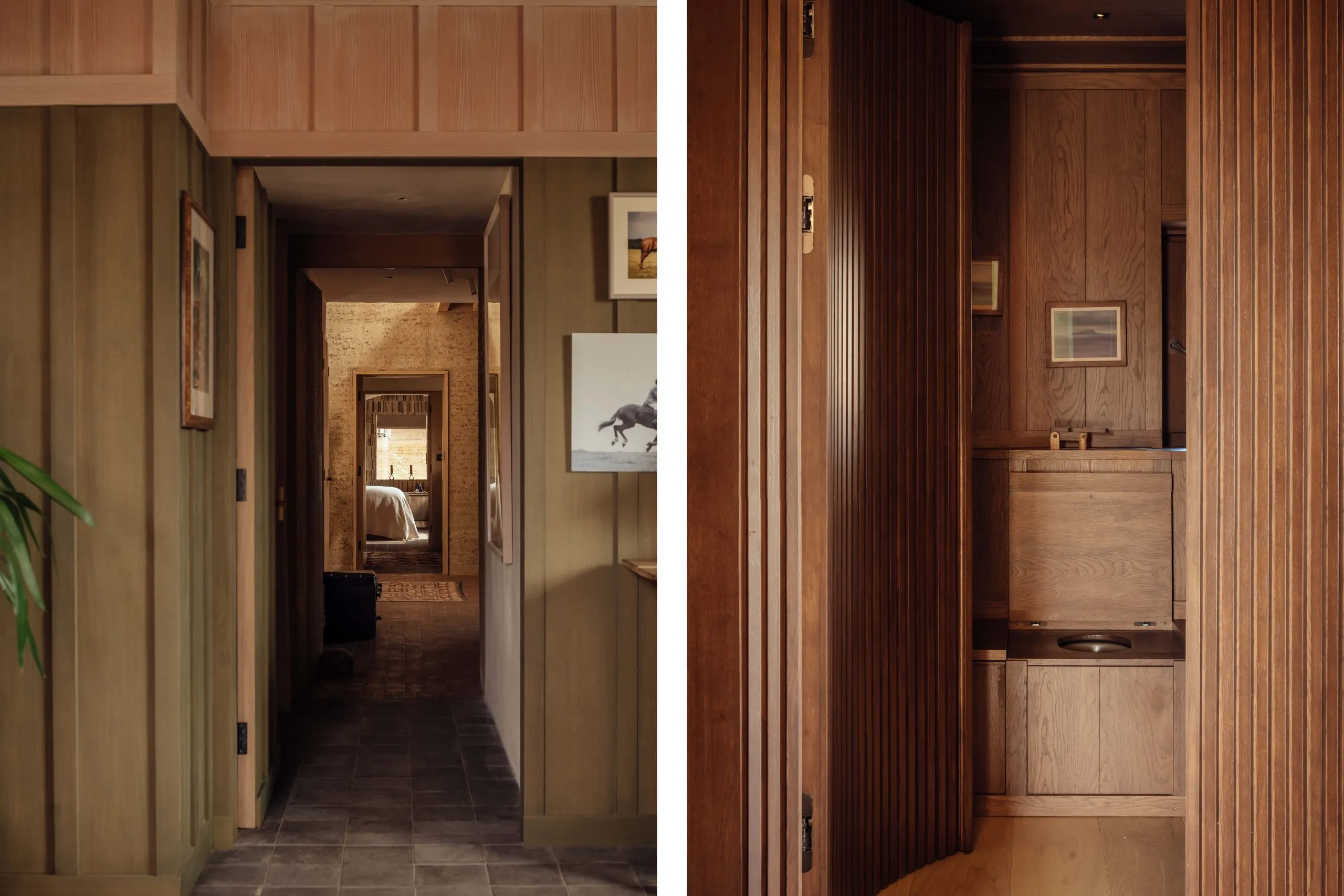
Natural materials were prioritised and celebrated where possible. The walls were complemented by rammed earth floors and walls plastered with clay specified by Clayworks, using natural pigments to colour rooms. Clay plaster, Tadelakt plaster and wood boarding form the interior linings and there is no gypsum plasterboard in the house. Chicksgrove and Purbeck limestone quarried in the South West form window sills, floors, showers, sinks and column bases. Timber-terrazzo using wood waste defines the circular lobby of the master bedroom. Other bio-based materials include woodfibre insulation, mycelium pendants and lamps made from recycled seaweed and paper waste. Timber cladding to the roofs and walls is left untreated, allowed to weather without additives. Renewable strategies such as a ground source heat pump, photovoltaic slate roof and rainwater harvesting further reduce the carbon impact.
Emaad Damda, project lead, Tuckey Design Studio
Clients’ view
There’s something about standing on earth, as guardians for our lifetime, and really caring for it, nurturing it and knowing that you can leave it in a better place than it was when we first came here. We looked at maps going back about 400 years and there was nothing on the site at all until the early 18th century, when it looked as if it was a brickyard. I could make a joke about mountains and molehills, but it has been a much bigger, longer and more fulfilling project than we ever imagined.
It’s magical. The building has a life of its own, so I love when I’m walking through this house to see the elements that have been brought to us by the various individuals and their skills and imagination. I was saying to someone this week that I finally found the word that I can use to explain what it feels like to me to live in this house, which is wonderment. Every day I am in this sense of wonderment. it’s now become the centre for our lives and it’s our home. It has been a joyful discovery of ourselves and of what we can do and bring to it, contributing to it –and of how we can live.
Rammed Earth House clients
Working detail
The brief set the task for the design team to design an unmistakeably contemporary country house grounded in environmental sensibility.
The design team considered both embodied carbon and operational carbon from the outset and worked with the clients to understand how the house could be designed to be as self-sustaining as possible.
The choice of rammed earth as a primary building material was based heavily on circular economy principles and how we might consider the building grows out of and one day returns back to its landscape.
Passivhaus fabric-first principles were used as a reference; in fact the building’s primary energy figure of 88.4 kWh/m2 only just falls short of the AECB new build standard of <85 kWh/m2.
A ground source heat pump provides all heating and hot water for the homestead, and all gas was removed from the property. Photovoltaic slates generate 15 per cent of all the electricity required for the property and in part powers the clients’ electric vehicles. Water troughs collect rainwater and link to a below-ground rainwater harvesting tank that serves outdoor taps used to water the gardens. In the first year of occupation this has never had to be topped up with mains water, meaning that the gardens have been maintained solely through rainwater.
Emaad Damda, project lead, Tuckey Design Studio
Project data
Location: Wiltshire
Start on site: March 2021
Completion: June 2024
Gross internal floor area: 810m2 (main house 520m2)
Construction cost: Undisclosed
Architect: Tuckey Design Studio
Client: Private
Structural engineer: Webb Yates Engineers
M&E consultant: SGA Consulting
Quantity surveyor: Dadson & Butler
Project manager: Dadson & Butler
Principal designer: Tuckey Design Studio
CDM co-ordinator: Tuckey Design Studio
Approved building inspector: SOCOTEC
Interior designer: Todhunter Earle Interiors
Rammed earth consultant: Rowland Keable (feasibility), Lehm Ton Erde
Landscape architect: Pip Morrison
Sustainability consultant: The Healthy Home
Planning consultant: Brimble, Lea & Partners
Ecological consultant: Peach Ecology
Lighting consultant: John Cullen Lighting
Timber framer: Timber Frame Company
Stair joinery: Robert Lynch
Joinery: Willow & White, Orwells Furniture, Oakwrights, Monk, Somer, Penchard, William Garvey, Edward Collinson, David Haddock, Isabel Coulton
AV specialist: Edison Projects
Main contractor: Stonewood Builders
CAD software used: Vectorworks
Sustainability data
Percentage of floor area with daylight factor >2%: Not calculated
Percentage of floor area with daylight factor >5%: Not calculated
On-site energy generation: 10,250 kWh/yr
Total energy load: 60.87 kWh/m2/yr
Upfront carbon emissions (A1-A5): 494 kgCO2e/m²
Annual mains water consumption: 235 m3/occupant
Airtightness at 50Pa: 3.11 m³/hr.m²
Overall area-weighted U-value: External walls: 0.13 W/m2K, floors: 0.09 W/m2K, roofs: 0.13 W/m2K, openings: 0.91 W/m2K
Embodied carbon: 702.7 kgCO2e/m²
Whole-life carbon: 866 kgCO2e/m²
Predicted design life: 50+ years