
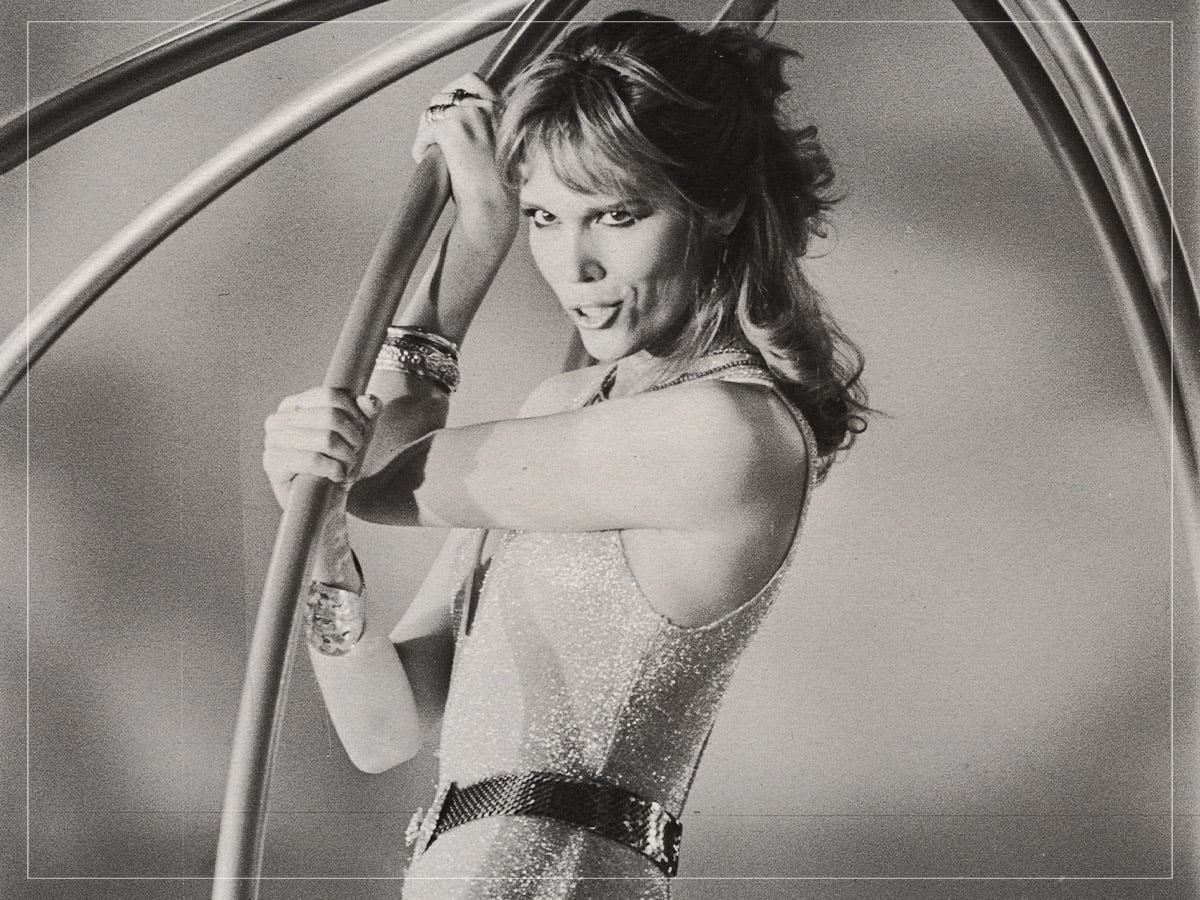
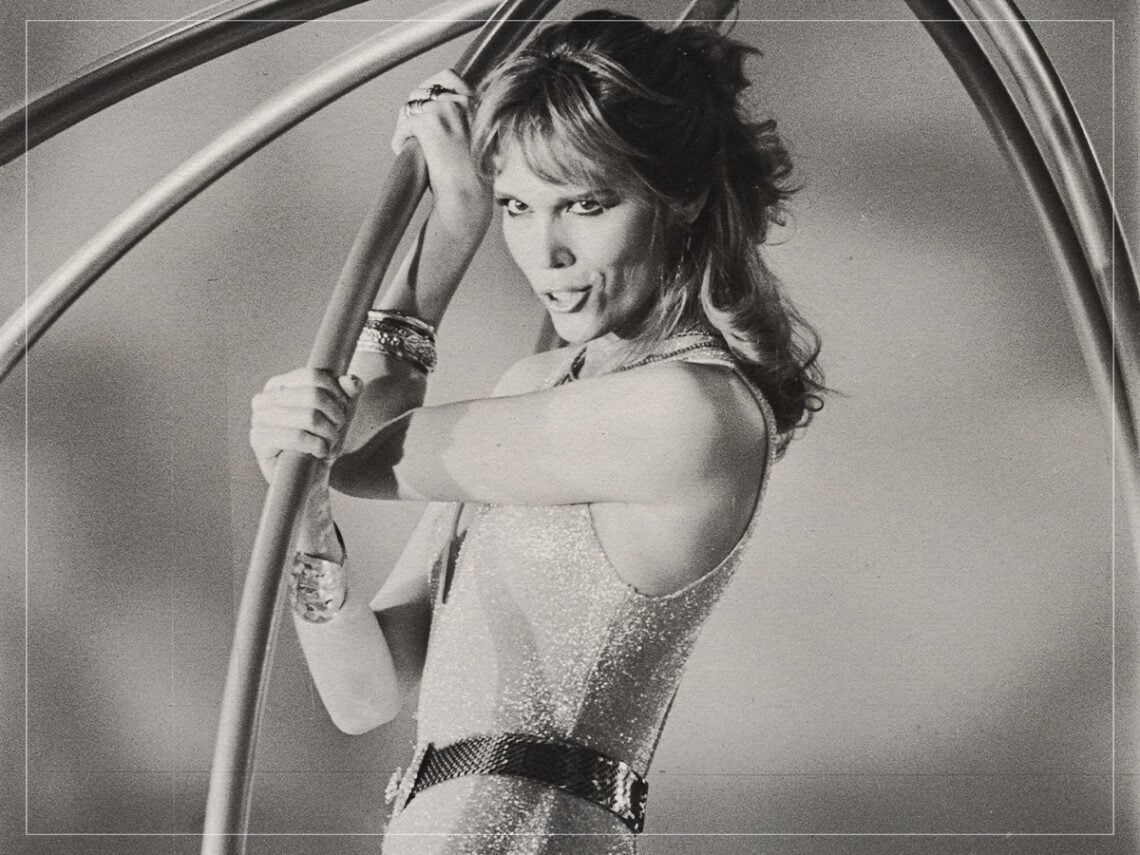
(Credits: Far Out / Bert Verhoeff / Anefo / Nationaal Archief)
Wed 18 February 2026 23:00, UK
The first time a large portion of the world saw Amanda Lear was on the cover of Roxy Music’s For Your Pleasure.
There she stood, clad in leather with a black panther on a lead. It was a pretty cool gig for any model to land, standing on the cover of one of the biggest bands in the world’s record, looking cooler than anybody has ever looked; however, Amanda Lear wasn’t satisfied. She started her career as a model, a job she got to fund her fine art education, but she hated the role.
“Before singing, I used to be a fashion model, the most boring job in the world,” she said when discussing her disdain for it, “People give you money because you’re beautiful: It’s immoral, and stupid… I’ve done nothing, I am a coat hanger.”
Lear had a deep appreciation for art and wasn’t satisfied with being a model. She started making music and intended to champion a more intellectual version of disco. She was always very vocal about how the genre dumbs itself down, and intended to create a variation of the sound which used lyrics with more nuance. Her willingness to try and evolve a genre which was already established and loved is a reflection of her commitment to art.
“Disco music is a fantastic medium, and it’s a pity not to use it intelligently: we used rock to communicate with youth,” she said. “What shocks me is seeing my colleagues, who sing well, sing idiocies. The music is good, the production is good, the singer is good. The lyrics are aberrant.”
She always said that she wanted to be the Juliette Gréco of the ‘80s, which meant creating a more complicated style of disco music. She didn’t stop there, though; her entire life became a work of art, as her career existed outside of modelling and music. A mystery began to surround Lear, one that onlookers couldn’t permeate, and which only added to this beautiful enigma, who was taking disco music to new heights.
Her relationship with Salvador Dalí helped to encourage such an approach to her image. The two were friends, and while Dalí wasn’t the most supportive of her art, he did help expand upon the mystery surrounding Lear by making the public question her gender. There were many rumours which circulated about whether Lear was born a man or a woman, all of which had been orchestrated by Dalí when he said, “You’re neither a girl nor a boy. You’re angelic, an archetype.”
Lear helped stir these rumours within her music with lines like, “The surgeon built me so well, that nobody could tell, I was somebody else”.
She also contributed to her mystery by constantly changing where she was born and who her parents were; she also never revealed her true age. Having this beautiful stranger singing intellectual disco was a truly unique artistic concept, and one that meant she was considered one of the highest forms of art when discussing her merit.
The writer and director of the documentary Queen Lear, Gero von Boehm, described her approach to art best as her willingness to make up an entire persona, all boiled down to her hatred of two things, two things which she shied away from her whole career.
“What she hates most,” said Boehm, “Is cliché and repetition.”