
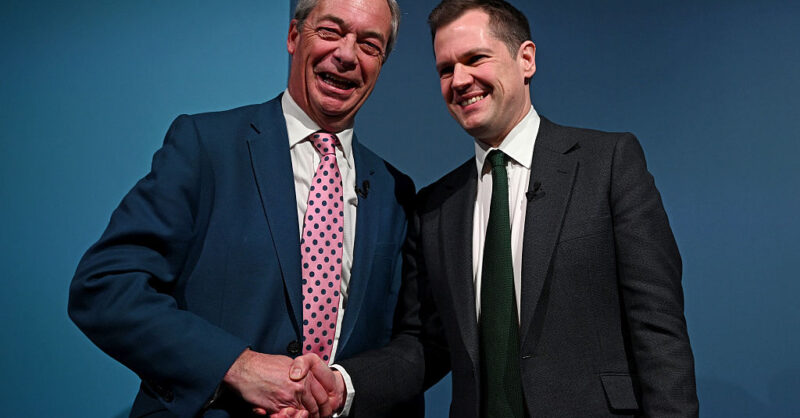

Photo by Leon Neal/Getty Images
The financial crisis did not only mark a change in Britain’s economic fortunes – we also saw a change in political attire. As bankers became unpopular, Westminster visually distanced itself from financial services. The new uniform was the hard hat and high-vis jacket. The era of politicians cosplaying as industrialists and builders had begun.
The latest to don the costume are Nigel Farage and Robert Jenrick. In his first major speech as “Shadow Chancellor” yesterday (18 February), Jenrick says he wants to “restore our proud industrial heritage” through a “new political economy”.
Farage and Jenrick have begun to realise that a desire to rebuild Britain’s industrial capabilities strikes deep into our national psyche. They are not alone. You cannot move for politicians on left and right calling for reindustrialisation. We are now on our fourth industrial strategy in ten years although we continue to see the numbers heading in the wrong direction.
The question is not why Nigel Farage and Robert Jenrick decided to embrace the cause of reindustrialisation, since its popularity has been obvious for years, but why it has taken the Thatcherite ex-metal trader and small-state former Tory so long to take it up. During the Brexit wars, Farage championed Australia’s and Iceland’s free trade deals with China as an “example of what can be achieved as an independent nation”. In 2018, he said that Thatcher’s reforms, which accelerated the decline for British industry, were “painful for some people, but… had to happen”. As recently as 2023, Farage was questioning why British Steel should be bailed out by the government at all. Jenrick has only made one major speech on industrial strategy in Parliament over 12 years. Only four months ago, Jenrick was writing the usual small-state Thatcherite dogma and attacking state intervention.

Subscribe to the New Statesman today for only £1 a week.
However, Farage now claims that industrial strategy is one of the few things that he has changed his mind on. According to Patrick Maguire in the Times, the Reform leader is pitching to be the 21st-Century Joseph Chamberlain, calling for an active state to back British industry and create a policy of “national preference”. Robert Jenrick says he wants a new industrial strategy because “the Chinese are building their middle class on the backs of ours”.
Reindustrialisation is obviously necessary. The reasons are legion. The UK’s crippling trade imbalance pushing higher inflation and driving the cost of living crisis. Britain’s growing geopolitical insecurity. The political discontent of millions of people living in deindustrialised communities. All these make a genuine effort to reindustrialise Britain essential. The latter is no doubt the main reason why Reform has taken up the mantle, and Jenrick is angling to become the Bonar Law to Farage’s Chamberlain. Despite all this rhetoric, doubts remain whether Reform, or any party, is serious about a new political economy.
Understanding what Reform means by reindustrialisation would be a start. Jenrick’s speech yesterday gave no clarity. According to the ONS Blue Book, “production”, which includes mining and quarrying, manufacturing, energy production and water supply, made up 13.5 per cent of the UK’s economic output. This is down from 22 per cent in 1990. In brass tacks, getting back to where we were in 1990 would mean generating £212bn in production output – roughly equivalent to doubling the contribution of our entire manufacturing sector. There are plenty of other ways of defining reindustrialisation, from closing our trade deficit in goods (£206bn) to increasing share of production-based employment. However, if reindustrialisation is to be more than just a slogan, it requires a clear target and goal. Just chucking the names of a few sectors out there, as Jenrick did yesterday, is not enough.
Reform is also silent on the cost of reindustrialisation. Whatever measure you take, rebalancing our economy is going to cost hundreds of billions of pounds. The private sector simply cannot do it on its own. Levels of capital investment in productive industries are currently lower in real terms than they were in 1997: around £69bn a year compared to £75bn a year back then. We’ll need more than scrapping Net Zero spending to provide that funding, which is the only thing on which Reform has a consistent position. Is Reform really going to put reindustrialisation ahead of tax cuts? At least Joseph Chamberlain was honest enough to advocate tariffs as a way to protect industry and raise revenue. Farage, by contrast, is a well-known free trader, tariff sceptic and tax cutter. Jenrick’s natural instincts are to cut state spending. In his speech yesterday, he said Reform wants to cut taxes as soon as fiscally prudent. This does not look like a new political economy, but a return to the Cameron-Osborne years.
Reform may deploy the usual Whitehall playbook and rely on foreign investment. The Trumpian “Britannia Card” indicates that Farage may seek to go down that road. In his speech, Jenrick also referenced the need to bring more foreign investors to the UK. They will find lots of willing establishment support. Britain has become expert in selling our assets and overseas ownership in UK manufacturing shares has risen by over £150bn since 1998. All this has led to a loss of strategic control. Crucial decisions from investment, R&D and product development and skills are being made in New York, Frankfurt, Tokyo rather that London, Birmingham or Manchester. If we are serious about reindustrialisation, we going to need to rely on our own capital, which will stick it out for the long term.
Is the Atlanticist Farage really going to take a Gaullist turn? Rumours suggest he might, with Maguire reporting that Reform is considering “minority stakes” in critical industries. This would be a welcome development, although Jenrick did not back his leader’s suggestion when questioned by journalists yesterday. Wherever Reform lands, rebuilding the British industry is going to require far more than just taking seats on boards and gentle encouragement. It means reforming corporate governance and using state power to direct capital to where it is needed most. Both Jenrick and Farage seem keener on channelling Nigel Lawson and financial deregulation than reforming Britain’s “extreme form of capitalism”.
The current discussion on deindustrialisation is best seen within the context of Net Zero. Nearly every reference from Farage or Jenrick to reindustrialisation is followed by an attack on Net Zero. However, as energy expert Professor Dieter Helm has noted we need more than just cheaper energy to rebuild domestic industry. The danger is that reindustrialisation is just another “culture wars” issue rather than a serious economic agenda.
Danny Kruger, Reform’s “head of preparing for government”, is fond of a religious metaphor, calling for Conservatives to “seek absolution” from Farage. However, it is Farage and Jenrick that appear to have experienced Damascene-conversions to reindustrialisation. Whether these Sauls can become the patron saints of Britain’s industrial revival remains to be seen. We would do well to reflect on Matthew’s Gospel, “by their fruits you will know them”.
[Further reading: Robert Jenrick’s Tory transformation of Reform begins]
Content from our partners