
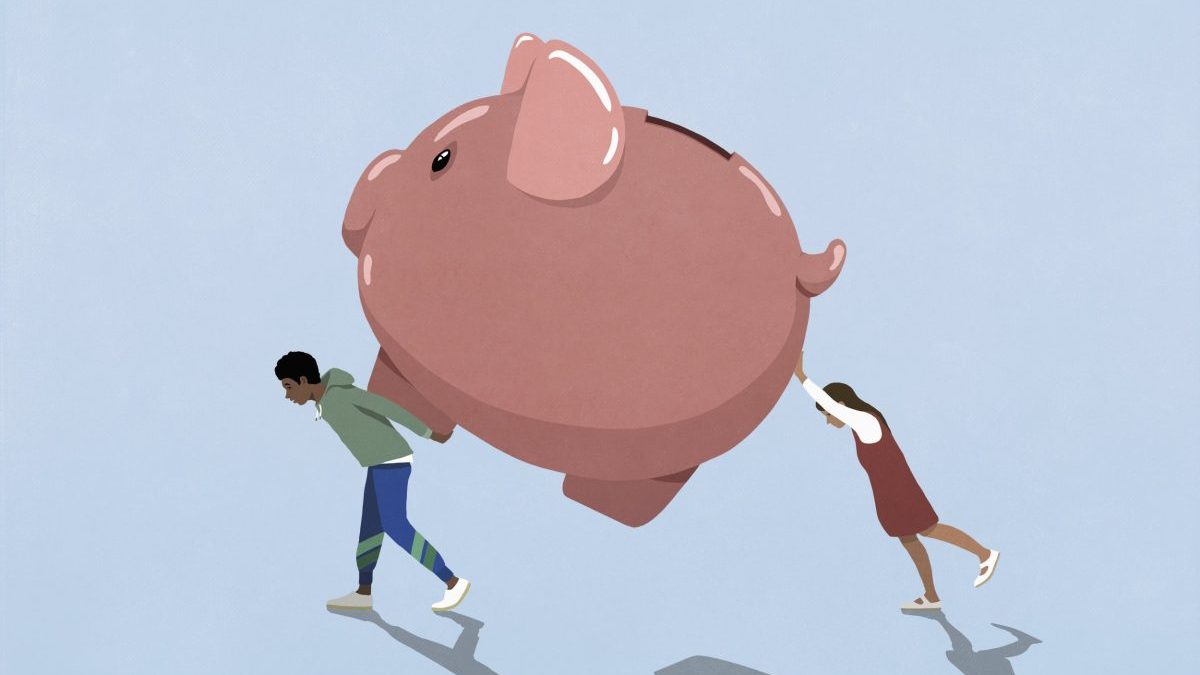
Boosting the pension contributions of a higher earner in a couple can mean higher retirement income – but experts say there are downsides too
Couples could end up boosting their pension savings by £170,000 if the higher earner pays into their retirement pot instead of each contributing equally, analysis shows.
Pension contributions attract tax relief at people’s marginal rate, with basic-rate taxpayers – earning between £12,570 and £50,270 – receiving 20 per cent, higher-rate payers – earning between £50,270 and £125,140 – getting 40 per cent, and additional-rate payers earning over £125,140 saving 45 per cent.
If both people in a couple earn different amounts, diverting contributions to the person who pays the bigger tax rate can dramatically increase their savings, according to wealth manager Rathbones.
A £10,000 contribution from a higher-rate earner effectively costs just £6,000 out of pocket, while £10,000 from a basic-rate earner costs £8,000 – making it more efficient to prioritise the higher-rate partner.
Ryan Jackson, associate financial planning director at Rathbones, said it was a “rare financial win” that did involve people saving more money to get more money, and was focused on tax efficiency.
But experts warned there are some risks if couples later divorce, and that anyone considering the move should think about speaking to a financial adviser.
Rathbones modelled scenarios for a couple that has one higher-rate taxpayer earning around £60,000 per year, and one basic-rate taxpayer, earning about £30,000.
If the couple pays £5,000 each into self-invested pensions (SIPPs) each year, they will save £14,583.
This is because the higher-rate taxpayer gets their 40 per cent tax relief, taking their contribution to £8,333, while the basic rate tax payer gets their 20 per cent tax relief, taking their contribution to £6,250.
However if only the higher earner pays £10,000 in, they will get the 40 per cent tax relief on the full amount, taking their contribution to £16,667.
If the couple were to increase their contributions every year by 2 per cent – the rate of inflation – and their investments grow 5 per cent per year, then 20 years later, they would accrue £595,821 if contributions were split equally.
However, if it was just the higher-earner paying in the full amount, two decades later they would accrue £680,968 – an improvement of £85,147.
If the couple were to doubles the household contribution to £20,000 per year, split evenly, the pot would reach £1,191,684 after 20 years
But prioritising the higher-rate partner lifts the pot to £1,361,895 – which is £170,211 extra them.
Jackson said: “Bigger tax relief means bigger upfront contributions – and once compounded over years or even decades, the result can be a retirement nest egg that’s dramatically larger.
“It’s one of those rare financial wins that doesn’t require saving more, just saving smarter.”
He recommended that couples start by agreeing their financial goals together – covering short-term priorities such as saving for a home, and longer-term plans like retirement and estate preparation.
Being open about income, savings, debts, and spending habits helps build trust and ensures that the plan is realistic, he added.
Is it the right choice, despite the tax advantages?
Experts broadly agree that joint planning makes sense but stress that individual circumstances matter.
In many cases, it would not be right to prioritise one partner entirely in a couple’s pension, even if this has tax benefits.
One key risk comes if the couple later separates. Former pensions minister Sir Steve Webb, now a consultant at LCP, warned: “In a world where couples often split, people need to be very cautious about strategies that could leave one partner with the lion’s share of the pension savings and the other with very little.
“Given the many reasons why women tend to reach retirement with private pensions much lower than men, we need to be very careful about advocating a strategy which could exacerbate those differences.”
Zoë Dagless, director of Meliora Financial Planning, said separation risk was a consideration, adding: “It’s similar to other joint financial decisions such as buying property. In reality, if a couple is married, pensions would form part of any divorce settlement.”
She said there were other reasons why it may make sense for a lower earner to prioritise their pension.
“One of the main reasons would be a particularly generous employer scheme, especially where there is strong matching from the employer, effectively providing additional ‘free money’,” she explained.
She also pointed out that when drawing down on pensions, having two distinct pots may advantage those with large savings.
Under current rules, people can draw a quarter of their pension savings tax-free when they hit 55, up to the value of £268,275. If one person in a couple ends up with a pension pot bigger than £1,073,100 – four times £268,275 – then they may be better having separate pots, to maximise the amount that can be taken tax-free.
Dagless added: “My general view is that there’s no blanket strategy when it comes to pension planning. While it will often make sense to favour the higher earner from a tax-relief perspective, other factors: such as employer generosity, age differences, and the desire to balance pension pots, mean it’s unlikely we would recommend creating an extreme imbalance in most cases.”