
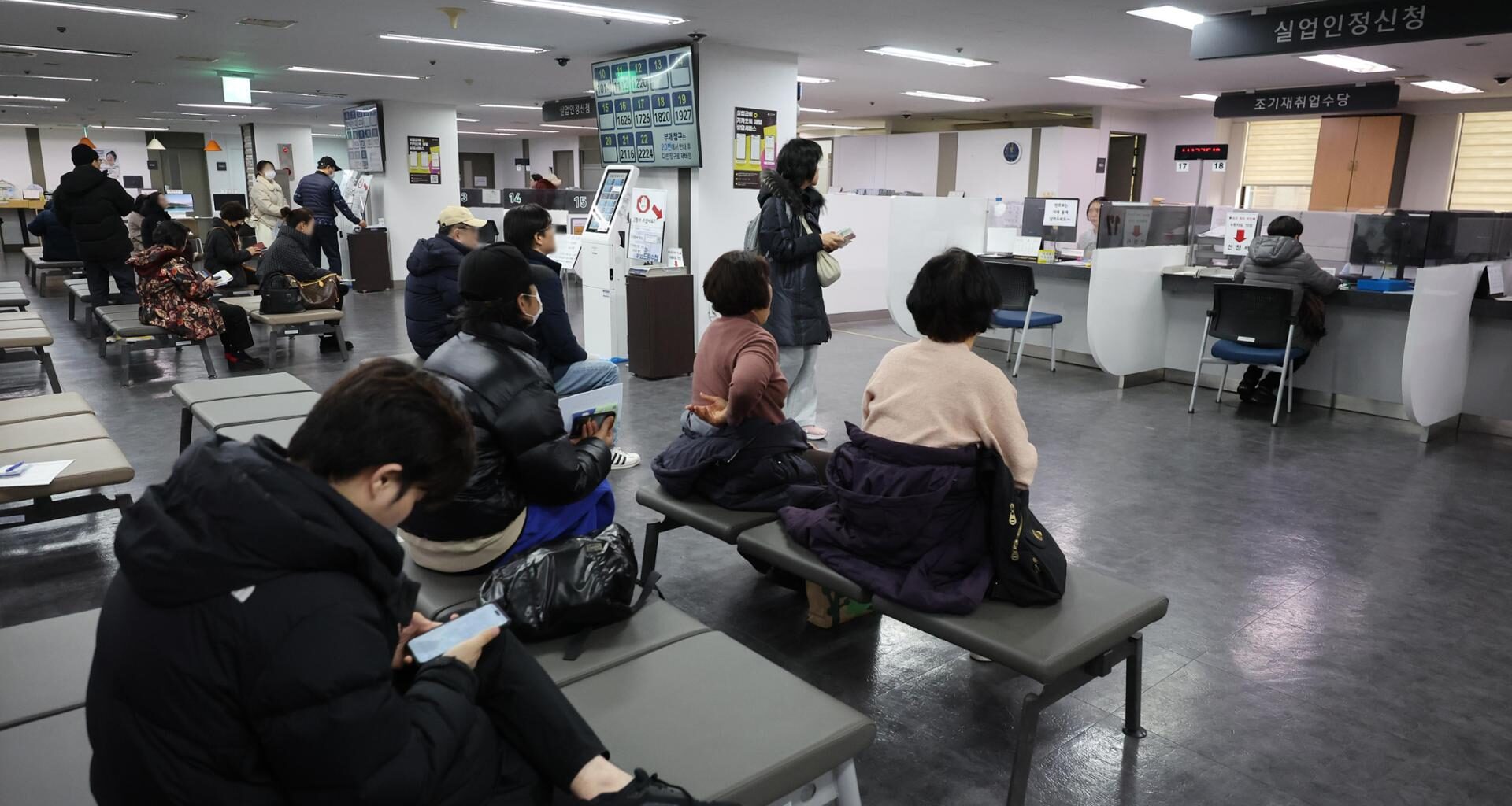
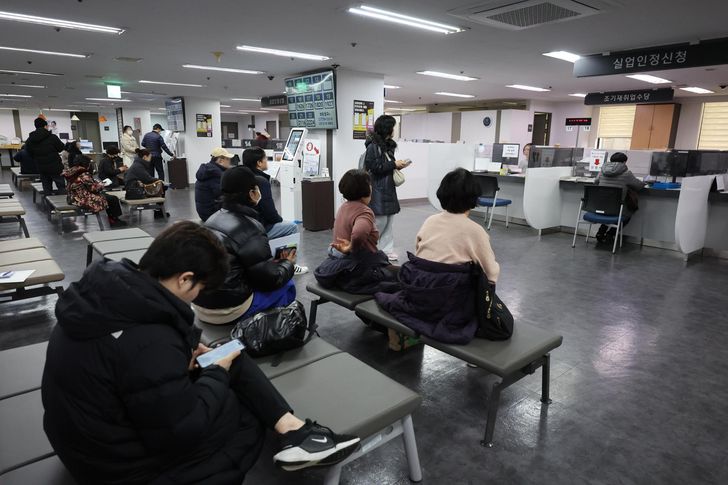
People file unemployment benefit applications at the Seoul Western Employment Welfare Plus Center in Mapo District, Seoul, Feb. 11. Yonhap
Employment among young professionals in South Korea is falling sharply as artificial intelligence (AI) spreads into professional fields, data shows. The contraction, appearing particularly pronounced among graduates in the humanities and social sciences, suggests that entry-level roles may be bearing the brunt of technological change.
According to an analysis of microdata from the Ministry of Employment and Labor’s Economically Active Population Survey, employment in the professional, scientific and technical services sector stood at 1.389 million last month, down 98,000 from a year earlier — the largest January decline since records began in 2013.
The sector includes research and development as well as professional services such as law and accounting.
The losses were heavily concentrated among workers in their 20s and early 30s. Employment among those aged 25 to 29 fell by 38,000 from a year earlier, while the number of workers aged 30 to 34 declined by 41,000. Workers aged 20 to 24 saw employment drop by 10,000, meaning younger cohorts accounted for nearly 90 percent of the overall decline in professional fields.
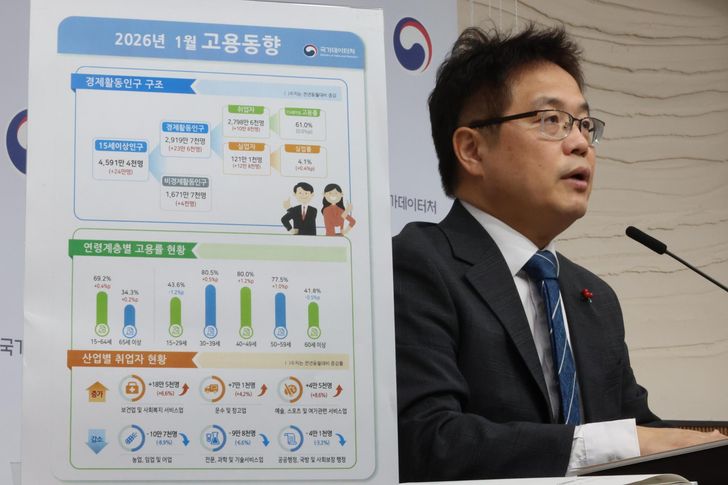
Bin Hyun-joon, director general of social statistics at the Ministry of Data and Statistics, announces January employment trends at Government Complex Sejong, Feb. 11. Yonhap
The decline adds to a recent downward spiral. In December, employment in the professional, scientific and technical services sector fell by 56,000 from a year earlier to 1.421 million — the largest December decline since records began.
Losses were again concentrated among younger workers, with employment among those aged 25 to 29 and 30 to 34 each falling by about 30,000.
Analyses indicate that the impact of AI is concentrated on younger generations. According to a recent Bank of Korea report, 98.6 percent of the 211,000 jobs lost among people aged 15 to 29 over the past three years were in sectors with high exposure to AI.
Employment in professional services fields such as law, accounting and management fell by 8.8 percent during the same period, with assessments that entry-level roles that typically involve routine tasks are susceptible to replacement by AI.
Additionally, of the 1,200 people who passed the CPA exam last year, only 338 had secured jobs as of October, according to the Korean Institute of Certified Public Accountants. Industry observers attribute the shortfall partly to the rapid adoption of AI tools by accounting firms.
Experts also say the drop of 18,000 from a year earlier in employment among humanities and social science majors in professional, scientific and technical services reflects the same pattern.
However, caution is urged in interpreting the figures, a Ministry of Data and Statistics official said. While hiring slowdowns in some sectors may reflect technological change, he added, more time is needed to accurately assess the exact impact of AI.
This article from the Hankook Ilbo, the sister publication of The Korea Times, is translated by a generative AI system and edited by The Korea Times.