
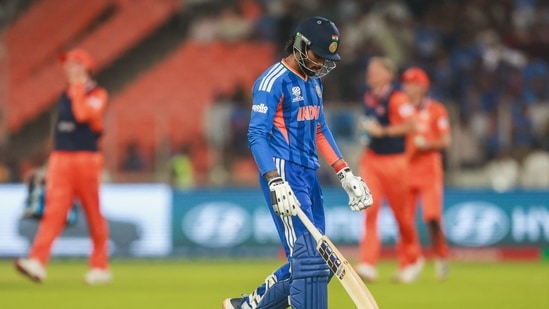
Tilak Varma’s post-Asia Cup 2025 final slowdown has become a real talking point because it hits India’s most precious currency: middle-overs tempo. When your number three is routinely scoring at 115-125, someone else must pay the interest – usually the power-hitters later, or the captain himself, who suddenly has to bat like a fireman instead of an artist.
 Tilak Varma has yet to fire for India at this T20 World Cup (Sportz Asia)
And that is why the debate has turned sharp in this T20 World Cup 2026: is Tilak reading conditions and match states correctly – or has the responsible innings for the final quietly become his default setting?
Also Read: Abhishek Sharma found out or the current slump is going to make a man of him?
The pivot point – September 28, 2025
In the Asia Cup final 2025 at Dubai, Tilak walked into a crisis and played the kind of knock that wins chases and earns trophies, and also starts arguments later. He made 69 off 53 as India chased down a competitive total under immense pressure.
That knock did two things at once:
1. It proved he can bat deep under stress
2. It effectively stamped a role in him: stabiliser first, accelerator second.
The evidence: What he’s done since that final
Post the final, his T20I list features two different Tilaks – and the gap between them is the whole story.
The “I can still change games” Tilak
– 62 off 34 vs South Africa
– 73 off 42 vs South Africa
Those two innings matter because they kill the almost lazy conclusion that he has lost intent. The ceiling is intact.
The “I won’t let us lose it here” Tilak
The T20 World Cup 2026 sample is the one everyone is quoting back at him: 106 runs in four innings at a strike rate of 120.45. It is also painfully symmetrical: 25, 25, 25, 31 – four starts, no conversions. Even in the Netherlands match, where India still piled up 193, Tilak’s 31 off 27 sat in a phase where India had early damage and needed someone to hold shape before the late surge.
Tactical shift or dropped anchors
This isn’t about aesthetics. It is about match logic.
Why it appears a tactical response1) His low-tempo knocks have context
– In the Asia Cup final, he came in at 10/2 and built a chase where the first need was survival, not flare.
– In the Netherlands game, India again suffered early setbacks, and then exploded late through Shivam Dube, mainly. That innings shape naturally assigns the pressure-absorption responsibility to one batter.
2) The high gear still appears immediately when the game demands it
The 62(34) and 73(42) came in this stretch – so, it is not a permanent slowdown.
Why is suspicion fair
Here is the uncomfortable part: T20 punishes only those who don’t convert from number three. The World Cup analysis – 106 runs off 88 balls faced – is exactly the band that creates pressure on the rest of the order. And once the pattern shows up on a big stage, the debate becomes inevitable: should India move their best disruptor, Suryakumar Yadav, up to face more balls, and use Tilak as the floater who stabilises at 4 or 5, depending on the fall of wickets? That argument is open now with the Super 8s approaching.
What is happening
Tilak Varma hasn’t forgotten how to score fast. He is being asked – implicitly or explicitly – to ensure the innings more often than India should need. That is a team-composition signal, not just an individual one.
The risk is subtle: once you keep rewarding the stabiliser role, a batter can start playing for stability even if the moment has changed. Modern T20 doesn’t need an anchor; it needs a gearbox, and the real critique for Tilak in this tournament is that the shift from second to fourth gear is arriving a few balls late.
If India persist with Tilak at number three, the next step is to define a trigger
– By 15 balls faced, his strike rate needs to be climbing decisively.
– In overs 7-15, he must be producing boundary pressure at a rate that prevents the field from settling into a dot-ball comfort.
If he does that, concerns around his strike rate would die down instantly. If he doesn’t, then the “SKY over him” conversation won’t just be noise – it would start to materialise.