
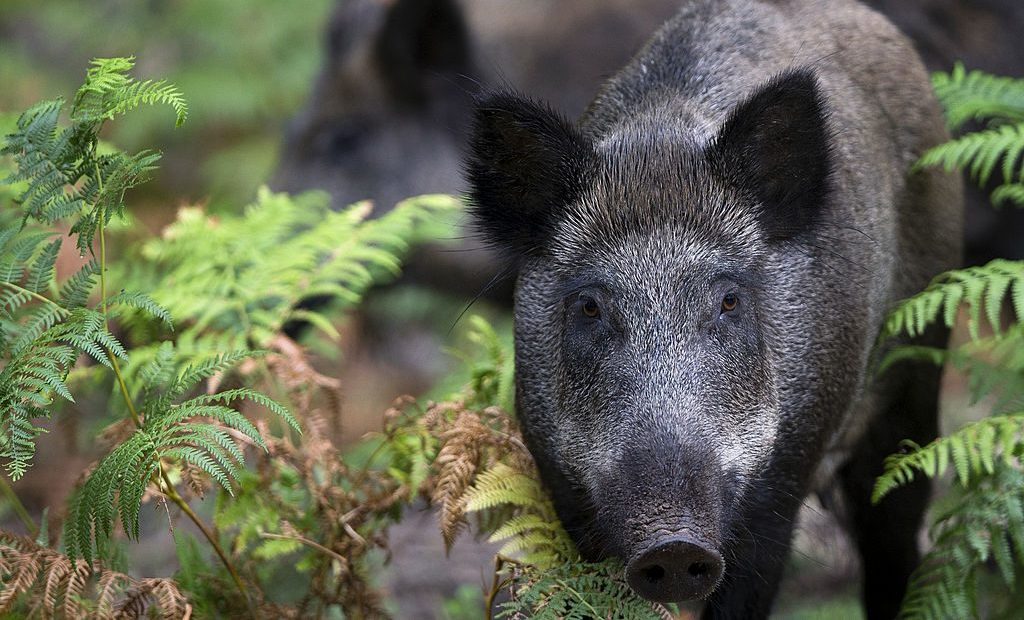
A wild boar was the last thing Eliana Thompson expected to see on an evening drive in Hampshire. She nearly flattened it, there on the road outside Petersfield. Fortunately for the hog, and Thompson’s fender, she pressed the brakes in time. The boar, for its part, looked unbothered — defiant, even — as it stared into the headlamps of the graphic designer’s VW Golf. “It looked very healthy,” Thompson says, recalling an almost-human air of nonchalance.
When Thompson met her friends that night, she challenged them to guess what she’d just seen. When they all guessed right, her heart sank. The oinkers, it turned out, were the talk of the town, with sightings along Stoner Hill Road plastered over Facebook and the local news. Yet if Thompson was thrilled at her encounter, not all her neighbours agreed. Comments left on local Facebook groups range from the welcome, to the bemused, to the outright murderous. “Police,” said one, “should get someone out to shoot it”.
This is typical. The descendants of enterprising boars hopping farm fences in the Eighties, British wild boars are rural wildlife’s version of Marmite: a keystone species that could bring untold benefits to Britain’s biosphere — but also wreak havoc for gamekeepers and farmers. More than that, this is one of the few species in the country on which your opinion is likely to be informed by your politics. Your typical Guardian reader will see them as unjustly maligned; dirty, to be sure but, thanks to their habit of turning over the soil, capable of large-scale rejuvenation. The average Telegraph reader, though, will have been treated to many a tale of the wild boar chaos in the UK and Europe. The animals have attacked dog walkers on Dartmoor and disrupted Italian prosciutto production.
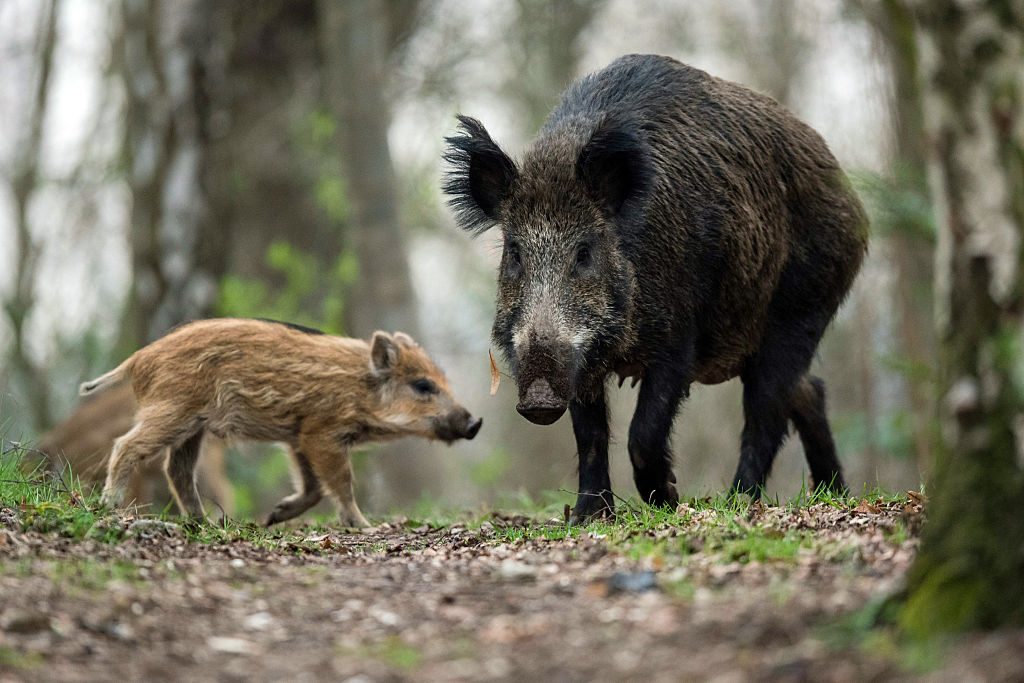 Like this pair in Germany, boars are a common sight on the Continent. (Gregor Fischer/DPA/AFP/Getty)
Just how divisive these animals have become is also illustrated by the hostile reaction of the New Forest Wildlife Park’s press officer when I ask to see a family of wild boar at the zoo and interview one of their keepers. It’s an impolite no. “[W]e have learnt over the years to not engage in any media requests regarding wild boar,” he says, “as the story never gets published in a true and pro-conservation-based format.”
I see the family anyway. When I approach the fence, the sow stares directly at me from inside her sty, while four brown, striped piglets chase each other in circles, before all five begin to root through the pitted earth outside. They’re looking for food: invertebrates, seeds, bulbs. Then, in a separate enclosure to her right, the sow’s mate emerges: black-eyed, tusked and much, much fatter than his partner. For a moment, he stares at the sow and her hoglets, as if pining to join them, before losing interest and waddling off, stopping occasionally to shake great clouds of brown dust off his frame.
Though these boars don’t seem particularly fearsome, I’m also glad to see them behind two sets of wire fencing. Being charged by one, as Jake Swindells was in Sweden several years ago, can prove to be a painful experience. “It’s not fun,” admits the Countryside Alliance Scotland director. “They can open up the inside of your leg, rip the arteries. They can disembowel you quite easily if you stumble and fall.”
We’ve long known how brutal boars can be. Medieval chronicler Bartholomaeus Anglicus described them as the indomitable bruisers of the British forest, “that for his fierceness and his cruelness, he despiseth and setteth nought by death”, preferring to mount frontal charges against spear-wielding hunters even after being mortally wounded. This defiance saw the boar adopted as a symbol of dauntlessness by the elite, from the Anglo-Saxon kings sporting boar eyebrows on their helmets to the knights that depicted the creature rampant, tongue bared, on their coats of arms. That symbolism outlived the boar themselves in British forests, who were hunted to extinction by the 13th century.
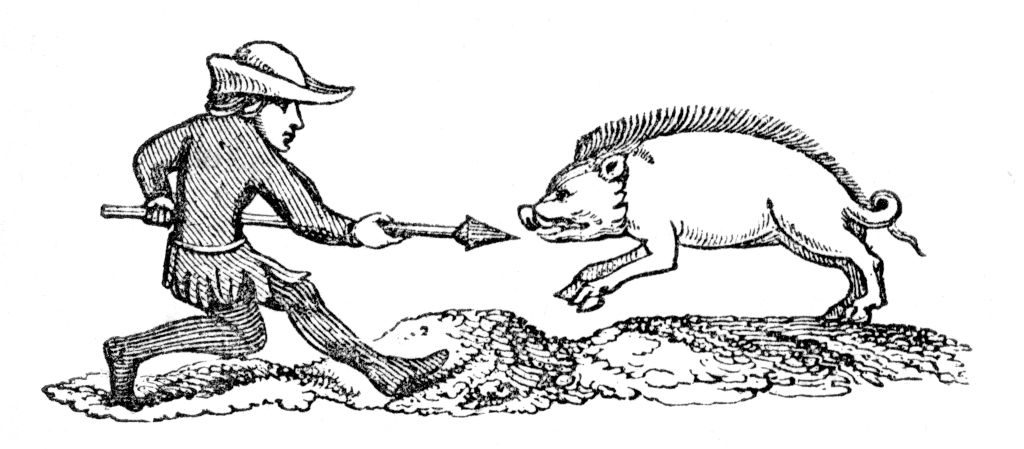 Boars were part of British life for centuries. (Print Collector/Print Collector/Getty)
Their history thereafter is one of sporadic releases of continental-born hogs — naturalist Gilbert White recorded one such occurrence in 1789, which led to the group, or “sounder” being exterminated by locals — until the Eighties. That’s when the UK developed a taste for farm-reared boar. Escapes soon followed, and by the following decade stable populations had been established in Scotland, the Kent-Sussex borders, Devon and the Forest of Dean. Taken together, there are perhaps 2,600 nationally — not enough to lead to many human-boar confrontations. In the Highlands, says Swindells, you’re much more likely to see the destruction left by wild boars, from half-eaten crops to pitted lawns, than face their tusks head on. Even then, he adds, rural communities in the Highlands are still coexisting relatively peacefully with these hairy hogs. That’s largely because populations remain relatively low compared to those in Europe. Should those sounders go forth and multiply a bit too much, controlling the population is and has been an option.
All the same, Swindells suggests that intentional reintroductions in Scotland are undesirable: while wild boars do a good job of regenerating the soil, a reintroduced population would almost certainly escape from whatever conservation area designated as their new home and march headlong toward new potential feeding grounds — farmland, back gardens — where they definitely wouldn’t be welcome. In time, they’ll encounter roads and private property, and begin spinning the flywheel of negative stories about ruined lawns and car accidents all over again.
“They’ll encounter roads and private property, and begin spinning the flywheel of negative stories about ruined lawns and car accidents all over again.”
That’s clear enough in the Forest of Dean. Home to an estimated 583 boars, which Forestry England regularly culls to keep to an even 400, sounders in the area have been recorded marching past pubs, scaring motorists by rooting alongside roads and even biting off a man’s fingertip. All the same, says Chantal Lyons, the author of Groundbreakers, a history of wild boar in Britain, you’d be hard-pressed to find much hysteria in the area now. Having lived alongside them since the Eighties, concerns about the animals have “really died down” — and shown what life might be like in rural England if they were fully reintroduced.
This, says Lyons, would not only be good for the soil, but the soul, too, an infusion of the truly wild into our staid, regimented lives. As she says in her book, more and more studies point to the rejuvenating effect of short, sharp shocks delivered by hunger or intense exercise. “We don’t need animals to run in sheer terror from,” Lyons writes. “But we do need a space in our minds for the unknown — or that which can only be known through other, different beings.”
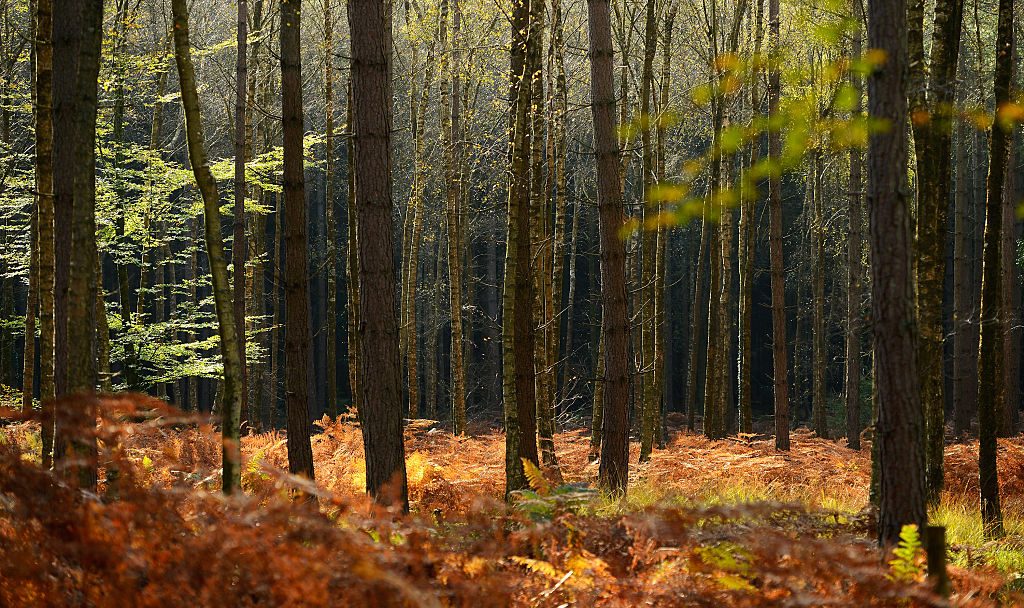 Are there sounders hidden in the New Forest? (Mike Hewitt/Getty)
All the same, Lyons is also a realist. Plenty of species have been successfully reintroduced to the UK in recent years, she says, but they tend to be cuddly and stay out of the way of people, like most wild animals in the British countryside. But wild boar, because “they are of a size and a power that we’re not used to in this country,” test our mettle for large-scale rewilding. Because of the oft-repeated threat that wild boar might spread swine flu to pig farms, meanwhile, it’s unlikely that their legal status as dangerous wild animals will be downgraded in the near future.
Guerilla rewilders have different ideas, with the sudden appearance of wild boar in Devon last year prompting suspicions of an illegal release. It is possible that the same thing happened outside Petersfield. In certain respects, Stoner Hill would be a much better habitat for the boar than Dartmoor. Steep and so forested it almost feels Jurassic, the terrain is forbidding to walkers and, as I can attest myself, difficult for drivers to ascend in anything higher than third gear. But descriptions of the boars’ behaviour by eyewitnesses, coupled with the fact that only a handful were ever seen, suggest a more innocuous origin.
The fact that the boars of Petersfield were seen as often in the daylight as in the gloom, Lyons explains, indicates that they’re not genuinely wild boar — but rather recent escapees from a local farm. A landowner in Froxfield, on the western side of the plateau of farmland scaled by Stoner Hill, also suggests that they may have simply been dumped by someone too cheap to hire someone to euthanise them. It’s a wish that seems to have been granted, judging by the persistent rumours that one was hit by a car and another shot by a gamekeeper.
There is, of course, the possibility that wild boar are already living, unseen, on the West Sussex and Hampshire borders. Though often mistaken for muntjac deer in low light and thick undergrowth, local news report isolated sightings near surrounding hamlets. I also speak to a local gunsmith who sometimes hears idle chatter from gamekeepers about wild boar, albeit shyer and smaller than those recorded outside Petersfield, scampering out of sight before they can get a shot off. Then, tantalisingly, a source sends me a clip of a healthy wild boar in Colemore, four miles north of Stoner Hill, which he claims was taken days after the feral pigs were last spotted in East Meon — though, since he has deleted the original video and its metadata, this proves impossible to verify.
What if boar were to return to Hampshire in greater numbers? Eliana Thompson wouldn’t really mind. “I think it would be lovely if we had them, personally,” she says, provided people had guidance on how to react if they encounter these beasts of the forest. “They’ve got just as much of a right to be here as we have.” Perhaps. But it’s still hard to imagine that this country is ready for boars’ full-scale reintroduction. It hasn’t been for centuries. Our countryside is more crowded and slashed with borders than we appreciate, borders guarded in their multitude by gamekeepers, farmers and unsympathetic motorists. The boars that survive will be small and wily, trained by generational trauma to scamper to the safety of the next dark hollow when he hears the heavy footfall of an unsuspecting Briton. Such creatures may well have found a way to survive in the forests of Hampshire. One hopes that they have.