
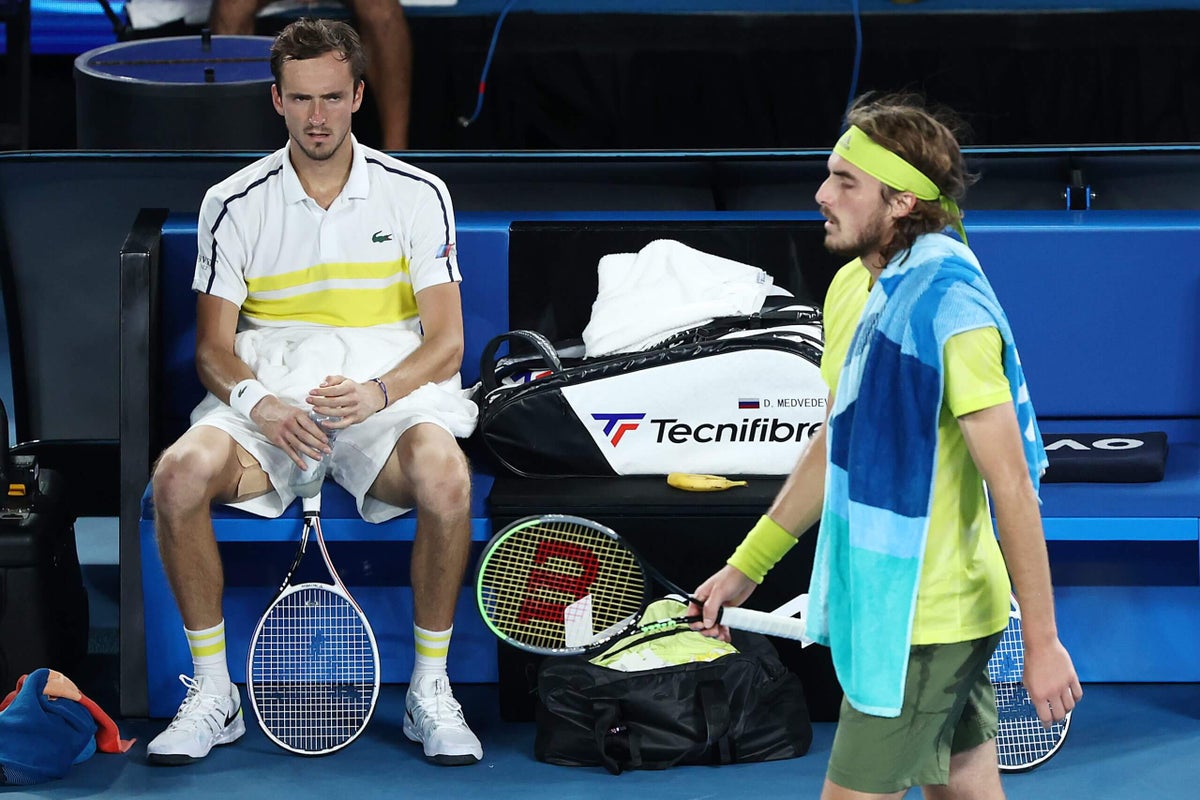
In front of a sparse crowd for a second-round match at the Qatar Open in Doha on Wednesday, the rivalry between Stefanos Tsitsipas and Daniil Medvedev entered its third age.
Once a riveting aggro-fest between two of the game’s rising stars, and then a compelling, but more respectful duel between two top-ranked players, it is now altogether less consequential. Many tennis rivalries can become disappointingly one-sided or fade into irrelevance as the players involved enter their late careers.
Medvedev and Tsitsipas, who both endured relatively miserable 2025 seasons that confirmed their distance from the sport’s biggest prizes, now meet as emblems of a sport passing them by, at first very slowly and then all at once.
A few years ago, Medvedev won the 2021 U.S. Open, and claimed the world No. 1 ranking soon after. Tsitsipas has reached two Grand Slam finals — at the 2021 French Open and the 2023 Australian Open — losing both to Novak Djokovic, the first from two sets up. In the next few years, Djokovic’s longevity and the emergence of Carlos Alcaraz and Jannik Sinner lowered their ceilings, before last season arrived to cave them in.
In 2025, Medvedev won just one Grand Slam match, sliding down the rankings from No. 5 to No. 18, before a late surge pushed him to just outside the top 10. Shoulder and hernia issues appeared to rob Medvedev’s once-formidable serve of its potency, and he lost control of his occasionally combustible — but usually watchful — personality.
After a first-round exit against France’s Benjamin Bonzi at the U.S. Open, where Medvedev’s conduct in whipping up the crowd and turning on umpire Greg Allensworth earned him a $42,500 fine, Medvedev split with his coach of the previous eight years, Gilles Cervara. After an upsurge under new coaches Thomas Johansson and Rohan Goetzke, he has started 2026 railing at “not-round” tennis balls.
Tsitsipas had an even more tumultuous year. His ranking fell from No. 11 to No. 36, as he tried everything to rediscover his youthful brilliance. He switched rackets, hired Djokovic’s former coach Goran Ivanišević, and then rehired his father, Apostolos, after an ill-fated two-month stint during which Ivanišević publicly criticized his new player.
“I have never seen such an unprepared player in my life,” Ivanišević told SportKlub last July. “Me, at my age and with this bad knee, I’m three times in better shape than him.”
A back injury, partly aggravated by his change of racket, hampered Tsitsipas all year. A feisty five-set loss to Daniel Altmaier at the U.S. Open left him unable to walk for a couple of days.
Tsitsipas’ body is better now, and in beating Medvedev 6-3, 6-4 Wednesday, he produced his best win by ranking since the middle of 2024. Medvedev was disappointingly flat, hitting double faults at key moments and sarcastically admonishing himself and his team. But even that wasn’t done with the conviction or relish that for so long made Medvedev tennis’ favorite anti-hero.
There was a time when Medvedev vs. Tsitsipas was a defining rivalry on the ATP Tour, first for angst and then more so for tennis. It earned its own Wikipedia page (now marked for deletion): Medvedev, the straight-talking disruptor with a huge serve and a jarring, impenetrable game that would partly redefine baseline tennis, against Tsitsipas, the misty-eyed, would-be philosopher with a classically refined one-handed backhand and penchant for the spectacular.
Their intensity initially belied their on-court status. Both players were outside the top 50 for their first meeting at the 2018 Miami Open, a match that produced some of the seminal beef in recent tennis history. Medvedev confronted his opponent at the end of a 2-6, 6-4, 6-2 win, after Tsitsipas had taken a five-minute “emergency bathroom break” during the decider, before failing to apologize for a mid-rally net cord.
Tsitsipas muttered the phrase “bull—- Russian,” prompting Medvedev to deliver one of the immortal lines: “You better shut your f— up, OK?”
“Hey Stefanos, you wanna look at me and talk?” Medvedev went on.
“I answer him because he doesn’t know how to fight. He is a small kid who doesn’t know how to fight.” After the umpire intervened and Tsitsipas left the court, Medvedev said: “If he doesn’t say anything, I have no problem with him but if he says something to me and he wants to fight, he needs to do it.”
“That (match) felt very wrong, the overall ambience,” Tsitsipas told the No Challenges Remaining podcast in 2021. “It didn’t belong to tennis. It felt like an MMA (mixed martial arts) fight.”
During the 2019 ATP Finals, Tsitsipas said of the match: “I did get pissed and said what I said, which I do regret, but at the time, I was very frustrated that things happened this way.
“It’s not that I hate him. As he said, we will not go to dinner together.”
After beating Tsitsipas again at the 2018 U.S. Open, Medvedev referenced the “strange” fact that his rival had blocked him on Instagram. After winning their third match that year at the Basel Open, Medvedev celebrated exuberantly. Following a no-look handshake from Tsitsipas, Medvedev posted on Instagram: “Ooops, I did it again.”
When Medvedev made it five wins out of five against Tsitsipas at the Shanghai Masters in 2019, the then-21-year-old Greek didn’t hold back in his post-match news conference when asked what it was like playing Medvedev. “I don’t mean to be rude at all, but it’s just boring. It’s boring. It’s so boring that — I don’t know.
“I hate myself for putting myself into that situation where I have to play in his own terms and not in my terms. And that’s reminding me of my childhood, when I was 12 years old, playing inside the court.
“So he has a huge serve, and if you manage to get it back, it’s just countless balls inside the court. You have to hit as hard as you can side to side, be accurate, and make him move.”
Medvedev said soon after that he had “stopped taking Tsitsipas seriously.” Alexander Zverev, another peer and rival, said at the time that Medvedev and Tsitsipas had “a weird relationship.”
When Tsitsipas finally secured a win over Medvedev, at the ATP Tour Finals a month later, he celebrated as if he had won the title. In his on-court interview, Tsitsipas said, “It was one of the most important victories of my career.” He added in a news conference: “It means more than extra. It’s a victory that I craved for a long time now, and it’s great that I came in at this moment.”
By then, Medvedev and Tsitsipas had emerged as serious players at the top of the game. They were seen as likely successors to the Big Three of Federer, Rafael Nadal and Djokovic, who were thought to be coming towards the end of their careers.
Their next meeting came on one of tennis’ biggest stages: An Australian Open semifinal on Rod Laver Arena in 2021. The pair were respectful in the leadup, as had become the case as their rivalry developed, with Tsitsipas rowing back on his “boring” comments from a couple of years earlier.
Medvedev came through in straight sets, before winning again at the same stage, on the same court, 12 months later. Medvedev was the reigning U.S. Open champion and world No. 2; Tsitsipas was world No. 4. This time, the aggro returned. Enraged by Tsitsipas’ father’s frequent talking between points, Medvedev called umpire Jaume Campistol a “small cat” for his alleged failure to enforce the rules.
Earlier, Medvedev had said, “His father can talk every point? Bro, are you stupid? His father can talk every point?! Can his father talk every point?!”
In a news conference afterwards, Tsitsipas said, “I don’t pay attention to the stuff. Players like to do this stuff to throw you off mentally — could be maybe a tactic. It’s all right. He’s not the most mature person anyways.”
When Tsitsipas beat Medvedev seven months later at the 2022 Cincinnati Open, he celebrated with a dance that Medvedev pointedly repeated when winning a rematch at the Italian Open the following year. In between times, Medvedev had stuck up for close friend Andrey Rublev after Tsitsipas had said after losing to the Russian at the 2022 ATP Finals that: “I feel like the better player. He prevailed with the few tools that he has. He was able to really take advantage of them and win today.”
When Medvedev beat Rublev to win the Dubai Tennis Championships in March 2023, he said in his on-court interview: “Not long ago, one player said that he (Rublev) has just a few weapons, and I was reading this and I was like, ‘How can you say this?’”
“Andrey is one of the most skilful players on the tour, he just didn’t fully exploit his potential, but I’m sure that he can win Grand Slams, hopefully he can beat this guy who said it, many, many times, and I wish this for sure.”
Tsitsipas had apologized a few months earlier for those comments, which Rublev accepted.
By the time Tsitsipas and Medvedev were teammates at the 2024 Laver Cup for Team Europe, the old foes were playing down their rivalry.
And so to Wednesday. There was no needle when the players met at the net at the end of this one, just weary resignation from Medvedev that another match like this had gone against him.
Tsitsipas will play the No. 5 seed Rublev in the quarterfinals, before a possible semi against Alcaraz, the world No. 1. Tsitsipas would be a major underdog, against a player who has rendered all rivalries — other than his own with Sinner — largely irrelevant.
His and Medvedev’s feud may have entered the détente stage — this 76-minute clash was far from a classic — but it was an important win for Tsitsipas, even if it only served to emphasize how far away their rivalry is from having any real meaning, interpersonal or otherwise.