

Terry Mackintosh has owned the vintage car for 67 years but does not want to leave his children with a hefty bill by passing it on to them
A car lover is looking at ways to avoid his children getting a hefty inheritance tax bill – with one option to put his vintage Bentley car in a trust.
Terry Mackintosh, 89, bought the Bentley 67 years ago when he was 22 and is now looking at ways he can mitigate his children’s inheritance tax (IHT) bill as the car’s value has increased by over £200,000.
The 1920s car was purchased by Terry in 1959 for just £260 and is now worth at least £250,000. He still drives it to this day but will be looking to find a new home for his beloved car soon.
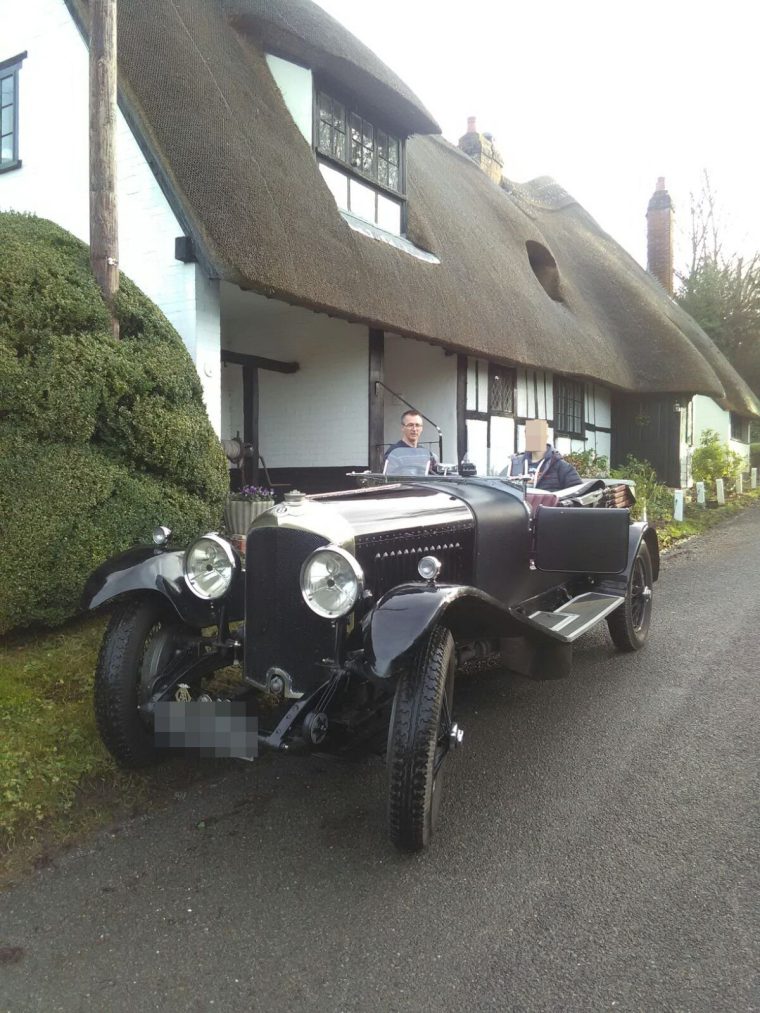 Terry Mackintosh still likes to drive the 1920s vehicle
Terry has four children but doesn’t think it is wise to gift the car to them as he is approaching his 90th birthday.
Under current IHT rules, those making gifts must live seven years after the gift is made which would make the asset IHT free.
If a person dies within seven years of giving a gift and there’s IHT to pay on it, the amount of tax due after their death depends on when they gave it.
Gifts given within three years before a person’s death are taxed at 40 per cent, while gifts given after three years but before seven years are taxed on a sliding scale known as “taper relief” between 8 and 32 per cent.
Although the value of the car alone is not enough to breach the nil-rate band, Terry is leaving other assets that will take him over the £325,000 threshold – the amount that can be passed on without having to pay tax.
To avoid his family facing hefty IHT bills, Terry is considering if it would be feasible to set up a family trust to avoid the tax.
He said: “My children would become powers of attorney, and we could pass the ownership of the car into a trust with the proviso that I could remain as the sole driver until such time until we find a new owner.”
New FeatureIn ShortQuick Stories. Same trusted journalism.
What is a trust?
A trust is a way of managing assets for people and involves the person who puts assets into a trust (the settlor), the person who manages the trust (trustee) and the person who benefits from the trust (beneficiary).
They can be set up for several reasons including controlling and protecting family assets or to pass on assets while someone is still alive.
The tax treatment of assets that are placed in a trust mean it can be a useful way for some people to mitigate their IHT bill – however the rules are complex and that may not always be the case for everyone.
Assets that are in a trust do not form part of a person’s estate, meaning they are not included when working out how much IHT is due to be paid, providing the person lives for seven years after the transfer.
Ollie Saiman, co-founder of advice firm Six Degrees, said in Terry’s case, the answer was nuanced and unlikely to be beneficial for a number of reasons.
“If the Bentley were transferred into a trust but the owner continued to use it as the sole driver, HMRC would typically view this as a ‘gift with reservation of benefit’.
“In simple terms, where someone gives an asset away but continues to benefit from it, the asset is usually still treated as part of their estate for inheritance tax purposes. That means the intended tax saving may not be achieved.”
He added there could be a tax implication at the point the car is transferred into the trust and could trigger an immediate IHT charge if the £325,000 nil rate band has been used.
IHT is often due when a trust reaches its 10-year anniversary of being set up or when assets are transferred out of the trust.
Katherine Waller, co-founder of Six Degrees, said: “Trusts can be useful tools in succession planning, including for valuable collectibles, but where the original owner wishes to retain personal use, the planning becomes more complex, and the benefits are not automatic.
“Lastly, the seven-year clock can apply to trust transfers, and so given the settlor’s 90 years, this may limit any efforts to totally remove the IHT risk, even if they stop using the vehicle entirely.”
Other options
Chris Etherington, tax partner at RSM UK, said before doing anything with the Bentley, Terry needs to take a step back and consider the total value of his estate, taking into account the nil-rate band (£325,000) and the residence nil-rate band (£175,000) – an additional allowance given to people who pass on their wealth to a direct descendant.
Etherington said: “Selling the Bentley may still represent one of the simplest things to explore as it should represent a ‘wasting asset’ for capital gains tax (CGT) purposes.”
A wasting asset is, simply, an asset which depreciates in value over time and are generally exempt from CGT as a result.
Etherington added: “Converting it into cash should not give rise to CGT as a result and opens a number of options. That can include reinvesting in potentially IHT‑advantaged assets, making lifetime gifts or funding living costs so that other assets can be preserved.”
If Terry’s children are uninterested in the car, they could sell it straight away, but Terry would have to part with his car.
One avenue Terry could consider is charitable giving, according to Etherington, who said this avenue was often overlooked.
“If the individual is passionate about the heritage of the vehicle, donating it to a museum or charitable trust could provide IHT relief, as assets left to a charity are outside of the estate.
“While this would not benefit the children financially, it may appeal to individuals motivated by legacy rather than wealth transfer. It might also result in a lower IHT rate being applied to other assets in the estate.”
Do you have a valuable asset and want to know how you can mitigate your IHT bill?
We want to hear from you!
Email Alina Khan on alina.khan@theipaper.com