
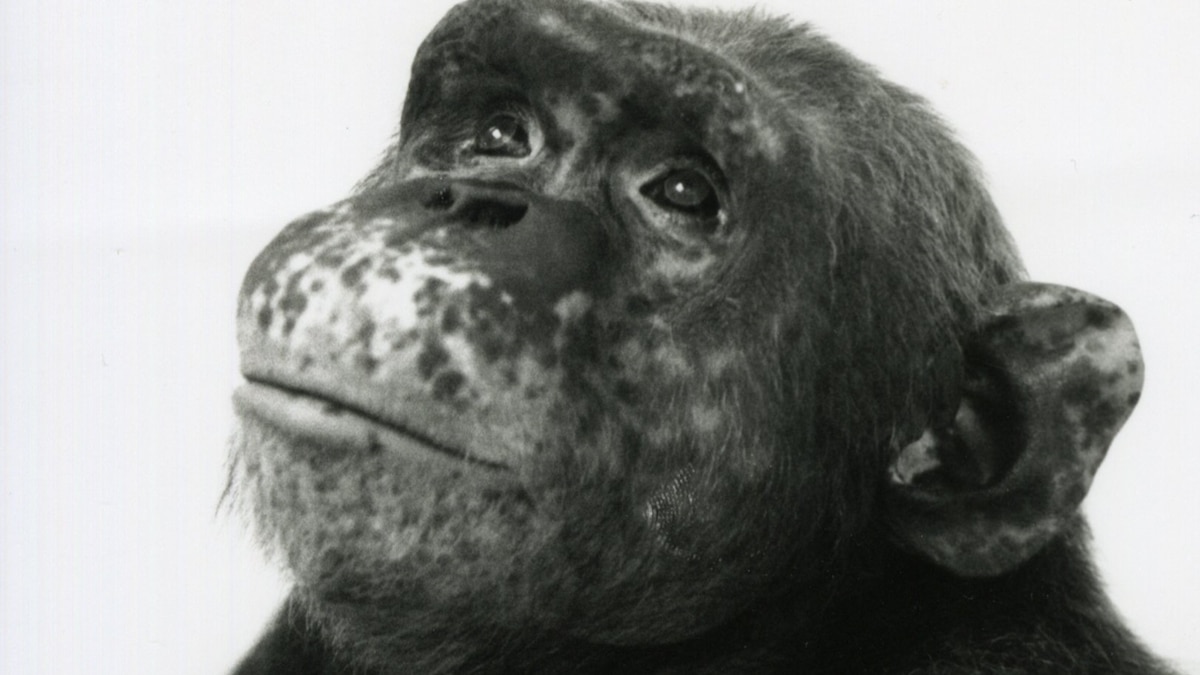
Their work inspired others to try and replicate their results, including a Columbia University professor named Herbert Terrace. In 1973 he acquired a chimpanzee that he named Nim Chimpsky, in reference to Chomsky. Terrace boasted Nim would soon be able to share his feelings, describe his imagination, and discuss the past and future. These claims, along with the Gardners’ and Fouts’ reluctance to put Washoe in the limelight, led to Nim outpacing Washoe in fame, even appearing on the cover of a 1975 issue of New York magazine.
Terrace would at first claim success, as Nim learned to make the gestures associated with the signs for “banana,” “hug,” and “play.” But Terrace would later conclude that the chimp had been reacting to prompts from his trainers, making the gestures to earn rewards, with no actual understanding of what he was doing. Nim, he believed, could not use the signs he learned conversationally or string them together into sentences that reflected thoughts.
Perhaps the problem wasn’t with Nim but with his environment.
“Nim lived with a family in New York on the Upper West Side, but he was brought to a classroom on the daily,” where he was drilled on signs for hours, says Valerie Chalcraft, a psychologist who works as an animal behaviorist and studied under the Gardners in the 1990s. Nim’s lessons were given in spare rooms, lacking the normal stimuli that a child enjoys in their first years. As a result, as Chalcraft puts it, it shouldn’t be surprising that Nim didn’t have much to say. “Human adults don’t teach their kids how to speak with rewards and punishments. It happens in a natural, relaxed setting, an enriched setting,” she says.
Nim also lacked stability and consistency. At least one close caregiver was abruptly cut out of the project, several others left on their own, and Nim had no other chimpanzees around during this era. After Terrace concluded the study in 1977, Nim was transferred to a research facility and then to a biomedical lab. Eventually, he was bought by a philanthropist and lived on a ranch until he died in 2000 of a heart attack at age 26.