
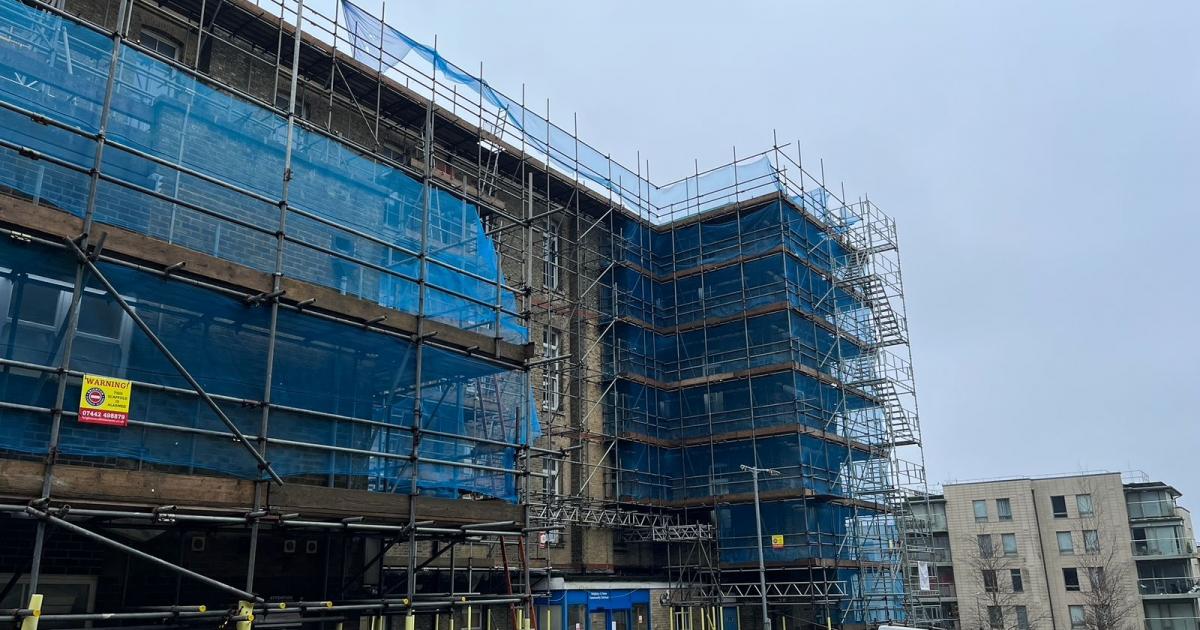
The swifts, which are on the UK’s red list of birds of conservation concern, make a return journey of several thousand miles to Africa each winter – before returning to Brighton for the summer to nest and raise their young.
Resident Sue Craig, 79, visited the site on the morning of February 19.
She was able to confirm that at least five of the 32 swift boxes on the site were behind scaffolding covered by blue netting, she said.
Swifts live almost their entire lives on the wing. When they return to Brighton, they will fly directly into their roosts without setting foot on the ground – assuming they are able to access them freely.
They are also site-faithful, meaning they will not just move to a nest somewhere else.
Fearing the colony could be “devastated” should they not be able to roost, she said: “Swifts are agile and acrobatic so if there was even a metre or less around each swift box free of netting then they might get away with it.
“They don’t give a toss about humans being around, they just need access to their homes.”
Brighton-based photographer Steve Geliot is also an admirer of the birds, describing them as an “absolutely magical” species.
Two of Geliot’s photographs were recently “highly commended” by judges in the 2026 South Downs National Park astrophotography competition.
“That end of Brighton is a hotspot for swifts and it’s wonderful,” he said. “It would destroy them if they can’t nest.”
Blocking access to the nests could also be a potential wildlife crime if the netting is still up when the swifts return. Under the 1981 Wildlife and Countryside Act, it is prohibited to “intentionally or recklessly […] obstruct or prevent any wild bird from using its nest.”
Craig, who has been monitoring the swift colony since 2022, said she has watched bird populations in Brighton decline more generally since she moved here in the 1990s.
“I used to watch my own little murmuration of starlings while peeling carrots at the kitchen sink. “That’s all gone now, and that broke my heart.”
Sussex Community NHS Trust, which oversees the site, said: “We are carrying out essential external repairs to some of our buildings, which requires temporary scaffolding and netting.
“We are aware of the swift boxes on the site and are taking steps to manage the works with this in mind.
“Repairs to buildings with swift boxes are due to finish in March, ahead of the birds’ expected return.
“If any unforeseen delays occur, we will be working to ensure the swifts can access their nesting sites.”
The swifts, however, are soon likely to be threatened again – this time by the redevelopment of the hospital site.
The trust announced plans in 2018 to sell the site to private developers to fund a new community health hub.
As the plans stalled, a community campaign sprung up calling for the land to remain in public hands.
The group – made up of local residents and housing, environmental, and heritage campaigners – hope to see it used for social and key worker housing while protecting biodiversity and the historical character of the site.
The community campaign will hold its next public meeting at the Brighton Friend’s Meeting House on Monday, March 30, at 7pm.