
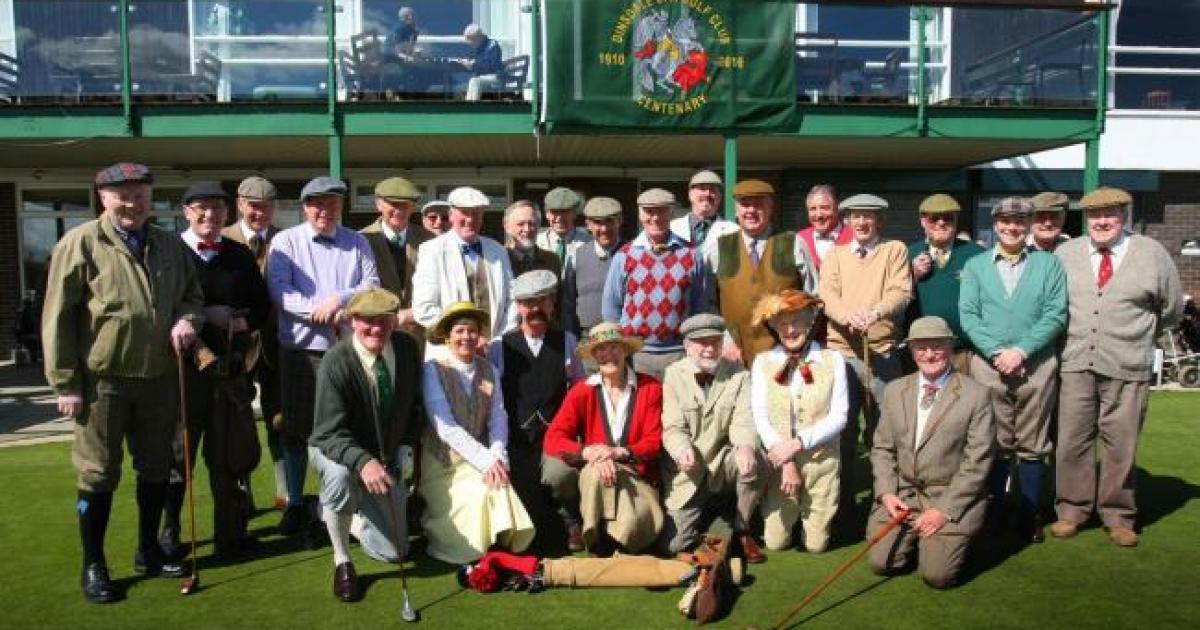
The golf club on the clifftops high above the River Tees is itself 116 years old, but before it was formed, a maverick entrepreneur with a famous name attempted to turn the area into a golfing tourist attraction.
He had a splendid 70-bedroom hotel for visitors to stay in, a sulphurous spring with health-giving water for them to drink and bathe in, glorious wooded riverbanks for them to walk in, the river for them to fish and trowse in, plenty of nearby pubs for them to refresh in, and he had the hottest holes in the most fashionable game for them to putt into.
A sketch of Allan Havelock-Allan’s nine holes in 1908 from the Newcastle Daily Chronicle
“Situated as it is in the pleasantest country imaginable, and surrounded by so many conveniences, it does not require the gift of prophecy to foretell the time, not far distant, when Dinsdale will be among the most favoured resorts of northern golfers,” wrote a correspondent who signed himself All Square in the Newcastle Daily Chronicle of February 21, 1908.
A very colourful view of Dinsdale Spa, near Middleton St George, with the 70-bedroom hotel on the clifftop on the right today being private residences with the Dinsdale Spa golf course wrapped around it. The bath-house which became the golf clubhouse can be seen down near the eriver
It had all started in 1789 when Lord Lambton’s men were speculatively drilling for coal in the district. Instead they struck a seam of water that was so whiffy that one of the workmen vomited for a week. Another, who suffered from bad rheumatism, found himself miraculously cured.
The half-timbered bath-house by the river became the clubhouse
Soon people flocked to take the health-giving waters. Lord Lambton built a half-timbered bath-house down by the river and then got Ignatius Bonomi to design a hotel on the clifftop that was so splendid that even the Duke of Wellington came to stay there.
Ignatius Bonomi’s spa hotel at Dinsdale is now private residences
Villagers in nearby Middleton One Row cashed in as well: 20 turned their properties into lodging houses while others worked in numerous pubs and cafes.
But even with the Stockton & Darlington Railway bringing visitors to its door, the spa was a short-lived fad, particularly once the wealthy realised the railway could take them further afield to warmer continental spas away from the vagaries of the south Durham climate.
So Dinsdale Spa was relaunched in 1863 and again in 1880, but come the start of the 20th Century, it was in need of more money.
In 1902, a new investor appeared on the scene. He was Allan Havelock-Allan, the younger son of Sir Henry Havelock-Allan of Blackwell Grange, the hero of Lucknow during the Indian Rebellion of 1857.
Allan Havelock-Allan was married to Annie Chaytor, the youngest daughter of Sir William Chaytor, of Clervaux Castle, near Croft, in North Yorkshire, and they lived in Blackwell Manor, on the edge of Darlington. In 1904, Annie gave birth to their third son, Anthony, who became the renowned film producer responsible for Brief Encounter.
Allan thought there was money in Dinsdale’s whiffy water, which he began marketing under the jazzy name of Ozala. Not only was it said to improver a drinker’s general health but it acted as a laxative and removed facial blemishes.
Allan also raised £1,000 (about £100,000 in today’s values) to refurbish the hotel, which he first began promoting to the fishing and hunting set – Allan himself was a keen foxhunter and the area had about 10 hunts where visitors could enjoy the thrill of the chase.
Then in 1906, to cash in on the latest craze, he began laying out nine golf holes.
Although the Scots had been knocking a ball into a hole with a stick since the 15th Century, in England golf fever really broke out around 1890. In the 20 years before the outbreak of the First World War, 1,200 clubs opened – that’s one a week for two decades.
The North East was an early adopter. Alnmouth club in Northumberland opened in 1869 and is regarded as the fourth oldest in the country followed by Seaton Carew – originally called the Durham & Yorkshire Golf Club – in 1874. It is the 10th oldest in the country, and Allan poached its pro, Mr Weastell, to lay out Dinsdale.
In 1906, when Dinsdale opened, there were 14 clubs in the North East, but Dinsdale was unique in aiming as much at tourists as it did at local club members.
Its first tee was at river-level beside the half-timbered bath-house which Allan converted into a clubhouse. A golfer then drove from the tee 186 yards up the 60ft cliff to the first green on a plateau at the top.
The hole was described as a “difficult bogey four” and the other eight holes were then arranged around the hotel, which offered golfers special room rates.
Allan promised to extend the course to the full 18 holes but in 1908, his company, the Northern Counties Spa Water Company, went into liquidation.
Then Annie left him, taking their five children with her, and sued for divorce.
Allan left Blackwell and headed for Kent, where he took over a hunt and blew a huge hole in the Havelock-Allan fortunes before being declared bankrupt with debts of £1,925 (nearly £200,000 in today’s values).
Echo memories – Ther Dinsdale Spa Golf Club’s handbook in the early 1960s showing the clubhouse in the former hotel
But he had planted an idea at Dinsdale, and his golf course was taken on by a consortium of local businessmen. The first secretary Hugh Lawson McGregor and the first captain was George Pym Gore, both accountants. Mr Pym Gore was also the captain of Darlington Cricket Club. He’d captained Harrow School’s eleven, been English public schools’ boxing champion and had once played in the same cricket side as WG Grace.
Their new club, with 18 holes, was opened in the summer of 1910. By the end of its first year, it had 121 members, 36 of whom were ladies and three juniors. Subscriptions were £2 2s, and the men played each year for a silver rose bowl and the women competed for a gold bracelet.
Visitors could play the course for 1s 6d on a weekday and two shillings on a Sunday when they were allowed to bring their caddies.
The course was at its busiest on a Wednesday afternoon when Darlington shut for half-day closing and all the businessmen motored out for a quick round.
“The hazards consist of grassy ravines, trees and water, and some of the short holes are considered the most sporting in the north,” said the Stockton Herald, South Durham and Cleveland Advertiser on August 20, 1910. “Extreme care has to be taken at these if the player wants to beat the ‘Colonel’.”
In October 1919, Dinsdale was visited by the legendary Dr Alister MacKenzie, who designed more than 50 golf courses in his career including Augusta in the US, the Royal Melbourne in Australia and the Darlington in 1914. Over the next two years, Dinsdale put his scheme into place, creating natural-looking parkland holes with undulating greens and strategic obstacles.
A 1965 drawing of the new Dinsdale Spa clubhouse, which opened the following year, exactly as designed
The clubhouse remained in the riverside bath-house until 1966 when a new £35,000 clubhouse was opened up on the clifftop. The old bath-house was sold for residential conversion, and the club concentrated on its high level holes which still wound around the 70-bedroom hotel, although during the 20th Century it became an asylum and then a residential school before also being converted to residential in 2001.
In 2005-06, Dinsdale’s layout was significantly reconfigured by designer David Hemstock, who created a par 72 course 6,462 yards long, which had modern fairways and hazards but retained the feel of MacKenzie’s 1920s parkland.
Dinsdale Spa Golf Club
In 2026, though, it is to close, putting a hole in one in Allan Havelock-Allan’s attempt to create a pioneering golf resort, and leaving a beautiful piece of grassland on which a developer could build a large village of themed streets named The Fairway, The Green and The Sandy Bunker.
Dinsdale Spa Golf Club
GOLF has the strangest vocabulary of any sport.
In the early 1890s, there was a popular song called The Bogey Man, about an elusive character hiding in the shadows. It had the chorus: “I’m the Bogey Man, catch me if you can.”
Early golfers ascribed each hole with a perfect score that the Bogey Man, who they also referred to as “Colonel Bogey”, had managed and then they tried to beat him – or “catch the colonel”, as the Advertiser said about the Dinsdale course in 1910.
Hitting one more shot than the Colonel meant being one over par on the hole which is now known as a “bogey”.
Dinsdale Golf Club Image: SARAH CALDECOTT
DINSDALE’S guests were treated to “trowsing” outings on the Tees by Middleton One Row villagers who were expert trowsers.
“Trowsing” was a form of salmon fishing that seems to have been unique to the Tees. A trowser had two boats which were linked together by a wide, flat piece of wood. The trowser stood on the plank and tried to spear salmon swimming in the river beneath him.
It was nearly as easy as trying to hit a small ball into a tiny hole many hundreds of yards away.
Blackwell Manor, once known as Blackwell Cottage until it was developed into a seven-bedroom mansion, was the home of Allan and Annie Havelock-Allan, and the birthplace of the film producer Anthony Havelock-Allan. When Allan Havelock-Allan went bankrupt in 1914, he said the only job he had ever had was as managing director of the company which promoted Dinsdale Spa as a golf resort from 1906 to 1908. The house was demolished in the 1960s and replaced by Cypress Close and the Church of Jesus Christ of Latter-day Saints
EARLY North East golf clubs: Alnmouth founded 1869, Seaton Carew 1874, Durham City and Cleveland (at Redcar) 1887, Whitley Bay 1890, Rothbury 1891, Bishop Auckland 1894, Barnard Castle 1899, Bamburgh Castle 1904, Morpeth, Hartlepool, Beamish Park, Allendale and Dinsdale Spa all 1906.
Dinsdale Spa is the third Darlington course to close in recent times after the original Blackwell Grange course in 2013 and Hallgarth Hotel’s nine holes in 2025.