
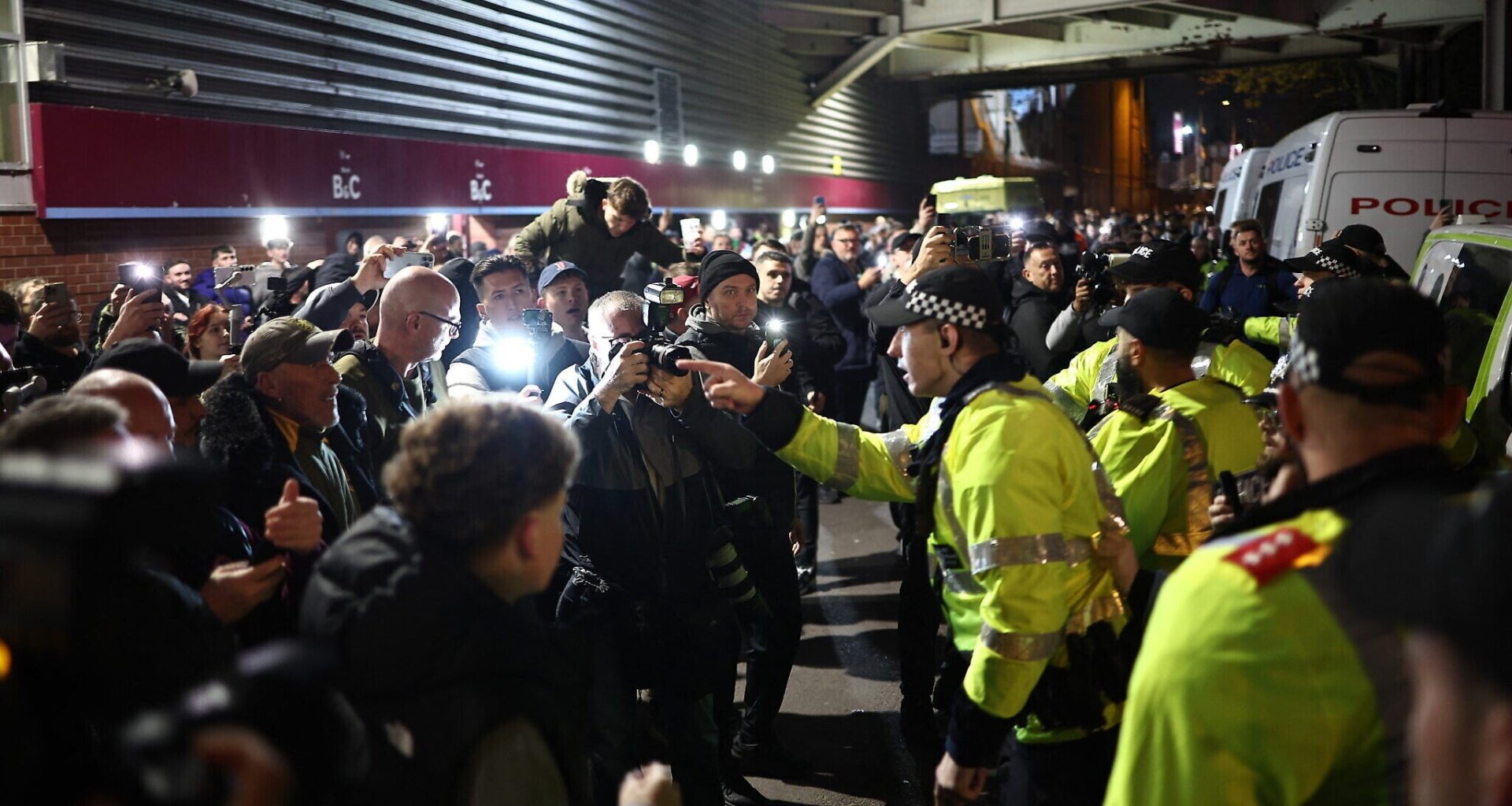
A report released Sunday by a panel of UK lawmakers into the banning of Maccabi Tel Aviv fans from a soccer game in Birmingham last year found that police failed to perform basic due diligence or liaise effectively with the Jewish community, while the government’s intervention in the matter failed to improve the situation.
The committee of seven lawmakers said they found no evidence of a “conspiracy” to keep out the Israeli fans, but said they “cannot rule out the suggestion that political pressure played a part” in what one of the authors — Labour MP Joani Reid — called “among the most serious policing failures in recent years.”
According to the report, “evidence was selected partially in order to justify the ban, and West Midlands Police were overly reliant on inaccurate and unverified information about the Maccabi Tel Aviv fans.”
“This incident has caused serious damage to trust in West Midlands Police, particularly among the local Jewish community, as well as to public confidence in the effectiveness of the force,” the lawmakers said.
At the same time, the committee noted that by “intervening only after the decision to ban away fans was taken, the Government increased tension around the fixture but was ineffectual in enabling Maccabi Tel Aviv fans to attend.”
Get The Times of Israel’s Daily Edition
by email and never miss our top stories
By signing up, you agree to the terms
The findings came after an earlier report, published last month, found that police succumbed to “confirmation bias” in their risk assessments.

Demonstrators raise anti-Israel signs ahead of a Maccabi Tel Aviv – Aston Villa soccer game in Birmingham, UK, set for November 6, 2025. (Screenshots via X, via Deen1fied on Instagram)
In the wake of the January report, local police chief Craig Guildford – who is the subject of two ongoing investigations into potential misconduct – stepped down in January, a move welcomed by the committee on Sunday.
British police used false information to justify the Maccabi ban, having relied for its research on an artificial intelligence program – Microsoft’s AI Copilot – that “hallucinated” a soccer match that had never taken place, in which Maccabi fans had ostensibly caused problems.
Guildford initially denied any use of AI by the force. The lawmakers’ report issued Sunday said he did not intentionally mislead lawmakers, but that “it demonstrates a remarkable lack of professional curiosity” that he did not get to the bottom of the matter once concerns were raised.
Additionally, police claimed that hundreds of Maccabi fans had targeted Muslim communities on the night preceding a 2024 game against Ajax in Amsterdam. Dutch police have since disputed that characterization of the confrontation, however, saying Maccabi supporters were targeted.
Following that game, a violent riot ensued during which local gangs — made up largely of local Muslims and Arabs — attacked Israeli fans, in what Dutch leadership described as an antisemitic act.

Screen grab taken from the UK’s Parliament TV of Chief Constable of West Midlands Police Craig Guildford giving evidence to the Home Affairs Committee on soccer policing, January 8, 2026. (House of Commons/PA Images via Getty Images)
The committee on Sunday also criticized Guildford for poor communication with, and about, the local Jewish community, whom the police did not consult before announcing the ban.
“It is not just that West Midlands Police harmed their relations with the Jewish community; their failure to engage may have weakened the robustness of their decision-making,” the report argued, noting that the police were already exposed to the views of those who wanted the Israeli fans banned, and “missed an opportunity to hear any contrary views.”
The lawmakers said they found no evidence the ban was motivated by antisemitism, but said the gap between the police’s robust engagement with other communities and its comparatively meager engagement with local Jews “provided a basis for some to perceive” it as such.
The committee also criticized police representatives for seeming to indicate that the Jewish community had signed off on the ban, which was not true. The lawmakers said they saw no evidence that these misleading comments were deliberate, but that they were nevertheless “surprising and disappointing.”
UK government’s intervention came too late
Despite the problems with the police force’s actions, the UK government’s intervention – publicly denouncing the decision, once it had already been made – made things worse, the lawmakers said.
The UK’s Home Office and Department for Culture, Media, and Sport knew by October 8, 2025, that a ban of Maccabi fans was likely, the report said.

Britain’s Prime Minister Keir Starmer (C) arrives with West Midlands Chief Constable Craig Guildford to greet members of the West Midlands Police Force at Arden Academy in Solihull, West Midlands, on August 8, 2024. (Joe Giddens / POOL / AFP)
“If the Government had intervened privately at this point, to make its preference known, and to offer assurances that the Government was prepared to support with additional resources, a different outcome might have been achieved,” the lawmakers wrote.
Instead, comments like those from UK Prime Minister Keir Starmer, who called the ban the “wrong decision,” only drew more attention to the game, they said.
The chair of the committee, Dame Karen Bradley, told The Guardian that it “should have been obvious” to the government in advance that the game could be a flashpoint.
“Government intervention was clumsy and came too late, and we reject the government’s argument that it could only intervene once the decision was taken,” Bradley said. “Their intervention when it came did little more than inflame tensions.”
One way to avoid a situation like this in the future, the committee concluded, would be introduce a designation of some soccer matches as “of national significance,” allowing for stronger intervention in sensitive cases.
You appreciate our journalism

You clearly find our careful reporting valuable, in a time when facts are often distorted and news coverage often lacks context.
Your support is essential to continue our work. We want to continue delivering the professional journalism you value, even as the demands on our newsroom have grown dramatically since October 7.
So today, please consider joining our reader support group, The Times of Israel Community. For as little as $6 a month you’ll become our partners while enjoying The Times of Israel AD-FREE, as well as accessing exclusive content available only to Times of Israel Community members.
Thank you,
David Horovitz, Founding Editor of The Times of Israel