
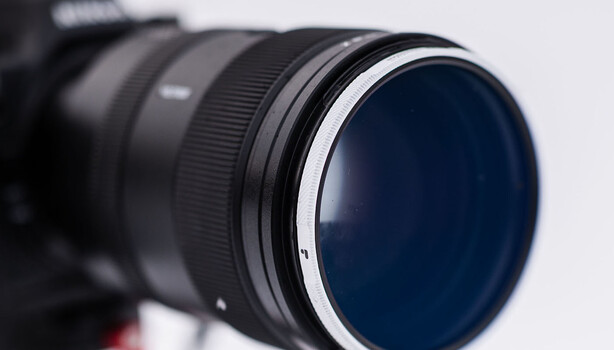
When PolarPro sent me their new Arctic circular polarizer, I was quite excited. This new polarizer has been designed specifically for winter photography in cold, harsh conditions.
As luck would have it, they sent the filter to the right person. I know a thing or two about shooting in harsh winter conditions, living in Canada. A typical winter often sees me out shooting in minus 26 degrees Celsius. I’ve been on photographic assignments to the Arctic and shot in as low as minus 62 degrees Celsius on occasion. Cold is my photographic collaborator.
So here’s how this review is going to work. I’ll reproduce what PolarPro has written about the PolarPro Arctic CP Filter on their website and respond to each point, one at a time. I have a couple of PolarPro’s CP filters, including the fairly new PolarPro 135 Series Chroma PL. It’s incredibly good—there’s no color cast at all—so that’s the one I’ll use for a direct comparison. Here we go then.
High Transmission Polarizer (45%) – Half a stop brighter than standard polarizers for low-light environments.
Chroma Polarization Technology – Perfect color rendition with zero color shift.
Short Throw Rotation (110 °) – Covers the full polarization range, 5x faster than traditional designs.
Glove-Friendly Surface – Enlarged grip surface for smooth adjustments in cold conditions.
Lens Hood Compatible – Slim frame design works seamlessly with lens hoods.
Helix MagLock + Standard Thread Sizes – Available in quick-swap Helix MagLock or standard 49 mm, 67 mm, 77 mm, 82 mm, 86 mm, 95 mm thread sizes.
Field-Tested in Greenland – Proven by Benjamin Hardman on a sailing voyage through Arctic ice fields.
The biggest downside to polarizers is they cost you between 1 to 2 stops of light. To save a half stop of light when shooting in low light would be useful and is the single biggest reason I’m interested in the Arctic CP.
We have well-below-freezing temperatures outside right now, and snow everywhere—perfect conditions, then. I headed out and shot a group of trees without a filter, and then put on my Chroma PL. One stop of light lost. Next, the Arctic CP, and one stop of light lost. Hmm—no difference. I tried shooting mostly snow, so very bright, and got the same results: both filters lost me one stop of light. I tried a shot with a darker scene and a lot less snow. Same results.
This is no scientific bench test; it’s me out photographing in the snow, which is what you’d be doing too, right? Does it perform differently on a sunny beach with blue skies? No idea. It’s marketed as a filter for this weather, so that’s the environment I’m testing it in.
No filter
PolarPro 135 Series Chroma PL – minus one stop
PolarPro Arctic CP – minus one stop
When I compared the PolarPro CPL to the 135 Series Chroma PL earlier this year, the results were pretty much the same. If I did the nerdy pixel-peeper thing, I could argue the CPL has an oh-so-slight color cast. To clarify, the Chroma PL had no color cast. It was very good.
So how does the Arctic PL compare? I can’t see a difference at all. And shooting snow is when a color cast is going to be the most obvious.
Here I stand, in the cold, freezing to death, for you, dear reader—so you better be paying attention. The short throw of 110 ° was noticeable, and good. There were hard stops at each end of the rotation, unlike the Chroma PL, where there were no hard stops; it just kept rotating. One could argue, however, that unless you’re going from horizontal to vertical shooting, you really don’t need to be turning the filter much once adjusted—especially in snowy winter conditions.
I have my Arctic gloves out with me, and my comfy alpaca wool gloves too. Both pairs turned the Arctic CP a little easier than the Chroma PL. Check.
Ah-ha—yes, the Arctic can be used with a lens hood. But so can the Chroma PL. Of course, this only works if your filter is the same size as your lens. Both of the filters in this test are 82mm, as was my lens, so all good.
These were tested by Benjamin Hardman on a grueling Arctic trip. A sailing voyage through Greenland, huh? A Monty Python sketch comes to mind: “Luxury! What I’d give to go on a sailing cruise through Greenland. We have to get up while it’s still dark, trudge through waist-deep snow in minus 50 degrees while keeping one eye peeled for polar bears.” I paraphrase, and jest. Benjamin has a fabulous body of work and has been on some pretty sweet adventures; it’s worth taking a look around his website.
Both filters lost me one stop of light, but notice how the color on all three images are the same. The lack of color casting on these filters is impressive.
PolarPro Arctic CP and the 135 Series Chroma PL
Conclusion
I think the question on your mind, and mine too, is whether the $150 Arctic CP filter is worth buying instead of the $140 135 Series Chroma PL, or PolarPro’s $140 regular CPL filter. Is the extra $10 worth it?
The answer is yes in theory, for that extra half stop of light alone—but there was no extra half stop of light. Both Arctic CP and 135 Series Chroma PL filters performed exactly the same. They both cost me one stop of light in the overcast, snowy conditions I tested them in. I shot a variety of winter landscape scenes over multiple days, and a couple of times the Arctic CP image did look very slightly lighter than the Chroma PL. But half a stop? Not even close.
If you want to go deeper on landscape shooting and post work beyond filter choice, Fstoppers’ Photographing the World: Landscape Photography and Post-Processing is a solid companion.
Positives
I liked that the Arctic CP filter had a very useful short rotation with hard stops.
I liked that it was a little more grippy.
I liked that it was white—there’s no confusion about what you have attached to your lens at a glance.
And it looks rather cool, too.
Negatives
It didn’t deliver that extra half stop of light, as promised.
It would have been nice if it were made with brass instead of aluminum—but this is a criticism of most filters, not just this one.
Bottom Line
Had the PolarPro Arctic CP given me that extra half stop, this would easily rate as a 9.5/10—maybe even a 10/10.
But it didn’t. Despite this, it’s an incredibly good filter—one of the best CP filters you can buy—so I can’t not give it an 8.5/10.
You can buy it here for $150 or buy the 135 Series Chroma PL here for $10 less.