
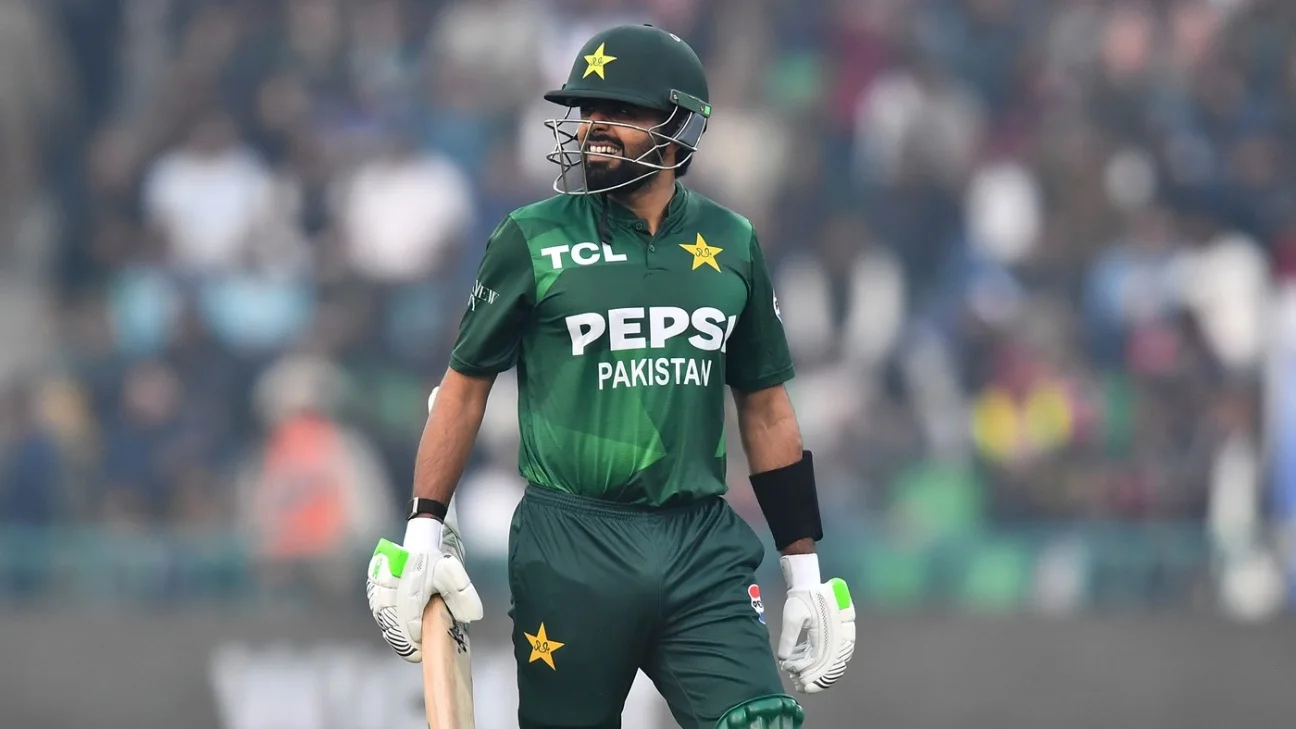
Faf du Plessis has called for “honest conversations” between Babar Azam and Pakistan coach Mike Hesson to work out how to maximise Babar’s potential in T20 cricket. On the eve of Pakistan’s match against New Zealand, which was eventually washed out due to rain, Hesson pointed out Babar’s T20 World Cup strike rate in powerplays was less than run a ball, and that his best use was “through the middle” of the innings.
Speaking to ESPNcricinfo’s show TimeOut, du Plessis called Babar “a world-class player”, but said the quick evolution of T20 cricket has left him “a little bit behind” when it came to scoring rates.
“I think all great players evolve their careers at different points,” he said. “We know Babar as one of the world’s best players for a very long time. I think the game of T20 cricket has moved so fast forward into strike rates that he’s found himself a little bit behind in terms of strike rates.
“If you’re Mike Hesson, you’re trying to find the best way to introduce him into the game. On tricky surfaces, there is a role for someone to play in the 120-130 strike rate. Hesson would have thought, ‘how can I get the best out of Babar Azam?’ The game has moved too far forward to be at 120-130. Now, you need to be 160 to 190 to 200-plus for you to maximise that first six.”
However, du Plessis argued the venue of Pakistan’s campaign at this T20 World Cup, where they play all their matches in the slower conditions of Sri Lanka rather than the flatter ones in India, made Babar’s use case more realistic.
“At this venue and in the specific conditions where there’s going to be a lot of spin, there can be a lot of value from someone like him in the middle and making sure that he anchors the innings.”
But Babar’s astronomic star power in Pakistan has led to intense scrutiny of his perceived drop-off in T20 cricket, with the Pakistan side’s performance interpreted and analysed through an almost singular focus on his performance. That pressure has invariably bled through to Pakistan’s selectors, who dropped him from the side through Pakistan’s Asia Cup campaign, with Hesson saying Babar would have to work on his spin game and strike rate in the Big Bash League to earn his place back. However, without explanation, he was called back up to the team before the BBL, and he has stayed there following a lacklustre BBL.
“It starts with honesty,” du Plessis said. “That’s the groundwork of any conversation that happens. Once you’re honest in your conversation [as a coach] then everything flows from that, whereas if you are hopping around and not telling the truth as a coach or a captain, it leads to holes that a player can jump onto. So the nature of the conversation is always really important.
“For a coach, it’s like, ‘listen, these are the numbers. The numbers are suggesting this. This is where the game is at the moment. In order for us to be successful as a team at this World Cup or this tournament, these are the areas that we want to be the best in. Or the areas where we feel we’re perhaps a little bit weak so we have to address that.’
“Once the stats are in front of a player, it’s pretty difficult to go ‘I’m not agreeing with you.’ Then as a player, you’ve got two choices. Either you put up a massive fight and you throw your toys or you go, ‘Okay, I need to get better, I need to improve and this is an area in my game that I can improve.'”
Du Plessis acknowledged that the challenge for Babar to evolve his game further was complicated by his age and experience. At 31, Babar has already served as the longest T20I captain for Pakistan, putting on the armband in 86 games. He has played 144 T20Is and 347 T20s. Du Plessis, drawing a parallel with his own experiences, warned there could be a temptation to avoid the discomfort of radically transforming his game, preferring to stick to what got him to this level.
“The question that you ask yourself is, ‘it’s worked for me up until now, so why must I change?’ That’s the guy on one shoulder. But what I always looked at was where I could get better? And one of the obvious things that was standing out from a stats perspective was that in my 15 first balls against spin, my strike rate was 120, and against seam it was 180. So one guy on your shoulder would go, ‘but that’s good. You’re striking at 140 [overall]? Why would you want to change?’ But [the other guy] would go, ‘you can do better, you can work on this.’
“The challenge with that is what you then go through is uncomfortable. Because now you’re doing something for the first time which you’ve never done in your entire career. I had to do that against spin. But it’s very easy in the nets because there’s no consequence. I went to the Hundred and I tried to do replicate what I did in the nets, and I failed. And the guy on my shoulder said, ‘why are you doing this, you’re successful.’ But the other guy goes ‘stick with it.’ Growth happens when you’re uncomfortable.”
Du Plessis eventually found success at the CPL that followed, which he was able to translate into his international game. He warned it was a difficult process, but one that Babar, too, would find was “worth it”. However, he warned it would only happen in a culture of mutual respect.
“It comes in the tone that you speak. If you are aggressive or you’re pointing fingers, no one in the world will accept that. So it’s almost like a partnership in a conversation of how can we get the best of you and also where can you improve to get the best result for the game.”
Danyal Rasool is ESPNcricinfo’s Pakistan correspondent. @Danny61000